Reasons for choosing our testing services
ZHONGXI Testing has obtained inspection qualification certifications from multiple countries and regions worldwide. We possess a senior testing team and advanced testing methods, providing independent, impartial, and professional third-party verification services for global carbon projects.

Internationally recognized authority
Certified by multiple international standards such as CNAS, VCS, and GS, with reports universally applicable worldwide.

Global service capability
Covering 140+ countries and regions, it supports on-site detection and remote verification in multiple languages.

Professional experimental methods
Adopt standard experimental methods to ensure accurate and reliable data.
Comprehensive Anti‑Mould Rating Testing for Plastics – Standardised Evaluation of Fungal Resistance for Material Development and Regulatory Compliance
The reliable assessment of anti‑mould (fungal) resistance in plastics has become a critical requirement for a wide range of industries, including automotive, construction, electronics, packaging, and medical devices. Mould colonisation not only compromises the aesthetic appearance of plastic components but can also lead to mechanical degradation, surface discolouration, loss of electrical insulation, and, in some cases, the release of allergenic spores and mycotoxins. Regulatory and industry standards – including ISO 846, ASTM G21, JIS Z 2911, BS EN 60721‑3‑3, and GB/T 24128 – mandate that anti‑mould efficacy be demonstrated using validated, standardised, and reproducible test methods. However, a robust anti‑mould rating for plastics is not a simple “pass/fail” assay; it requires a carefully designed, multi‑method approach that accounts for the polymer composition, the type and loading of additives (plasticisers, stabilisers, fillers, biocides), the surface topography, the test organism panel, the exposure conditions (humidity, temperature, light), and the required rating scale. Moreover, the increasing demand for durable, high‑performance mould‑resistant plastics for outdoor and high‑humidity applications, combined with the need to evaluate novel biocide systems and to differentiate between formulations, demands advanced analytical capabilities that go beyond the basic visual rating. Our ISO/IEC 17025‑accredited and GMP‑compliant laboratory offers a fully integrated plastic anti‑mould rating testing platform, covering the entire spectrum of standardised test methods, including the conventional visual rating (e.g., 0‑4 scale) and quantitative endpoints (e.g., percentage surface coverage, fungal biomass determination, and time‑lapse growth kinetics). We deliver quantitative, traceable data, full compliance with the relevant international standards, and expert interpretative reports that not only assign a rating but also provide actionable recommendations for formulation improvement and process optimisation. Our end‑to‑end service – from sample preparation and fungal culture maintenance to accelerated ageing and long‑term stability studies – ensures that you obtain the most reliable and defensible results for your product development, quality assurance, and regulatory submissions.
1. The Scientific and Regulatory Rationale for Anti‑Mould Rating Testing of Plastics
Anti‑mould testing of plastics serves multiple critical purposes: (a) to determine the intrinsic resistance of a plastic material to fungal colonisation; (b) to establish the relative performance of different formulations, biocides, or surface treatments; (c) to verify that the product meets the specified rating required for its intended application (e.g., indoor vs. outdoor, high‑humidity vs. dry environments); (d) to support regulatory compliance and product certification (e.g., UL, CE, REACH); (e) to monitor the durability of the Antifungal effect under accelerated ageing or real‑world exposure; and (f) to guide the optimisation of biocide loadings and formulation to achieve the desired performance with the minimal environmental impact. The choice of the test method – whether ISO 846 (for plastics), ASTM G21 (for synthetic polymeric materials), JIS Z 2911 (general), or other specialised standards – must be tailored to the plastic type, the expected fungal species, the application environment, and the required rating scale. A poorly designed or executed test can lead to false‑positive or false‑negative ratings, misclassification of a product's performance, and ultimately, a loss of market confidence or product failures in the field. Our service begins with a comprehensive consultation to select the most appropriate standard, the relevant fungal test panel (which typically includes Aspergillus niger, Penicillium chrysogenum, Chaetomium globosum, Trichoderma virens, and others), and the specific incubation and evaluation protocol that matches your product's intended use and regulatory pathway.
2. Our Extensive Anti‑Mould Rating Testing Capabilities for Plastics – Full Standard Coverage and Beyond
We maintain a complete suite of validated anti‑mould test methods that are fully compliant with the major international standards for plastics. Our portfolio includes:
2.1 Standardised Visual Rating – ISO 846, ASTM G21, JIS Z 2911, and GB/T 24128
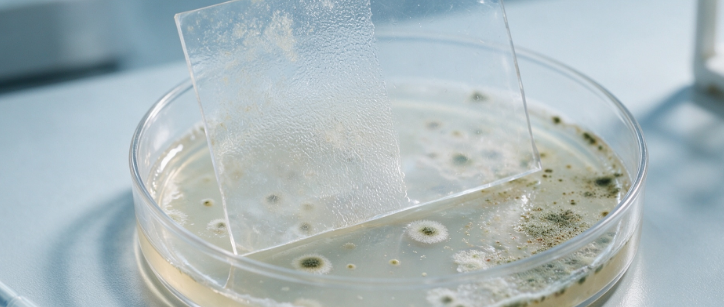
We perform the standard visual rating according to the relevant standard. The test specimens (plastic coupons or moulded parts) are inoculated with a mixed‑spore suspension of the specified test fungi and incubated under controlled conditions (e.g., 28 °C, 85‑90% relative humidity) for a defined period (typically 4 weeks for ISO 846 and ASTM G21, or up to 28 days for JIS Z 2911). At the end of the incubation, we evaluate the fungal growth on each specimen using a rating scale (e.g., 0 = no growth, 1 = traces of growth, 2 = light growth, 3 = moderate growth, 4 = heavy growth), with the aid of high‑resolution digital imaging and, if required, stereomicroscopy. We report the rating for each specimen and the average rating for the test batch, along with a clear pass/fail determination according to the specifications of the standard or your product requirement.
2.2 Quantitative Mould Growth Assessment – Beyond the Visual Rating
For clients requiring a more objective and precise measurement, we offer quantitative endpoints to complement the visual rating. We determine the percentage of surface coverage by fungal mycelium using automated image analysis (based on colour segmentation or texture analysis). We can also quantify the fungal biomass by extracting ergosterol (a fungal membrane component) or by measuring the total ATP (adenosine triphosphate) from the fungal cells, providing a direct correlation to the viable fungal load. These quantitative data are particularly valuable for benchmarking formulations, for statistical analysis, and for demonstrating a high level of performance (e.g., “no measurable growth” rather than simply “rating 0”).
2.3 Kinetic Growth Monitoring – Time‑Lapse and Real‑Time Imaging
We offer time‑lapse imaging and automated digital microscopy to monitor the onset and progression of fungal growth over the incubation period. This provides a kinetic profile of mould development, allowing us to distinguish between products that inhibit early colonisation from those that delay growth, and to identify the critical time points for any breakthrough. The kinetic data are presented as growth curves and are invaluable for formulation screening and stability studies.
2.4 Accelerated Ageing and Environmental Conditioning – Assessing Durability of the Anti‑Mould Property
We can combine the anti‑mould rating test with accelerated ageing protocols (e.g., UV exposure, thermal cycling, water immersion, or chemical resistance) to evaluate the long‑term durability of the Antifungal effect. This is essential for outdoor plastics or for applications where the material is subjected to aggressive environmental conditions. We compare the anti‑mould rating of aged specimens with that of unaged controls to quantify the loss of efficacy over time.
2.5 Fungal Species Customisation – Challenges with Specific Strains
In addition to the standard test panel, we can customise the fungal species used in the assay to match the expected environmental challenges of your product. For example, we can include specific moulds that are known to be problematic in tropical climates (e.g., Stachybotrys chartarum), or we can use isolates from your production or field‑failure samples to test the resistance of your product against actual contaminating strains. We also offer testing against a single species (e.g., for a specific application) or a mix of species.
2.6 Antifungal Efficacy Screening – MIC, MFC, and Zone of Inhibition
For clients developing Antifungal additives, we offer complementary minimum inhibitory concentration (MIC) and minimum fungicidal concentration (MFC) testing, as well as agar diffusion (zone of inhibition) assays, to screen and rank potential biocides or additives before incorporating them into formulations. These data are directly correlated with the performance in the rating test, enabling a rational and efficient formulation development.
2.7 Method Validation and Regulatory Acceptance – Ensuring Reproducibility
We provide full method validation for your anti‑mould rating test, including: (a) specificity (against different fungal species); (b) repeatability and reproducibility (within and between runs); (c) sensitivity (the ability to detect differences in performance); and (d) robustness to variations in inoculum, incubation time, and other experimental parameters. The validation report is structured to meet the requirements of regulatory submissions (e.g., for EPA, REACH, or national authorities).
3. Advanced Analytical Capabilities – Mechanistic Insight and Comprehensive Reporting
For clients requiring a deeper understanding of the fungal resistance or for high‑level product characterisation, we offer a suite of customised, research‑grade services that go beyond the standard rating:
3.1 Fungal Biomass Quantification by Ergosterol or ATP – Direct Correlation with Rating
We provide ergosterol extraction and HPLC analysis to quantify the fungal biomass on the test specimens. This method is highly sensitive and specific, and it provides an objective measure of fungal growth, independent of the visual interpretation. We also offer ATP bioluminescence for a rapid and quantitative assessment of viable fungal cells. These techniques are particularly valuable for products that are expected to show only trace amounts of growth, where visual differentiation is difficult.
3.2 DNA‑Based Identification of Surviving Fungal Populations
After the test, we can perform DNA extraction and ITS sequencing to identify the fungal species that have colonised the test specimens, providing evidence of whether the growth is from the inoculum or from environmental contaminants. This is crucial for troubleshooting and for confirming the specificity of the anti‑mould activity.
3.3 Time‑Lapse Microscopy and Morphological Analysis
We use automated time‑lapse microscopy to observe the attachment, germination, and hyphal extension of fungal spores on the plastic surface, providing a detailed morphological characterisation of the resistance mechanism (e.g., inhibition of germination, or inhibition of hyphal extension). We provide video clips and frame‑by‑frame analysis.
3.4 Leaching and Migration Studies of Antifungal Agents
For plastics that contain biocides, we can perform leaching tests (e.g., by water immersion or simulated environmental exposure) to determine the rate and extent of biocide release, and we correlate the remaining anti‑mould activity with the residual biocide concentration. This is essential for predicting the long‑term performance and the potential environmental impact.
3.5 Formulation Optimisation and Troubleshooting
Based on the test results, we provide expert advice on formulation modifications, such as adjusting the loading of biocides, using synergistic combinations, or applying surface treatments (e.g., plasma or coatings) to improve the rating. We can also diagnose the root causes of a product failure (e.g., insufficient biocide dispersion, poor compatibility with the polymer, or inadequate processing) and propose corrective actions.
4. Data Integrity, Standardisation, and Comprehensive Reporting
All tests are performed under a strict quality management system that includes the use of certified reference fungal cultures, routine daily controls, and participation in proficiency testing schemes (where available). Our reports provide:
- Full method description – detailing the standard used, the fungal species, the inoculum preparation, the incubation conditions, the sampling schedule, and the evaluation procedure.
- Detailed results – including the visual rating (with images), the quantitative biomass data (if requested), the kinetic growth profiles (if performed), and a clear pass/fail statement.
- Quality control data – the results of the concurrent controls, confirming the validity of the test run.
- Graphical outputs – including photographs of the specimens, histograms of the ratings, and the growth curves.
- Interpretative comments – by our senior mycologists and material scientists, providing an expert opinion on the performance, the potential limitations, and the recommended actions for improvement.
Our reports are structured to be directly usable for regulatory submissions, for internal quality assurance, and for marketing claims.
Turnaround times: 4‑6 weeks for the standard rating test (including the incubation period), 2‑3 weeks for accelerated screening (e.g., using a shorter incubation with a higher inoculum), and 1‑2 weeks for quantitative biomass analysis. Express services are available for urgent projects.
5. Why Choose Our Laboratory for Your Plastic Anti‑Mould Rating Testing
We are one of the few laboratories that hold ISO/IEC 17025 accreditation and GMP compliance for the full spectrum of anti‑mould rating test methods, including ISO 846, ASTM G21, JIS Z 2911, and GB/T 24128. Our integrated infrastructure combines a state‑of‑the‑art mycology facility, a polymer science laboratory, and an advanced image analysis suite – enabling cross‑verification of results and a comprehensive understanding of the fungal resistance performance. Our team comprises PhD‑level mycologists, polymer chemists, and material scientists with extensive experience in method development, validation, and regulatory submissions, and we have a proven track record of supporting product development and market approvals for leading plastic manufacturers and converters.
We offer unparalleled flexibility: we work with all types of plastic materials – thermoplastics, thermosets, elastomers, and composites – and we can adapt to your specific additive package, your target fungi, and your regulatory requirements. Our secure online portal enables real‑time tracking, access to raw data, and downloadable certificates of analysis.
Our modular pricing ensures cost‑effectiveness: you select the level of analysis – from a simple rating to a full kinetic and biomass study – with discounts for routine monitoring programmes and bulk submissions. We also provide training, method transfer, and technical consultancy to help you build or strengthen your internal anti‑mould testing capabilities.
With a proven history of serving over 90 clients in the plastic, automotive, construction, and packaging sectors, we have enabled our partners to develop robust mould‑resistant materials, achieve regulatory compliance, and differentiate themselves in the market. We invite you to leverage our expertise for your plastic anti‑mould rating testing needs.
Contact our technical experts today to discuss your plastic product, your performance targets, and the applicable standards. We will design a tailored testing plan and provide a detailed proposal within one business day.