Reasons for choosing our testing services
ZHONGXI Testing has obtained inspection qualification certifications from multiple countries and regions worldwide. We possess a senior testing team and advanced testing methods, providing independent, impartial, and professional third-party verification services for global carbon projects.

Internationally recognized authority
Certified by multiple international standards such as CNAS, VCS, and GS, with reports universally applicable worldwide.

Global service capability
Covering 140+ countries and regions, it supports on-site detection and remote verification in multiple languages.

Professional experimental methods
Adopt standard experimental methods to ensure accurate and reliable data.
erichsen cupping (Deep Drawing) Testing Services: Determining Sheet Metal Formability & Stretchability
As an independent third-party testing service provider, we offer comprehensive erichsen cupping (also known as the deep drawing or cup drawing test) for metallic sheets, strips, and thin plates. The cupping test is one of the oldest and most widely used methods for assessing the formability and ductility of metal sheets under biaxial stretch forming conditions. It measures the depth to which a sheet metal specimen can be deformed by a spherical punch before cracking occurs – a critical parameter for quality control in the automotive, aerospace, home appliance, packaging, and metal processing industries. Our accredited laboratory follows international standards (ISO 20482, ASTM E643, GB/T 4156, JIS Z‑2247, EN 14-69) using computer-controlled cupping testers to deliver accurate, reproducible, and legally defensible formability data. This article outlines our cupping (deep drawing) testing capabilities – including scope, key test items, and standard test methods – to help manufacturers, quality assurance teams, and R&D departments verify sheet metal formability and optimize stamping processes.
1. What Is Cupping (Erichsen) Testing?
The cupping test (also known as the Erichsen test) is a standardized sheet metal forming test that evaluates the ability of a metallic sheet to undergo plastic deformation in stretch forming without failure. During the test, a spherical punch (ball head) is pressed into a clamped sheet specimen until a crack appears – typically a through‑thickness crack that allows light to pass through. The depth of punch penetration at the moment of fracture, measured in millimetres, is called the **erichsen cupping value (IE)** or **Olsen value (OE)**. A higher IE/OE value indicates better formability and deeper drawing capability. The forming process essentially records the stretching capacity of the metal material, which is directly comparable with a stretch‑forming process. The edge zones (borders) are firmly clamped and therefore are not affected – or only slightly affected – by forming; the test specimen is pulled until a crack occurs that runs the full thickness of the specimen and is just wide enough to allow light to pass through part of its length.[reference:0][reference:1]
The test is widely accepted because it simulates real‑world stamping conditions in a simple, rapid, and cost‑effective manner. It provides immediate feedback on whether a material has adequate ductility for a given forming operation, and it is particularly sensitive to anisotropy (directional variation in mechanical properties), surface condition, and lubrication. As a result, the cupping test has become a cornerstone of quality control and material specification across numerous metal‑forming industries.
2. Our Testing Scope for Cupping (Deep Drawing) Evaluation
We cover a comprehensive range of metallic materials, product forms, and testing configurations:
By material type: Cold‑rolled steel (low carbon, high strength low alloy – HSLA, DP steel); Hot‑rolled steel; stainless steel (austenitic, ferritic, martensitic grades); Aluminum and aluminum alloys (1xxx‑8xxx series); Copper and copper alloys (brass, bronze, copper‑beryllium); Brass and bronze sheets; Titanium and titanium alloys; Nickel alloys; Coated sheets (galvanized, zinc‑plated, tin‑plated, aluminized, painted); Clad and laminated metals; Strip metals for electronic and battery applications; Precision thin strips (thickness down to 0.1 mm).
By product form / specimen geometry: Square specimens (90 mm × 90 mm or 100 mm × 100 mm) – standard for ISO 20482; Strip specimens (width 90 mm, length ≥ 90 mm) – for narrow or limited materials; Round specimens (diameter ≥ 90 mm); Custom‑sized specimens (minimum width 90 mm for standard compliance).
By test condition / environment: Ambient temperature (20‑25°C) – for routine quality control; Elevated temperature (up to 300°C) – for hot‑forming applications (by arrangement); Lubricated or dry conditions – lubricant is typically a thin layer of graphite grease applied to the specimen to reduce friction; the standard ISO 20482 includes an informative annex that recommends the composition of graphite grease。[reference:2]
By industry application / standard: Automotive (body panels, chassis components, structural reinforcements) – verifying formability of cold‑rolled and high‑strength steel sheets; Home appliance (washing machine drums, refrigerator liners, microwave cavities) – ensuring deep‑drawing quality of coated and uncoated sheets; Packaging (metal cans, bottle caps, crown closures, easy‑open ends) – assessing drawability of tinplate and aluminum sheets; Electronics (shield cans, battery casings, contact springs) – evaluating thin strip formability; Construction (profiled sheets, roofing panels) – quality control for galvanized and pre‑painted steel sheets; Aerospace (fuselage panels, bulkheads) – qualification of aluminum and titanium alloys for stretch‑formed components; Research & development (new alloy development, process optimization) – comparative testing of candidate materials.
3. Key Test Items & Measurements We Perform
Our cupping (deep drawing) testing services deliver quantitative formability parameters and process‑oriented characterization.
3.1 erichsen cupping Value (IE) – Primary Output
The most important result of the erichsen cupping test is the Erichsen value (IE), expressed in millimetres (mm). This value represents the penetration depth of the spherical punch at the moment when the first through‑thickness crack appears on the specimen. The IE value is a direct indicator of the material‘s ability to undergo biaxial stretch forming without failure. For example, for a low‑carbon steel sheet of 1.0 mm thickness, a typical IE value may range from 9‑11 mm, while for a deep‑drawing grade steel, the IE value may exceed 11 mm. High IE values indicate superior formability, making the material suitable for complex deep‑drawing applications. Measurements are performed at a resolution of 0.01 mm, with at least three valid tests per sample (specimen) as recommended by ISO 20482, and the average value is reported in millimetres.[reference:3][reference:4]
3.2 Maximum Forming Force (Fmax)
During the test, the force required to deform the specimen is continuously monitored. The maximum force (in kN or N) at the point just before fracture (or at the moment of fracture) is recorded. This parameter helps quantify the material‘s deformation resistance under biaxial stretching and is useful for press capacity calculations and for comparing the relative strength of different batches under identical forming conditions. The force is also used as a supplementary parameter to determine the exact moment of failure: when the load drops (by approximately 5‑10%), the crack has initiated. If the maximum load plateau cannot be clearly identified, the test may alternatively be terminated when the first visible crack that allows light to pass through is observed.[reference:5]
3.3 Force‑Displacement Curve
We generate a complete force‑displacement (load‑stroke) curve for each test. This curve provides valuable insight into the material‘s deformation behaviour, including the onset of necking, work hardening, and ductile fracture. The shape of the curve can help diagnose material inconsistencies, lubrication issues, or anisotropy.[reference:6]
3.4 Failure Mode Analysis (Crack Pattern)
After the test, we examine the cracked cup to characterize the failure mode: single crack (clean rupture, ideal for deep‑drawing materials); multiple radial cracks (indicates excessive brittleness or poor formability, often correlated with low IE values); star‑shaped fracture (observed in thin materials or when edge constraint is inadequate); flaking or delamination (for coated or laminated sheets). High‑resolution photographs of the fractured specimen are included in the report as visual evidence.
3.5 Formability Rating vs. Reference Materials
For comparative studies, we can test batches of material against a reference standard (e.g., a previously qualified sheet) and report the relative formability index (IEsample / IEreference). This service is particularly useful for production quality control when supplier batches need to be accepted or rejected based on historical performance. We can also establish acceptance limits (e.g., minimum IE value of 9.5 mm for a 0.8 mm thick steel sheet) to support procurement specifications.
4. Standard Test Methods We Apply
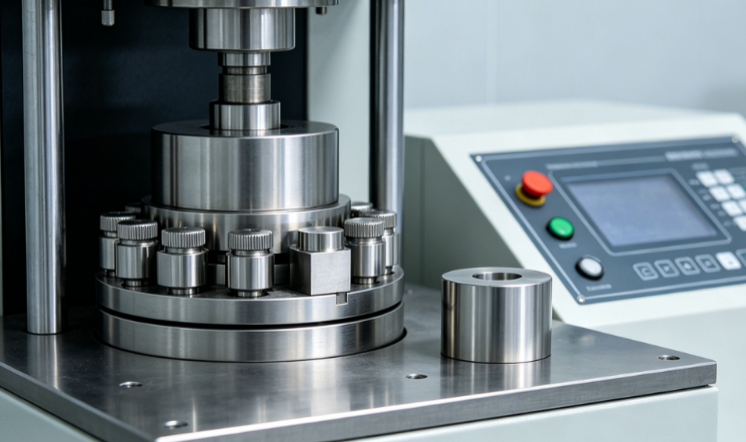
All cupping tests are performed according to internationally recognised standards, with strict attention to specimen dimensions, clamping force, punch speed, and end‑point detection criteria. Our laboratory is ISO/IEC 17025 accredited and equipped with computer‑controlled cupping testers with resolutions of 0.01 mm and a maximum clamping force of 10 kN. Our operators are trained to detect the first light‑visible through‑thickness crack consistently, minimizing subjective variation between test runs.
4.1 ISO 20482 (erichsen cupping Test)
ISO 20482:2013 (Metallic materials – Sheet and strip – erichsen cupping test). – The international standard that specifies the test method for determining the ability of metallic sheets and strips having a thickness from 0.1 mm up to 2 mm and a width of 90 mm or greater to undergo plastic deformation in stretch forming. The test uses a spherical punch of 20 mm diameter (for thickness ≤ 2 mm) or 27 mm diameter (for certain specifications). The specimen is clamped between a blank holder and a die with a clamping force of approximately 10 kN. The punch travels at a constant speed (typically 0.1‑20 mm/min) until a through‑thickness crack appears. At least three tests are performed, and the average cupping value (IE) is reported in millimetres. The standard also includes an informative annex A that recommends the composition of the graphite grease used for lubrication, ensuring that test results are not compromised by friction variations across different laboratories.[reference:7]
4.2 ASTM E643 (Olsen Cupping Test – Ball Punch Deformation)
ASTM E643‑24 (Standard Test Method for Ball Punch Deformation of Metallic Sheet Material). – The American equivalent of the Erichsen test, standardized as the Olsen cupping test. It covers the procedure for conducting the ball punch deformation test for metallic sheet materials intended for forming applications, with a thickness between 0.2 mm and 2.0 mm. The test uses a 25.4 mm (1 inch) diameter steel ball attached to a punch or a spherical indenter. The ball punch deformation test is widely used to evaluate and compare the formability of metallic sheet materials. The measured deformation depth at fracture (or at a specified load limit) is the Olsen value (OE). ASTM E643 also specifies the clamping method, specimen geometry (typically 90 mm square or strip), and the procedure for calculating the punch displacement. The test can be performed on a universal testing machine equipped with appropriate fixtures or on a dedicated cupping tester.[reference:8]
4.3 GB/T 4156 (Chinese National Standard)
GB/T 4156‑2020 (Metallic materials – Sheet and strip – erichsen cupping test). – The Chinese national standard that aligns with ISO 20482:2013. It specifies the method for determining the ability of metallic sheets and strips with a thickness from 0.1 mm up to 2.0 mm, and a width of 90 mm or greater, to undergo plastic deformation in stretch forming. The test uses a spherical punch of 20 mm diameter, a die, and a blank holder. A clamping force of 10 kN is maintained. The punch travels at a constant speed (typically 2‑20 mm/min) until a through‑thickness crack appears. At least three tests are performed, and the average cupping value (IE) is reported in millimetres. The standard specifies that the test must be conducted at (23 ± 5)°C, with the specimen conditioned for at least 24 hours if required. The standard also includes detailed requirements for the testing machine, the calibration of the displacement sensor (resolution 0.01 mm), and the force measurement system.[reference:9]
4.4 JIS Z‑2247 (Japanese Standard)
JIS Z‑2247 (Method for erichsen cupping test). – The Japanese industrial standard that also defines the erichsen cupping test for metallic sheets and strips, with similar parameters to ISO 20482. This standard includes additional guidance on specimen preparation, particularly for thin foils, and is often referenced by Japanese automotive and electronics manufacturers for material qualification. It mandates that the test be performed at room temperature (15‑35°C) and that the test area be free from surface defects that could influence the fracture initiation point.[reference:10]
4.5 Other Related Standards
DIN EN 14‑69 – The European standard preceding ISO 20482, still used in some legacy specifications. We can perform tests according to this standard on request, with the appropriate specimen dimensions and punch geometry.
GB/T 15825.3 (Sheet metal formability and test methods – Part 3: Cupping test) – A more comprehensive Chinese standard covering the cupping test as part of a broader sheet metal forming test suite.
5. Test Procedure & Specifications (ISO 20482 / GB/T 4156 Example)
Our laboratory strictly follows the procedural requirements of ISO 20482 and GB/T 4156. The following step‑by‑step procedure is standardised for cupping tests.
Step 1: Specimen preparation – The specimen is cut to the required dimensions: typically a square of 90 mm × 90 mm or a strip 90 mm wide and at least 90 mm long, or a circular blank of diameter ≥90 mm. Both sides of the specimen are lightly lubricated with a specified graphite grease (a thin, uniform layer) as recommended by ISO 20482 Annex A to minimize friction between the specimen, die, and punch. The specimen is marked with an identification code.
Step 2: Measurement of thickness – The specimen thickness (t) is measured at three points using a micrometer with an accuracy of ±0.01 mm. The average thickness is recorded. The thickness is essential for verifying that the material lies within the applicable range (0.1‑2.0 mm).
Step 3: Mounting and clamping – The specimen is placed centrally between the die (lower tool) and the blank holder (upper clamping ring). The clamping force (blank holder force) is set to 10 kN ± 0.5 kN. The force is applied hydraulically or pneumatically and monitored by a force sensor. The specimen is clamped so that it cannot slide during the test, but without excessive force that would damage the surface or alter the deformation characteristics. The die (which is annular) has a central hole of diameter 27 mm or 33 mm (depending on the standard).
Step 4: Test execution – The spherical punch (20 mm diameter ball for materials ≤2 mm thick; 27 mm ball for thicker materials) is positioned at the centre of the clamped area. The punch is advanced at a constant speed of 0.1‑20 mm/min (typically 2‑20 mm/min for most steels) using a servo‑controlled actuator. The force and punch displacement are continuously recorded. The test is terminated when the first through‑thickness crack appears that is visible to the naked eye and allows light to pass through part of its length (the “light‑visible crack”). For automated systems, the test may also be terminated when the load drops by 5‑10% from the peak force, indicating fracture.
Step 5: Post‑test measurement – Immediately after fracture, the punch displacement (cupping depth, IE) is recorded from the displacement sensor (resolution 0.01 mm). The fractured specimen is removed from the fixture and visually inspected. The crack pattern is photographed and classified.
Step 6: Data analysis – For each specimen, the following data are recorded: initial thickness (t), IE value (mm), maximum forming force (Fmax, kN), failure mode (type of crack pattern), and any observations (e.g., off‑centre cracking, edge tearing, buckling).
Step 7: Statistical summarisation – At least three valid tests are performed for each material condition. The mean IE value, standard deviation, and range are calculated. Results are compared against customer specifications or reference values (e.g., minimum IE = 9.0 mm for a 1.0 mm steel sheet).
6. Advantages & Limitations of Cupping Testing
Advantages: The test is rapid (typically 2‑5 minutes per specimen) and requires minimal sample preparation. It directly simulates the biaxial stretch‑forming process encountered in industrial stamping operations. The IE value is a single, easy‑to‑interpret index that correlates well with deep‑drawing performance. The test is highly sensitive to material anisotropy, surface condition, and lubrication, making it a valuable tool for quality control. It requires only a small specimen (90 mm × 90 mm), which is often available from off‑cuts. The test is standardized internationally, allowing direct comparison across different laboratories and production sites. The test equipment (cupping tester) is relatively inexpensive and can be operated by a single technician.
Limitations: The test is only applicable to sheet materials with a thickness between 0.1 mm and 2.0 mm (or up to 3 mm on some extended‑range testers). Thicker plates cannot be tested using this method. The result (IE value) is highly dependent on proper clamping force, lubrication consistency, and punch speed – requiring careful adherence to the standard procedure. The test does not directly measure tensile properties (yield strength, elongation) or n‑values (strain hardening exponent), which may be needed for comprehensive forming simulation. For very thin materials (<0.3 mm), the specimen may wrinkle before cracking, making the endpoint difficult to determine. The test is not well‑suited for very anisotropic materials where fracture may propagate preferentially along the rolling direction, potentially biasing the IE value.
7. Reporting & Result Presentation
Our test reports are detailed, transparent, and compliant with ISO/IEC 17025 and the relevant standard. Each report includes:
Specimen identification – Material grade, batch number, supplier, specimen dimensions (width, length, thickness), number of specimens tested, and any pre‑test conditioning.
Test conditions – Standard referenced (ISO 20482, ASTM E643, GB/T 4156, etc.), punch diameter (mm), clamping force (kN), punch travel speed (mm/min), lubricant type (graphite grease specification), temperature and humidity, test date.
Individual test results – For each specimen: thickness (mm), IE value (mm), maximum forming force (Fmax, kN), failure mode description (e.g., single crack, multiple cracks, star‑shaped).
Statistical summary – Mean IE (mm), standard deviation, coefficient of variation, number of valid tests, and a box‑and‑whisker plot (if multiple specimens).
Force‑displacement curve – Graphical representation of load vs. punch displacement for each specimen (or a representative curve if multiple specimens show similar behaviour).
Photographic evidence – High‑resolution photographs of the fractured cup (top view and side view) for each tested specimen, with annotations highlighting the crack pattern and crack initiation point.
Calibration records – Displacement sensor calibration date (resolution 0.01 mm), force sensor calibration date, verification of punch geometry, and last maintenance record.
Compliance statement – Pass/fail determination against customer specification, purchase order, or material standard (e.g., “The mean erichsen cupping value of 9.7 mm meets the customer requirement of ≥ 9.2 mm”).
8. Why Choose Our Third‑Party Cupping (Deep Drawing) Testing Services?
As an independent laboratory, we provide unbiased, accurate, and legally defensible formability data. Our strengths include:
ISO/IEC 17025 accreditation – Our cupping testing (ISO 20482, ASTM E643, GB/T 4156) is CNAS/CMA accredited, with regular participation in proficiency testing (e.g., inter‑laboratory comparisons). We maintain a quality system compliant with ISO/IEC 17025 and, where required, GLP principles.
State‑of‑the‑art cupping testers – We operate computer‑controlled cupping testers (e.g., ZwickRoell 146-100, Tinius Olsen, and custom‑designed units) with closed‑loop force and displacement control. Our testers feature high‑precision displacement sensors (resolution 0.001‑0.01 mm, depending on the system), hydraulic clamping systems (clamping force 10‑50 kN), and real‑time data logging. We can accommodate specimens of thickness 0.1‑3.0 mm (extended range) and widths up to 100 mm.
Rapid turnaround – Routine cupping tests (5 specimens, one material condition) completed within 1‑2 business days. Large batch testing (≥20 specimens) scheduled within 1 week. Urgent “crash” tests (single specimen) available on request.
Detailed, client‑focused reporting – Reports include individual IE values, statistical summaries, force‑displacement curves, high‑resolution photographs of the cracked cup, and clear pass/fail conclusions. For R&D projects, we can also provide raw data files (CSV, Excel) for further analysis.
Confidentiality – Full protection of your material composition, supplier information, and proprietary specifications.
Consultative support – Our materials engineers assist with test method selection (ISO vs. ASTM vs. GB), interpretation of low IE values (e.g., identifying root causes such as grain size, inclusion distribution, or improper annealing), and recommendations for improving material formability (e.g., adjusting the annealing cycle, modifying the cold‑rolling reduction). We also help set acceptance limits for incoming inspection.
We also offer complementary formability tests: limiting dome height (LDH) tests (ISO 12004‑2), forming limit curve (FLC) determination, and tensile testing (n‑value and r‑value determination) – to provide a complete assessment of sheet metal formability.
Whether you need to qualify a new batch of cold‑rolled steel for automotive body panels, verify the deep‑drawing performance of aluminum sheet for can manufacturing, compare the formability of coated versus uncoated strips, or investigate the root cause of cracking in a stamping line, our cupping (deep drawing) testing experts are ready to deliver reliable, actionable results.
Get Started with Your Cupping (Deep Drawing) Testing Project
Contact our team with your material type (steel, aluminum, copper, etc.), thickness (0.1‑2.0 mm), sheet dimensions (minimum 90 mm × 90 mm), target standard (ISO 20482, ASTM E643, GB/T 4156, JIS Z‑2247, or customer specification), and any special requirements (lubrication, clamping force, test speed). We will provide a detailed quotation, specimen preparation and submission guidelines (cleaning, cutting, marking), and a testing schedule. Let us help you ensure that your sheet metals have the formability required for efficient, defect‑free stamping operations.
This article provides an overview of our erichsen cupping (deep drawing) testing capabilities. For specific test methods, sample quantity, and pricing, please request a tailored service proposal.