Reasons for choosing our testing services
ZHONGXI Testing has obtained inspection qualification certifications from multiple countries and regions worldwide. We possess a senior testing team and advanced testing methods, providing independent, impartial, and professional third-party verification services for global carbon projects.

Internationally recognized authority
Certified by multiple international standards such as CNAS, VCS, and GS, with reports universally applicable worldwide.

Global service capability
Covering 140+ countries and regions, it supports on-site detection and remote verification in multiple languages.

Professional experimental methods
Adopt standard experimental methods to ensure accurate and reliable data.
resilience (Elastic Recovery) Testing Services: Quantifying Springback & Energy Return of Polymers, Elastomers & Foams
As an independent third-party testing service provider, we offer comprehensive resilience (elastic recovery) testing for a wide range of materials – including elastomers, rubbers, flexible foams, plastics, gel pads, athletic footwear, and cushioning materials. resilience is a measure of a material‘s ability to absorb energy when deformed and to return that energy upon release. It is expressed as the percentage of energy returned relative to the energy input. This property is critical for impact absorption, vibration damping, comfort, and durability in applications such as shoe soles (energy return for running efficiency), mattress foams (recovery from compression), automotive suspension bumpers, and industrial vibration isolators. Our accredited laboratory follows international standards (ASTM D2632, ASTM D3574, ISO 4662, GB/T 1681, ISO 8307) using rebound resilience testers (vertical rebound, pendulum, or ball drop methods) and dynamic mechanical analyzers. This article outlines our resilience testing capabilities – including scope, key test items, and standard test methods – to help manufacturers, quality assurance teams, and material developers evaluate energy recovery and long‑term performance.
1. Our Testing Scope for resilience (Elastic Recovery)
We cover a broad range of materials, product forms, and testing configurations:
By material / product type: Vulcanized rubbers (natural rubber, SBR, NBR, EPDM, silicone, fluorocarbon, neoprene); Thermoplastic elastomers (TPE, TPU, TPV); Flexible polyurethane foams (mattress foams, cushioning, seating); Microcellular urethanes (shoe midsoles); Gel materials (silicone gel, hydrogel, gel pads); Rubber compounds for tires, belts, and vibration mounts; Plastics (some rigid polymers with elastic behavior – by arrangement); Sports equipment (golf balls, tennis racket grips, running shoe midsoles).
By test method / rebound type: Vertical rebound (falling ball or falling plunger) – measures the height of rebound of a dropped mass; Pendulum rebound (Schob or similar) – measures the energy returned by a swinging pendulum striking the specimen; Ball drop resilience (for foams) – a steel ball is dropped onto the specimen and rebound height is recorded; Dynamic mechanical analysis (DMA) – measures storage modulus (E‘) and loss modulus (E“) to calculate tan δ and percent resilience.
By specimen geometry / condition: Rubber test buttons (cylindrical or disc, typically 29 mm diameter × 12.5 mm height per ASTM D2632); Foam test blocks (50 mm × 50 mm × 50 mm or 380 mm × 380 mm × 50 mm for ball rebound); Molded or cut specimens; Conditioned at standard temperature (23±2°C) and humidity (50±5% RH); Elevated or low temperature resilience (by arrangement).
By industry application / standard: Rubber and elastomer quality control – ASTM D2632 (vertical rebound), ISO 4662 (rebound resilience); Flexible polyurethane foams – ASTM D3574 (ball rebound), ISO 8307; Shoe soles and athletic footwear – SATRA TM144, ASTM F1976 (energy return); Vibration damping and anti‑vibration mounts – resilience as an indicator of damping capacity; Tire tread compounds – resilience correlates with rolling resistance (higher resilience = lower rolling resistance).
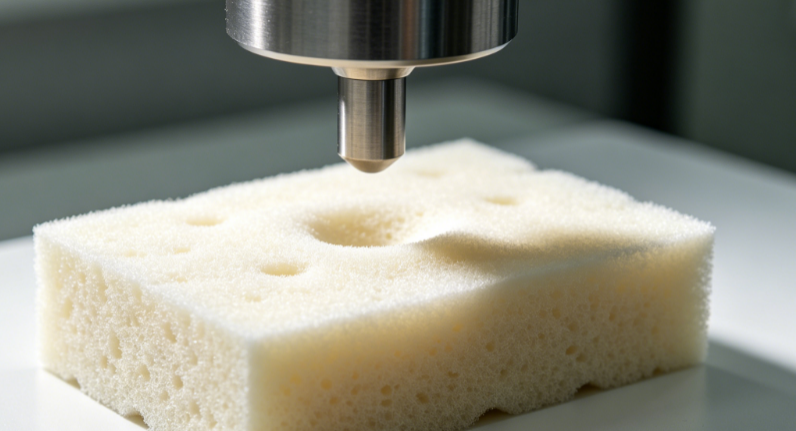
2. Key Test Items & Measurements We Perform
Our resilience testing services deliver quantitative energy return data, damping characteristics, and material classification.
2.1 Rebound resilience (Percent resilience)
The primary output is the percentage of the incident energy that is returned by the material. For vertical rebound tests (ASTM D2632, ISO 4662), a plunger or ball is dropped from a fixed height onto the specimen, and the rebound height is measured. resilience (%) = (hrebound / hdrop) × 100. For rubber compounds, resilience values typically range from 30% (highly damped) to 90% (highly elastic). For flexible polyurethane foams, ball rebound values range from 20% to 70% depending on foam density and formulation.
2.2 Energy Return (for Athletic Footwear & Midsoles)
We measure the actual energy returned (in Joules) during a simulated impact cycle using a rebound tester equipped with a force transducer. The energy returned is calculated as the area under the unloading force‑displacement curve. This value is often expressed as a percentage of the input energy (resilience), but absolute energy (J) is also reported for engineering design.
2.3 Damping Characteristics (Loss Factor & Tan δ)
For vibration isolation and damping applications, resilience is inversely related to damping capacity. Using dynamic mechanical analysis (DMA), we measure the loss factor (tan δ = E“/E’), where E‘ is the storage modulus (elastic component) and E“ is the loss modulus (viscous component). A low tan δ (high resilience) indicates low damping; a high tan δ indicates high energy dissipation. This parameter is critical for selecting materials for shock absorption versus vibration isolation.
2.4 Coefficient of Restitution (COR)
For ball rebound tests on foams and rubbers, we report the coefficient of restitution (e = vrebound / vimpact). COR is calculated from the rebound height: e = √(hrebound / hdrop). COR ranges from 0 (perfectly inelastic) to 1 (perfectly elastic).
2.5 Temperature Dependence of resilience
For materials that change stiffness with temperature (e.g., rubbers near their glass transition temperature), we perform resilience tests at multiple temperatures (‑40°C to +100°C) and generate a resilience vs. temperature curve. This is essential for materials used in outdoor or automotive applications.
2.6 Aging & Durability Effects (resilience Retention)
We measure resilience before and after accelerated aging (heat aging, UV exposure, ozone, or fluid immersion) to assess how well the material retains its elastic properties over time. A significant drop in resilience indicates degradation (cross‑link scission, embrittlement, or plasticizer loss).
3. Standard Test Methods We Apply
All tests are performed according to internationally recognised standards. Our laboratory is ISO/IEC 17025 accredited and equipped with vertical rebound testers (ASTM D2632), pendulum rebound testers (ISO 4662), ball drop testers for foams, and dynamic mechanical analyzers (DMA, e.g., TA Instruments Q800).
3.1 Rubber & Elastomer resilience Standards
ASTM D2632 (Standard test method for rubber property – resilience by vertical rebound). – A plunger (mass 28 g) is dropped from 500 mm height onto a cylindrical rubber specimen (29 mm diameter × 12.5 mm height). The rebound height is measured electronically. The percent resilience is calculated as (rebound height / 500 mm) × 100. The test is performed at 23±2°C. Multiple drops (typically 5) are averaged.
ISO 4662 (Rubber, vulcanized – Determination of rebound resilience). – Two methods: vertical rebound (similar to ASTM D2632) and pendulum rebound (Schob type). The pendulum method uses a swinging hammer that strikes the specimen; the loss in amplitude (or the rise angle) is measured. resilience is calculated from the ratio of rebound angle to initial angle.
GB/T 1681 (Determination of rebound resilience of vulcanized rubber). – Chinese national standard equivalent to ISO 4662.
3.2 Flexible Polyurethane Foam resilience Standards
ASTM D3574 (Standard test methods for flexible cellular materials – slab, bonded, and molded urethane foams). – Test H: ball rebound. A steel ball (16.3 mm diameter, 16.3 g) is dropped from 500 mm height onto the foam specimen (at least 50 mm thick). The rebound height is recorded, and the percent resilience is calculated. The foam is conditioned for 24 hours at 23°C, 50% RH. The average of three drops is reported.
ISO 8307 (Flexible cellular polymeric materials – Determination of resilience by ball rebound). – Similar to ASTM D3574, but with a steel ball of 16.3 mm diameter dropped from 500 mm height onto a foam block of at least 50 mm thickness.
GB/T 6670 (Determination of rebound resilience of flexible cellular materials). – Chinese standard.
3.3 Dynamic Mechanical Analysis (DMA) for resilience
ASTM D4065 (Standard practice for plastics: dynamic mechanical properties). – Measures storage modulus (E‘), loss modulus (E“), and tan δ. resilience can be calculated as 1/(1+tan²δ) for small‑deformation conditions.
ISO 6721 (Plastics – Determination of dynamic mechanical properties). – Provides methods for measuring complex modulus and damping.
3.4 Footwear & Athletic Materials
ASTM F1976 (Standard test method for energy return of athletic footwear). – Uses a drop tester with a mass of 8.5 kg dropped onto the heel region; the force‑time curve is integrated to calculate energy input and energy returned. resilience is calculated as (energy returned / energy input) × 100.
SATRA TM144 (resilience of rubber – vertical rebound method). – Specific to shoe soling materials.
4. Test Procedure & Specifications (Example – ASTM D2632 for Rubber)
Our laboratory strictly follows the procedural requirements of ASTM D2632. The following step‑by‑step procedure is standardised for vulcanized rubber resilience testing.
Step 1: Specimen preparation – Rubber test buttons are molded or cut to dimensions: diameter 29 mm ± 0.5 mm, thickness 12.5 mm ± 0.5 mm. The top surface is smooth and parallel to the bottom surface. At least 5 specimens are prepared per material.
Step 2: Conditioning – Specimens are conditioned at 23±2°C, 50±5% RH for at least 24 hours before testing.
Step 3: Mounting – The specimen is placed centrally on the anvil of the vertical rebound tester. The anvil is rigid and flat.
Step 4: Drop test – The plunger (mass 28 g, hardened steel tip) is raised to a height of 500 mm (or 200 mm for some materials) and released to fall freely onto the specimen. The rebound height is measured by an optical sensor or magnetic scale. For each specimen, 5 drops are performed at 10‑second intervals, and the rebound height is recorded.
Step 5: Calculation – resilience (%) = (hrebound / hdrop) × 100. The average resilience of the 5 drops (excluding the first drop, which may condition the surface) is reported.
5. Advantages & Limitations of resilience Testing
Advantages: Provides a direct, simple measure of energy return that correlates well with real‑world performance (e.g., running shoe comfort, vibration isolation efficiency). Highly standardized methods (ASTM, ISO) allow direct comparison between materials and suppliers. The test is rapid (2‑5 minutes per specimen) and requires minimal sample preparation. Can be performed at various temperatures to assess thermal sensitivity. For rubber compounds, resilience is inversely related to hysteresis and rolling resistance, making it a key quality indicator for tire treads.
Limitations: The test is sensitive to specimen geometry, surface finish, and conditioning (temperature, humidity). For very soft or viscous materials (e.g., unvulcanized rubber, gels), the rebound may be too low to measure accurately. Vertical rebound is a high‑strain rate test; results may not correlate with quasi‑static elastic recovery (e.g., compression set). The test does not directly measure energy dissipation mechanisms (e.g., viscoelastic losses).
6. Reporting & Result Presentation
Our test reports are detailed, transparent, and compliant with ISO/IEC 17025 and the relevant standard. Each report includes:
Specimen identification – Material description, formulation, batch number, specimen dimensions, conditioning history.
Test conditions – Standard referenced, test method (vertical rebound, pendulum, ball drop), drop height, plunger mass (if applicable), temperature and humidity, number of replicates.
Individual results – For each specimen: rebound height (mm) for each drop, calculated resilience (%). For multiple specimens, the mean and standard deviation are provided.
Statistical summary – Mean resilience (%), coefficient of variation, range.
Calibration records – Calibration date of the rebound tester, verification of drop height, plunger mass, and temperature sensors.
Compliance statement – Pass/fail determination against customer specification or material standard (e.g., “The resilience of 65% meets the requirement of ≥ 60% for this rubber compound”).
Additional graphs – For DMA tests: storage modulus (E‘), loss modulus (E“), and tan δ vs. temperature or frequency.
7. Why Choose Our Third‑Party resilience Testing Services?
As an independent laboratory, we provide unbiased, accurate, and legally defensible resilience data. Our strengths include:
ISO/IEC 17025 accreditation – Our resilience testing (ASTM D2632, ISO 4662, ASTM D3574, ISO 8307) is CNAS/CMA accredited, with regular proficiency testing (e.g., rubber round‑robins).
Multiple complementary methods – We offer vertical rebound (ASTM D2632), pendulum rebound (ISO 4662), ball rebound (for foams), and DMA (for dynamic mechanical properties). This allows us to match the test method to your material and application.
Temperature control – We can perform resilience tests from -40°C to +200°C using temperature chambers integrated with rebound testers or DMA.
Aging studies – We combine resilience testing with accelerated aging (heat, UV, ozone, fluids) to predict long‑term performance.
Fast turnaround – Routine resilience tests (5 specimens, one condition) completed within 1‑2 business days. Full temperature sweep (‑40°C to +100°C) in 3‑5 business days.
Detailed reporting – Includes rebound height data, resilience percentages, and, where applicable, DMA curves (E‘, E“, tan δ).
Confidentiality – Full protection of your material formulations and product designs.
Consultative support – Our polymer scientists assist in interpreting resilience values (e.g., high resilience for energy return vs. low resilience for vibration damping), selecting test methods, and relating resilience to processing parameters (cure time, filler loading, cross‑link density).
Whether you need to qualify a new rubber compound for a tire tread, measure the energy return of a foam mattress core, compare the resilience of different TPE materials for shoe soles, or evaluate the damping characteristics of a vibration isolator, our resilience testing experts are ready to deliver reliable, actionable results.
Get Started with Your resilience Testing Project
Contact our team with your material type (rubber, foam, elastomer, polymer), product application, required test method (vertical rebound, ball rebound, pendulum, DMA), and applicable standard (ASTM, ISO, GB/T, customer spec). We will provide a detailed quotation, sample submission guidelines (dimensions, quantity, conditioning requirements), and a testing schedule. Let us help you quantify the energy return and elastic recovery of your materials for improved product performance.
This article provides an overview of our resilience (elastic recovery) testing capabilities. For specific test methods, sample quantity, and pricing, please request a tailored service proposal.