Reasons for choosing our testing services
ZHONGXI Testing has obtained inspection qualification certifications from multiple countries and regions worldwide. We possess a senior testing team and advanced testing methods, providing independent, impartial, and professional third-party verification services for global carbon projects.

Internationally recognized authority
Certified by multiple international standards such as CNAS, VCS, and GS, with reports universally applicable worldwide.

Global service capability
Covering 140+ countries and regions, it supports on-site detection and remote verification in multiple languages.

Professional experimental methods
Adopt standard experimental methods to ensure accurate and reliable data.
Rebar (Steel Reinforcement Bar) Testing Services: Ensuring Structural Integrity for concrete Construction
As an independent third-party testing service provider, we offer comprehensive testing for steel reinforcement bars (rebar) used in concrete construction – including plain round bars, deformed bars (ribbed), high‑strength bars, epoxy‑coated rebar, stainless steel rebar, and welded wire mesh. Rebar is the primary tensile reinforcement in concrete structures, providing strength, ductility, and crack control for buildings, bridges, pavements, dams, and foundations. Its mechanical properties, chemical composition, dimensional accuracy, weldability, and corrosion resistance must be verified against international standards (ASTM A615, A706, A955; ISO 6935‑2; BS 4449; GB/T 1499.2; EN 10080). Our accredited laboratory follows these standards to deliver accurate, reproducible, and legally defensible test data. This article outlines our rebar testing capabilities – including scope, key test items, and standard test methods – to help steel mills, construction contractors, engineers, and quality assurance teams ensure rebar compliance and structural safety.
1. Our Testing Scope for Steel Reinforcement Bars
We cover all common rebar grades, product forms, and testing categories:
By rebar type / grade: Plain carbon steel rebar (Grade 40, 60, 75, 80 – ASTM A615); Low‑alloy steel rebar (ASTM A706 – weldable); High‑strength rebar (Grade 100, 120, 150); Epoxy‑coated rebar (ASTM A775, A934); stainless steel rebar (ASTM A955); Zinc‑coated (galvanised) rebar (ASTM A1094); Welded wire reinforcement (ASTM A1064).
By product form: Deformed bars (hot‑rolled, quenched & self‑tempered); Plain round bars; Coiled bars; Cut & bent bars; Prefabricated reinforcement assemblies; Welded wire mesh sheets and rolls.
By test category: Mechanical properties (yield strength, tensile strength, elongation, bend/rebend, fatigue – by arrangement); Chemical composition (carbon equivalent, alloying elements, residual elements); Dimensional characteristics (nominal diameter, mass per unit length, rib geometry); Metallurgical examination (grain size, microstructure, decarburisation); Weldability & weld testing (tensile of welded joints, macro‑etch); Coating performance (epoxy coating thickness, adhesion, pinhole detection; zinc coating mass/uniformity); Corrosion resistance (salt spray, chloride permeability, cathodic disbondment).
By international specification: ASTM A615/A615M (deformed & plain carbon steel bars); ASTM A706/A706M (low‑alloy steel bars – weldable); ASTM A955/A955M (stainless steel bars); ISO 6935‑2 (steel for reinforcement – ribbed bars); BS 4449 (carbon steel bars for concrete reinforcement); GB/T 1499.2 (hot‑rolled ribbed bars – China); EN 10080 (steel for reinforcement – general).
2. Key Test Items & Measurements We Perform
Our rebar testing services are organised into six performance domains. Each domain addresses critical properties required by building codes (ACI 318, Eurocode 2, GB 50010) and procurement specifications.
2.1 Mechanical Properties (Tensile & Bend)
yield strength (fy) – measured at 0.2% offset (for materials without a distinct yield point) or from upper/lower yield. Requirements per ASTM A615 Grade 60: fy ≥ 420 MPa (60,000 psi). For Grade 80: fy ≥ 550 MPa (80,000 psi).
Ultimate tensile strength (fu) – maximum stress sustained during tensile test. Ratio fu/fy typically ≥ 1.25 (for seismic applications).
Percentage elongation – measured over a gauge length of 4× or 5× nominal diameter. ASTM A615 Grade 60 requires elongation ≥ 9% (for bar sizes #3‑#6), ≥ 8% (for #7‑#11).
Bend test (cold bend) – rebar specimen is bent around a mandrel of specified diameter (e.g., 3×, 4×, or 6× nominal diameter) through 90° or 180°, then examined for cracks or rupture. ASTM A615/A706, ISO 6935‑2, GB/T 1499.2.
Rebend test (for quenched & self‑tempered bars) – after aging (e.g., 30 min at 100°C), the specimen is bent and then straightened to specified angle; no cracking permitted.
Fatigue strength (axial or flexural) – by arrangement (ASTM E466). For bridge and high‑cycle applications.
2.2 Chemical Composition Analysis
Carbon (C) – ≤ 0.30% for ASTM A615 (or ≤ 0.35% for Grade 60). Lower carbon improves weldability.
Manganese (Mn) – ≤ 1.20% (ASTM A615).
Phosphorus (P) – ≤ 0.05% (for A615), ≤ 0.035% for weldable A706.
Sulfur (S) – ≤ 0.05% (A615), ≤ 0.045% (A706).
Silicon (Si) – for A706: 0.15‑0.50%.
Carbon Equivalent (CE) – calculated as CE = C + Mn/6 + (Cr+Mo+V)/5 + (Ni+Cu)/15. For weldable A706, CE ≤ 0.55% (or ≤ 0.50% for larger bars).
Residual elements (Cu, Ni, Cr, Mo) – specified per standard.
Alloying elements for stainless rebar – Cr, Ni, Mo (e.g., Cr ≥ 10.5% for ASTM A955).
Methodologies: OES (ASTM E415, E1086), combustion analysis for C, S, N, ICP‑OES for trace elements.
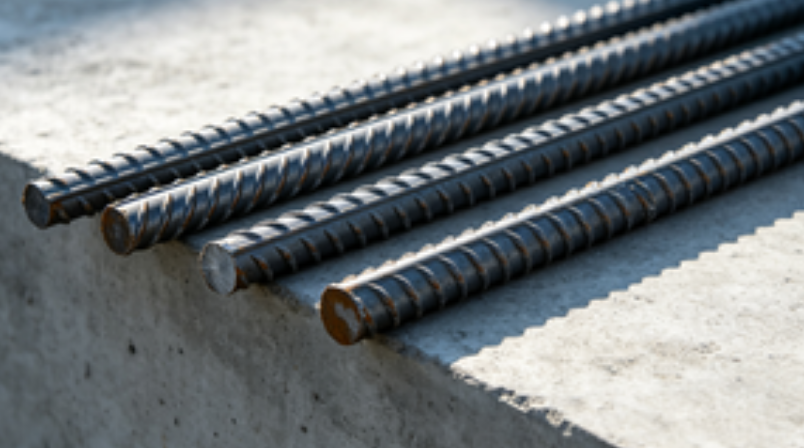
2.3 Dimensional & Mass Verification
Nominal diameter – measured with calipers or laser gauge at multiple points along the bar. Tolerances per ASTM A615: ±0.3 mm for sizes #3‑#6, ±0.5 mm for #7‑#11.
Rib geometry – rib height, rib spacing, rib gap (for deformed bars). Measured with profile projector or digital calipers per ASTM A615, ISO 6935‑2. Requirements: rib height ≥ 0.4 mm for #4 bar, ≤ 0.6× rib spacing.
Mass per unit length (kg/m) – weighed on a balance and divided by length (minimum 1 m). Tolerance: ±6% (ASTM A615) or ±4% (ISO 6935‑2).
Straightness (bowing) – deviation from a straight line, measured on a flat table. Maximum bow: 1.0‑1.5 mm per metre (depends on standard).
Length tolerance – ±50 mm for standard lengths (12 m).
2.4 Metallurgical & Microstructural Examination
Grain size – ASTM E112 – for quality control of heat treatment.
Decarburisation depth – measured microscopically on transverse cross‑section (ISO 3887). Excessive decarburisation reduces surface hardness and fatigue life.
Non‑metallic inclusions (ASTM E45) – sulfides, oxides, silicates.
Microstructure – identification of phases (ferrite, pearlite, bainite, martensite). Quenched & self‑tempered bars should have a tempered martensite rim and a ferrite‑pearlite core.
Surface defects – laps, seams, scabs, cracks – inspected visually and microscopically.
Hardness traverse (Vickers) – for evaluating heat treatment uniformity.
2.5 Weldability & Welded Connection Testing
For rebar assemblies (prefabricated cages, welded wire mesh, or site‑welded splices):
Tensile test of welded joint – specimen containing the weld (butt weld or lap weld) is tested in tension; failure should occur in the bar away from the weld. Minimum tensile strength: ≥ 95% of specified bar strength.
Macro‑etch examination of weld cross‑section – reveals weld penetration, fusion, porosity, and cracks (ASTM E340).
Weld bend test (guided bend) – for transverse weld specimens.
Chemical analysis of welding consumables (filler metal).
2.6 Coating Performance (for Epoxy‑Coated or Galvanised Rebar)
Epoxy coating thickness – measured by magnetic or eddy current gauge (ASTM D1186). Minimum thickness: 0.18‑0.30 mm (depending on bar size).
Holiday (pinhole) detection – using a high‑voltage spark tester (ASTM G62). Coating shall be free of pinholes.
Adhesion (cross‑cut/tape test) – ASTM D3359 – coating shall not lift from the substrate.
Cathodic disbondment (ASTM G8) – after 24‑48 hours at 65°C, measure radius of disbondment from a holiday.
Zinc coating mass (galvanised rebar) – ASTM A1094, A123 – mass per unit area (g/m²) determined by stripping method.
Zinc coating uniformity (Preece test) – repeated immersion in copper sulfate solution.
Salt spray resistance (ASTM B117) – for coated rebar (hours to first red rust).
3. Standard Test Methods We Apply
All tests are performed according to internationally recognised standards. Our laboratory is ISO/IEC 17025 accredited and equipped with universal testing machines (up to 1000 kN for rebar), torsion testers, hardness testers, metallographic microscopes, coating gauges, and spark testers.
3.1 Tensile & Bend Test Standards
ASTM A615 / A615M (Standard specification for deformed and plain carbon steel bars). – Includes tensile, bend, and mass requirements.
ASTM A706 / A706M (Low‑alloy steel deformed bars – weldable).
ISO 6935‑2 (Steel for reinforcement – Part 2: Ribbed bars).
BS 4449 (Steel for reinforcement of concrete – Carbon steel bars).
GB/T 1499.2 (Hot‑rolled ribbed bars – China).
ASTM E8 / E8M (Tension testing of metallic materials) – for yield, tensile, elongation.
ASTM E190 (Guided bend test for ductility of welds).
3.2 Chemical Composition Standards
ASTM E415 (OES for carbon and low‑alloy steel).
ASTM E1019 (Combustion analysis for C, S).
ISO 14284 (Sampling for chemical analysis).
ASTM A751 (Chemical analysis of steel products).
3.3 Dimensional & Mass Standards
ASTM A615 / A706 – Appendix (dimensional tolerances).
ISO 6935‑2 – Clause 5 (dimensions, rib geometry).
GB/T 1499.2 – Clause 6 (rib height, rib spacing).
ASTM E29 (Rounding of dimensional values).
3.4 Metallurgical Standards
ASTM E112 (Grain size – comparison, intercept).
ASTM E45 (Inclusion rating).
ISO 3887 (Decarburisation depth).
ASTM E340 (Macro‑etch testing).
3.5 Weld Testing Standards
AWS D1.4 (Structural welding code – reinforcing steel).
ASTM E2033 (Radiographic testing of welds).
ASTM E165 (Liquid penetrant testing of welds).
3.6 Coating Performance Standards
ASTM A775 / A775M (Epoxy‑coated steel reinforcing bars).
ASTM A934 (Epoxy‑coated bars for fusion bonding).
ASTM A1094 (Zinc‑coated bars – hot‑dip).
ASTM B117 (Salt spray testing).
ASTM G62 (Holiday detection).
ASTM D3359 (Adhesion).
4. Why Choose Our Third‑Party Rebar Testing Services?
As an independent laboratory, we provide unbiased, accurate, and legally defensible rebar test data. Our advantages include:
ISO/IEC 17025 accreditation – CNAS/CMA certified, with regular proficiency testing (e.g., ASTM E8, E23, A615).
High‑capacity testing – universal testing machines up to 1000 kN (220 kip) for full‑size bar tension tests (up to #18 size).
Complete test suite – mechanical, chemical, dimensional, metallurgical, weld, and coating tests – all under one roof.
Fast turnaround – typical tensile, bend, and mass tests (5‑10 specimens) within 2‑3 business days; full certification programme in 1‑2 weeks.
Detailed reporting – includes stress‑strain curves (if requested), raw data (yield load, tensile load, elongation, mass), rib geometry measurements, coating thickness profiles, and clear pass/fail against specification limits.
Confidentiality – full protection of your mill certificates, production data, and customer information.
Consultative support – our metallurgists help interpret low elongation, brittle fractures, or poor bend performance, and advise on process adjustments (heat treatment, chemical composition).
Whether you need to qualify a new rebar mill, verify incoming material for a high‑rise project, test welded rebar assemblies, or evaluate epoxy coating integrity, our rebar testing experts are ready to deliver reliable, actionable results.
Get Started with Your Rebar Testing Project
Contact our team with your rebar grade (e.g., Grade 60, Grade 80, A706), bar size (e.g., #6, #10), specification (ASTM A615, GB/T 1499.2, ISO 6935‑2), and required test items (tensile, bend, chemical, coating). We will provide a detailed quotation, sample submission guidelines (minimum length: 1 m for tensile, 500 mm for bend, 300 mm for chemical), and a testing schedule. Let us help you ensure that your reinforcement bars meet all strength, ductility, and dimensional requirements for safe concrete construction.
This article provides an overview of our rebar testing capabilities. For specific test methods, sample quantity, and pricing, please request a tailored service proposal.