Reasons for choosing our testing services
ZHONGXI Testing has obtained inspection qualification certifications from multiple countries and regions worldwide. We possess a senior testing team and advanced testing methods, providing independent, impartial, and professional third-party verification services for global carbon projects.

Internationally recognized authority
Certified by multiple international standards such as CNAS, VCS, and GS, with reports universally applicable worldwide.

Global service capability
Covering 140+ countries and regions, it supports on-site detection and remote verification in multiple languages.

Professional experimental methods
Adopt standard experimental methods to ensure accurate and reliable data.
wire rope Testing Services: Ensuring Safety & Reliability for Lifting, Mooring & Tension Applications
As an independent third-party testing service provider, we offer comprehensive testing for wire ropes used in cranes, elevators, mining hoists, suspension bridges, mooring lines, tow lines, offshore platforms, and industrial lifting equipment. wire ropes are critical load‑bearing components – their failure can lead to catastrophic accidents, equipment damage, and loss of life. Our accredited laboratory follows international standards (ISO 4309, ASTM A931, EN 12385, API 9A, GB/T 20118, DIN 15020) to evaluate mechanical strength, fatigue life, wear resistance, corrosion resistance, and internal/external integrity. This article outlines our wire rope testing capabilities – including scope, key test items, and standard test methods – to help manufacturers, lifting equipment owners, inspection bodies, and safety regulators verify wire rope fitness‑for‑purpose.
1. Our Testing Scope for wire ropes
We cover all common wire rope constructions, sizes, and applications:
By rope construction: 6×19 (6 strands, 19 wires per strand), 6×36, 8×19, 19×7, 35×7, compacted strand, multi‑strand, spiral strand, locked coil; left‑lay / right‑lay; ordinary lay / Lang lay; galvanised (zinc‑coated), stainless steel, and polymer‑coated ropes.
By application: Crane ropes (overhead, tower, mobile); Elevator / hoist ropes; Mining hoist ropes; Offshore mooring ropes (platforms, FPSO); Suspension bridge cable strands; Fishing warp and trawl ropes; Towing hawsers; Winch lines; Seismic cables; Ropes for passenger ropeways / cable cars.
By test category: Mechanical properties (breaking force / tensile strength, ductility, torque, fatigue life); Dimensional inspection (diameter, lay length, strand geometry); Metallurgical examination (wire fracture analysis, microstructure, galvanising coating mass & uniformity); Non‑destructive testing (magnetic flux leakage – MFL, visual/endoscopic internal inspection); Chemical composition (core steel analysis, coating element identification); Abrasion / wear testing; Corrosion resistance (salt spray, acid/alkali immersion).
By regulatory framework: ISO 4309 (cranes – wire rope inspection and discard); ASTM A931 (tension testing of wire rope); EN 12385 (steel wire ropes – safety); API 9A (wire rope for oilfield service); GB/T 20118 (steel wire ropes for general purposes); ISO 3154 (stranded wire ropes for mine hoisting).
2. Key Test Items & Measurements We Perform
Our wire rope testing services are grouped into six performance domains. Each domain addresses critical safety and performance requirements for different service conditions.
2.1 Mechanical (Tensile) Breaking Force
Minimum breaking force (MBF) – the ultimate tensile load (in kN) that a wire rope can withstand before fracture. Measured on a universal testing machine (500 kN to 5,000 kN capacity) with special rope grips (capstan or wedge‑type, or resin‑potted ends). The rope is pulled at a specified speed (typically 5‑10 mm/s) until rupture. MBF must meet or exceed the nominal value specified in the relevant standard (e.g., EN 12385, API 9A, GB/T 20118).
Actual breaking force – recorded maximum load from the test, with detailed failure mode description (e.g., core extrusion, wire fracture at grip, outer strand break).
Load‑extension curve – optional – records elastic elongation and yield point of the rope.
Standards: ASTM A931, ISO 10425, EN 12385‑1, API 9A Section 10.
2.2 Dimensional & Construction Verification
Rope diameter – measured at intervals along the rope (minimum 3 points) using a steel rule or electronic diameter gauge (tolerance typically ±0‑5% for nominal diameter).
Lay length (pitch) – distance along the rope for one full revolution of an outer strand. Measured with a steel tape (tolerance ±5%).
Number of strands and wires – counted manually against construction drawing.
Strand geometry – strand diameter, wire arrangement (e.g., 6×19 filler wire, 6×36 Seale).
Mass per unit length – weighed on balance, length measured (minimum 10 m). Tolerance ±5% of nominal.
Standards: EN 12385‑2 (dimensional tolerances), ISO 3179 (measurement of diameter), GB/T 20118 (mass tolerances).
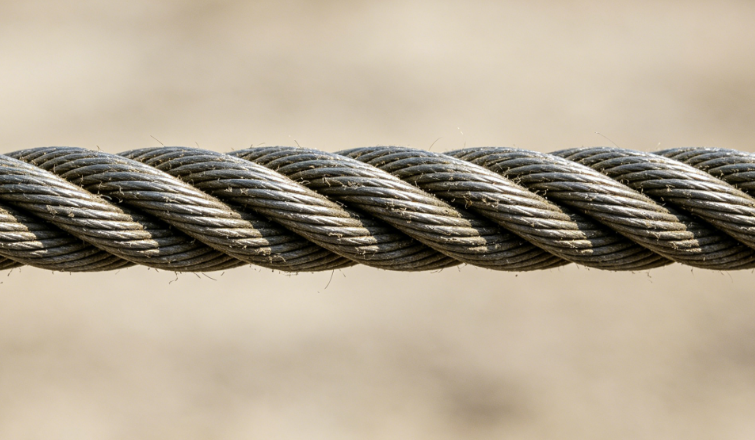
2.3 Wire Metallurgical & Coating Tests
Wire tensile strength (before rope construction) – individual wires extracted from a rope sample and tested in tension to determine the grade (e.g., 1570 MPa, 1770 MPa, 1960 MPa).
Wire torsion (ductility) – a wire specimen is twisted around its axis until fracture; number of twists required (e.g., ≥12 twists for 1 mm diameter wire).
Wire bending (reverse bend) – wire bent back and forth over a mandrel; number of cycles to failure.
Zinc coating mass (for galvanised rope) – gravimetric method (ASTM A90) – dissolve coating and measure mass loss; minimum mass (g/m²) per ISO 7989, Class A or Class B.
Coating uniformity – Preece test (copper sulfate immersion) for hot‑dip galvanised wires.
Microstructure of drawn wire – grain flow, inclusion content, heat treatment condition.
Chemical composition of wire steel – OES (C, Mn, Si, P, S, Cr, Ni, Cu).
Standards: ISO 2201 (wire tensile), EN 10264 (steel wire for ropes), ASTM A90 (zinc coating), ISO 7989 (coating mass).
2.4 Fatigue & Endurance Testing
Bending fatigue (over sheave) – rope specimen is bent repeatedly over a test sheave (pulley) of specified diameter under tension (e.g., 20% MBF). Number of cycles to wire breakage is recorded (ISO 4309, ASTM A1221). Essential for elevator and crane ropes.
Axial (tension‑tension) fatigue – rope loaded in tension between two grips with a sinusoidal cycle (R = 0.1 to 0.2) at high frequency (10‑20 Hz). Used for mooring and tension member qualification.
Torque and rotation measurement – for ropes under load, to evaluate torque‑balanced characteristics (important for single‑fall cranes).
Standards: ISO 4309, ASTM A1221 (bending fatigue), API 9A Appendix A (fatigue for offshore ropes).
2.5 Non‑Destructive Testing (NDT) of wire ropes
Magnetic flux leakage (MFL) – detects internal and external wire breaks, corrosion pitting, cross‑sectional loss (LMA – loss of metallic area), and localised faults. A magnetising head passes along the rope, and sensor arrays (Hall effect or induction coils) record flux leakage. Per ASTM E1571, ISO 4309, or OEM procedures (e.g., MAVIS, ReelShift).
Flux leakage / LMA mapping – quantitative measurement of loss of metallic cross‑section (%).
High‑speed MFL for long ropes (mine hoist, suspended bridge) – up to 2 m/s scan speed.
Visual / endoscopic inspection – for large‑diameter ropes (≥ 50 mm), using a borescope to inspect internal strands after unlaying the rope.
Magnetic particle inspection (MPI) – for wire rope end terminations (sockets, swaged fittings).
Radiographic testing (RT) – for complex termination areas (zinc‑poured sockets).
Standards: ASTM E1571 (MFL of ferromagnetic wire rope), ISO 4309 (condition evaluation using NDT), ASME B30.30 (rope inspection criteria).
2.6 Corrosion & Environmental Durability
Salt spray (ASTM B117, ISO 9227) – for galvanised or coated ropes; hours to first red rust.
Acid / alkali immersion – for ropes used in chemical plants.
Hydrogen embrittlement susceptibility – by pre‑loading notched specimens (ASTM F1624).
Stress corrosion cracking (SCC) – bent specimens immersed in corrosive environment (e.g., seawater, H₂S‑containing).
Marine environment exposure – accelerated testing with cyclic wet/dry and UV.
3. Standard Test Methods We Apply
All tests are performed according to internationally recognised standards. Our laboratory is ISO/IEC 17025 accredited and equipped with large‑capacity tensile machines (5,000 kN maximum), rope fatigue testers, MFL scanning equipment, and metallographic preparation systems.
3.1 Mechanical (Breaking Force & Elongation)
ASTM A931 (Tension testing of wire rope).
ISO 10425 (Steel wire ropes – determination of actual breaking force).
EN 12385‑1 (Steel wire ropes – determination of breaking force).
API 9A (Specification for wire rope – breaking strength).
GB/T 20118 (Steel wire ropes – breaking force test method).
3.2 Dimensional & Construction Verification
EN 12385‑2 (Dimensional tolerances).
ISO 3179 (Measurement of diameter).
GB/T 20118 (Mass per unit length).
3.3 Wire & Coating Tests
ISO 2201 (Steel wire – tensile testing).
EN 10264 (Steel wire for ropes – technical delivery conditions).
ISO 7989 (Zinc coating mass).
ASTM A90 (Zinc coating mass – gravimetric).
ISO 7802 (Wire reverse bend test).
ISO 9649 (Wire torsion test).
3.4 Fatigue & Torque Standards
ISO 4309 (Fatigue bending test – over sheave).
ASTM A1221 (Bending fatigue of wire rope).
API 9A Annex A (Fatigue of offshore ropes).
ISO 2021 (Torque measurement for ropes).
3.5 NDT Standards
ASTM E1571 (MFL examination of ferromagnetic wire rope).
ISO 4309 (Annex B – NDT inspection).
ASME B30.30 (Rope condition evaluation).
3.6 Corrosion Standards
ASTM B117 (Salt spray).
ISO 9227 (Salt spray – neutral, acetic, copper‑accelerated).
NACE TM0177 (Sulfide stress cracking).
4. Why Choose Our Third‑Party wire rope Testing Services?
As an independent laboratory, we provide unbiased, accurate, and legally defensible wire rope test data. Our advantages include:
ISO/IEC 17025 accreditation – CNAS/CMA certified, with regular proficiency testing (e.g., ASTM A931, ISO 4309).
High‑capacity testing – tensile machines up to 5,000 kN (1.1 million lbf) for ropes up to 100 mm diameter.
Full‑service rope testing – mechanical, dimensional, wire/coating, fatigue, NDT (MFL), and corrosion – all under one roof.
MFL scanning for condition assessment – on‑site or laboratory rope evaluation for internal wire breaks and corrosion.
Fast turnaround – typical tensile breaking force test within 2‑3 business days; full qualification programme in 2‑4 weeks.
Detailed reporting – includes breaking force records, load‑extension curves, diameter/lay measurements, NDT signal plots (MFL), wire test data, and clear pass/fail against specification.
Confidentiality – full protection of your rope construction, proprietary lay design, and customer fleet data.
Consultative support – our wire rope engineers help interpret NDT anomalies, recommend discard criteria per ISO 4309, and advise on rope construction selection for specific applications.
Whether you need to certify a new wire rope batch for crane use, perform periodic condition assessment of mine hoist ropes, test mooring rope breaking strength for offshore platform, or investigate a rope failure, our wire rope testing experts are ready to deliver reliable, actionable results.
Get Started with Your wire rope Testing Project
Contact our team with your rope diameter, construction (e.g., 6×36 IWRC), nominal breaking strength, applicable standard (ASTM A931, EN 12385, API 9A, etc.), and required test items (breaking force, NDT, fatigue, wire tests). We will provide a detailed quotation, sample submission guidelines (minimum length for tensile: 2 m, for NDT: full coil length, for wire extraction: 1 m), and a testing schedule. Let us help you ensure that your wire ropes are safe, reliable, and compliant with global standards.
This article provides an overview of our wire rope testing capabilities. For specific test methods, sample quantity, and pricing, please request a tailored service proposal.