Reasons for choosing our testing services
ZHONGXI Testing has obtained inspection qualification certifications from multiple countries and regions worldwide. We possess a senior testing team and advanced testing methods, providing independent, impartial, and professional third-party verification services for global carbon projects.

Internationally recognized authority
Certified by multiple international standards such as CNAS, VCS, and GS, with reports universally applicable worldwide.

Global service capability
Covering 140+ countries and regions, it supports on-site detection and remote verification in multiple languages.

Professional experimental methods
Adopt standard experimental methods to ensure accurate and reliable data.
brinell hardness Testing Services: Reliable Material Strength Evaluation for Large‑Grain & Bulk Components
As an independent third‑party testing service provider, we offer comprehensive brinell hardness testing for metallic materials – including ferrous and non‑ferrous alloys, cast irons, aluminum alloys, copper alloys, bearing materials, and large‑section components such as forgings, castings, and steel plates. The brinell hardness test, introduced by Swedish engineer Johan August Brinell in 1900, is the oldest and one of the most widely recognized static macro‑hardness testing methods[reference:0]. It evaluates a material‘s resistance to permanent indentation by pressing a hardmetal ball (typically 10 mm diameter) into the specimen surface under a specified load, then measuring the diameter of the resulting spherical impression[reference:1]. Because the Brinell test produces a relatively large indentation, it averages out local microstructural variations and provides an accurate representation of bulk material hardness – making it the preferred method for coarse‑grained, inhomogeneous, or as‑cast materials. Our accredited laboratory follows international standards (ISO 6506, ASTM E10, GB/T 231) to deliver accurate, reproducible, and legally defensible test data. This article outlines our brinell hardness testing capabilities – including scope, key test items, parameter selection criteria, and standard methods – to help manufacturers, foundries, heat treaters, and quality assurance teams verify material compliance and product reliability.
1. What Is brinell hardness Testing?
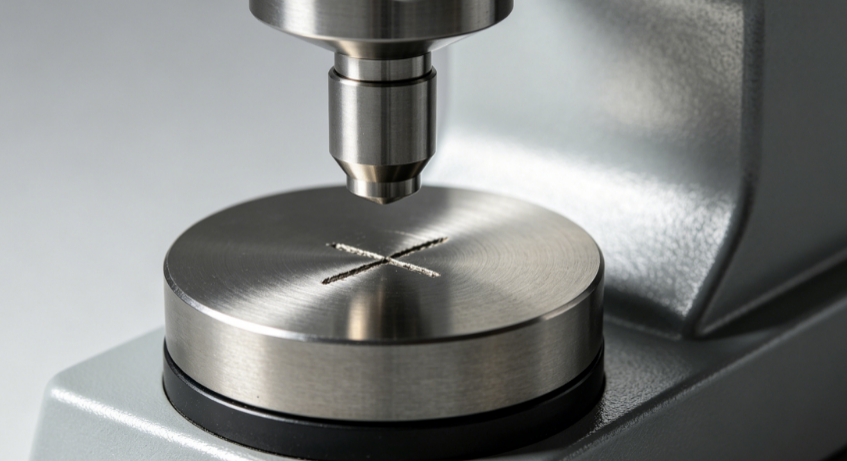
The brinell hardness test is a static indentation method in which a hardmetal ball (tungsten carbide) of specified diameter D is pressed into the test specimen with a defined test force F. After a prescribed dwell time (typically 10‑15 seconds), the test force is removed and the diameter d of the residual indentation is measured optically. The brinell hardness value (HBW) is calculated as the ratio of the test force to the spherical surface area of the impression. The calculation formula is as follows[reference:2][reference:3]:
HBW = 0.102 × 2F / [πD (D - √(D² - d²))]
Where: F = test force (N), D = ball diameter (mm), d = average indentation diameter (mm).
The suffix “BW” indicates the use of a hardmetal (tungsten carbide) ball indenter, which has replaced the earlier steel ball (HBS) in modern standards and is suitable for hardness values up to 650 HBW[reference:4]. brinell hardness values are typically expressed with additional parameters. For example, 150 HBW 10/3000/30 means: a brinell hardness of 150, measured with a 10 mm diameter hardmetal ball, a test force of 3000 kgf, and a dwell time of 30 seconds.
2. Our Testing Scope for brinell hardness
We cover a wide range of metallic materials, product forms, and component sizes:
By material type: Ferrous metals (carbon steel, alloy steel, cast iron, ductile iron, stainless steel, tool steel, spring steel, bearing steel)[reference:5]; Non‑ferrous metals (aluminum and aluminum alloys, copper and copper alloys – brass, bronze, titanium alloys, magnesium alloys, zinc alloys); Special alloys (high‑temperature alloys, wear‑resistant steels, austenitic manganese steel); Welded joints (weld metal, heat‑affected zone, base metal)[reference:6]; Powder metallurgy parts; Large forgings and castings; Steel plates, bars, and sections.
By component / product form: Large‑diameter shafts and axles; Ring forgings (bearing rings, gear rings, flange rings); Engine blocks and cylinder heads; Gear blanks and gearbox housings; Wind turbine components (main shafts, bearing rings, tower flanges); Steel castings; Pressure vessel plates; Construction steel (rebar, structural sections); Railway wheels and rails; Die blocks and tooling; Heavy machinery components.
By test condition / environment: Laboratory testing (precision stationary Brinell machines, 250‑3000 kgf); Portable / on‑site testing (King portable Brinell testers, hydraulic or impact Brinell testers – for large immovable components); Elevated temperature (by arrangement); Ambient temperature (23 ± 5°C, standard).
3. International Standards & Compliance
All brinell hardness tests are performed in strict accordance with the following international standards:
ISO 6506‑1 (Metallic materials – brinell hardness test – Part 1: Test method) – Defines the principle, symbols, test force‑ball diameter combinations, and calculation procedure[reference:7].[reference:8]
ASTM E10 (Standard test method for brinell hardness of metallic materials) – Equivalent to ISO 6506, specifying test conditions, specimen preparation, and reporting requirements for the US market[reference:9][reference:10].
GB/T 231.1 (Metallic materials – brinell hardness test – Part 1: Test method) – Chinese national standard for brinell hardness testing, aligned with ISO 6506[reference:11].[reference:12].
ISO 6506‑2 (Hardness test machines – Verification and calibration) – Specifies direct and indirect verification methods for Brinell testing machines using calibrated reference hardness blocks.[reference:13]
ISO 6506‑3 (Calibration of reference blocks) – Defines the calibration of reference hardness blocks used for verifying hardness testers.
ASTM E140 (Hardness conversion tables) – Provides conversion relationships between brinell hardness and other scales (HRC, HRB, HV, tensile strength).
4. Key Parameters & Selection Criteria
To obtain accurate and representative brinell hardness values, three critical parameters must be selected correctly: the ball diameter (D), the test force (F), and the dwell time (t). These parameters determine the F/D² ratio, which governs the geometric similarity of indentations across different material hardness ranges.
Standard ball diameters available: 10 mm, 5 mm, 2.5 mm, 2 mm, 1 mm. The 10 mm ball is most commonly used for bulk testing of larger components; smaller balls are selected when testing thin sections or limited sample areas.[reference:14][reference:15]
Standard F/D² ratios and typical applications: The F/D² ratio (test force divided by the square of the ball diameter) ensures that indentations are geometrically similar regardless of the ball size selected. The following F/D² values are defined by ISO 6506 and ASTM E10[reference:16][reference:17]:
F/D² = 30 (F = 30D²) – Used for high‑hardness steels (hardness range 140‑450 HBW), heat‑treated steels, cast irons, and hard alloy steels. Typical combination: 10 mm ball / 3000 kgf.[reference:18]
F/D² = 15 – Recommended for medium‑hardness materials (hardness range < 140 HBW), such as annealed steels, low‑carbon steels, aluminum alloys, and copper alloys.[reference:19]
F/D² = 10 – Suited for soft non‑ferrous metals: pure aluminum (99.5 Al), soft copper, lead, tin, bearing alloys, and soft brasses. Typical combination: 10 mm ball / 1000 kgf.[reference:20]
F/D² = 5 – For very soft metals (hardness range 8‑35 HBW) such as pure aluminum, soft yellow brass, and some bronzes.[reference:21]
F/D² = 2.5 – For extremely soft materials, including lead, tin, and zinc alloys.[reference:22]
Dwell time (hold time): The test force must be maintained for a sufficient duration to allow full plastic deformation. Dwell time is selected based on material type[reference:23]:
- Ferrous metals (steel, cast iron) – 10 to 15 seconds.
- Non‑ferrous metals (aluminum, copper) – 30 seconds.
- Light metals (magnesium, zinc, soft alloys) – 60 seconds.
Test force selection (standardized levels): Common test force values available on Brinell testing machines include 3000 kgf (29.42 kN), 1500 kgf, 1000 kgf, 500 kgf, 250 kgf, 125 kgf, 62.5 kgf, 31.25 kgf, 15.625 kgf, and 1 kgf.[reference:24]
5. Test Procedure & Specifications
Our laboratory strictly follows the procedural requirements of ISO 6506‑1 and ASTM E10. The key steps and specifications are summarized below:
Specimen preparation – The test specimen surface must be flat, smooth, and free from foreign matter, oxide scale, grease, and machining marks. The required surface finish is Ra ≤ 1.6 μm, achieved by grinding with sequentially finer abrasives (e.g., 240 → 600 → 1200 grit). Grinding direction should be consistent to avoid cross‑scratches that interfere with indentation measurement. The test specimen thickness must be at least 8 times the depth of indentation, and after indentation, the back surface should show no visible deformation marks.[reference:25][reference:26]
Indentation spacing – The distance between the center of an indentation and the specimen edge must be at least 2.5 times the indentation diameter. The distance between adjacent indentation centers must be at least 3 times the indentation diameter. This spacing prevents edge effects and residual stress interference.[reference:27][reference:28]
Indentation measurement – After removing the test force, two mutually perpendicular diameters (d₁ and d₂) of the indentation are measured using a Brinell reading microscope (typically 20× to 40× magnification, with scale graduation ≤ 0.01 mm). The average diameter d = (d₁ + d₂) / 2 is used in the hardness calculation. If the difference between d₁ and d₂ exceeds 2% of the smaller measurement, the indentation is considered irregular, and the test should be repeated.[reference:29]
Number of indentations – For routine quality control, at least 3 indentations are performed at different locations on the specimen, and the average hardness is reported. For material acceptance testing, standards may require 5 indentations spaced as described above.
Verification of equipment – The brinell hardness tester is verified annually using certified reference hardness blocks (calibrated to ISO 6506‑3 or ASTM E10). The indirect verification method requires at least 5 indentations on each of two reference blocks covering different hardness levels. The measured average hardness must fall within the certified tolerance range for the block, and the repeatability error must be ≤ 1.5%.[reference:30][reference:31]
6. Materials & Components Suitable for brinell hardness Testing
brinell hardness testing is particularly well‑suited for the following materials and applications[reference:32][reference:33]:
Cast irons (gray iron, ductile iron, malleable iron) – The relatively large indentation averages out local variations in graphite distribution and provides a true measure of bulk hardness. brinell hardness has a well‑established correlation with tensile strength for cast irons.
Heat‑treated (annealed, normalized, quenched + tempered) steels – brinell hardness is the standard acceptance criterion for many heat‑treated steel components, including shafts, gears, and structural parts. The typical range for heat‑treated steels is 150‑400 HBW.
Coarse‑grained metals and alloys – Materials with heterogeneous microstructures (e.g., large‑grain non‑ferrous alloys, cast structures, sintered metals) are best characterized by the Brinell test because the large indentation averages over multiple grains, providing a representative hardness value.
Large forgings and castings – Engine blocks, cylinder heads, die blocks, large gear blanks, and heavy machinery components are typically evaluated using brinell hardness.
Non‑ferrous metals – Aluminum alloys (e.g., A356, 6061‑T6), copper alloys (brass, bronze), and bearing alloys (Babbitt) are commonly tested using lower F/D² ratios such as 10 or 5.
Steel plates, bars, and structural sections – brinell hardness is used for incoming material verification of normalized or annealed structural steels and pressure vessel plates.
Bearing materials (bronze, Babbitt) – Soft bearing alloys are well‑suited for Brinell testing with low test forces and small ball diameters.
Raw materials and semi‑finished goods – brinell hardness is particularly well‑suited for measuring coarse‑grained, inhomogeneous materials such as cast iron, annealed steel, and as‑cast alloys – where the large indentation averages out local microstructural variations.[reference:34]
7. Advantages & Limitations of brinell hardness Testing
Understanding the strengths and weaknesses of the Brinell method is essential for proper application and result interpretation[reference:35].
Advantages: The large indentation (typically 2‑5 mm in diameter) averages out local microstructural inhomogeneities and provides a representative bulk hardness value – particularly valuable for coarse‑grained materials such as cast iron, bronze, and as‑cast alloys. The Brinell test is relatively insensitive to minor surface preparation variations and minor surface waviness compared to other hardness methods. For steel and cast iron, there exists a well‑established (approximately linear) conversion relationship between brinell hardness and ultimate tensile strength (UTS ≈ 3.55 × HBW for carbon and low‑alloy steels) – facilitating design and material selection.[reference:36][reference:37]
Limitations: The large indentation constitutes destructive testing, leaving a visible mark that may be objectionable for finished components. The test is relatively slow (indentation time + measurement time per indentation) and is not suitable for high‑volume automated production screening. Brinell testing is not recommended for thin sections (< 1.0 mm for 10 mm ball) or very small components, as specimen thickness must exceed 8 times the indentation depth to avoid substrate anvil effects. For very hard materials (above 650 HBW), tungsten carbide balls may deform; such materials are better evaluated using the Rockwell (HRC) or Vickers (HV) methods. Test results obtained with different ball diameters and test forces may not be directly comparable unless the F/D² ratio is maintained.
8. Calibration & Verification of brinell hardness Testers
To ensure measurement accuracy and traceability, brinell hardness testers are verified by two complementary methods as specified in ISO 6506‑2 and GB/T 231.2[reference:38]:
Indirect verification (routine operational check) – Performed using certified reference hardness blocks calibrated according to ISO 6506‑3. The reference block is placed on the test anvil, and the appropriate test force is applied. At least five valid indentations are made on the block (spacing: distance from block edge ≥ 2.5 × d, between indentation centers ≥ 3 × d). The measured average hardness is compared with the certified value of the block. Acceptable tolerance: the deviation must not exceed ±3% of the certified value. Repeatability error must be ≤ 1.5%.[reference:39]
Direct verification (periodic machine calibration) – Performed by a calibration laboratory at longer intervals (typically every 12 months) to verify individual machine parameters: test force accuracy (±1.0%), indenter dimensional verification (ball diameter tolerance ±0.005 mm), loading mechanism and dwell time control (tolerance ±0.5 s), and measurement system (microscope scale calibration误差 ≤ 0.5%).[reference:40]
Daily / monthly operational checks – For laboratory accreditation and quality system compliance (ISO/IEC 17025), an internal run (3‑5 indentations on a reference block) is performed before each test series or at least monthly. Results are recorded on control charts to detect any systematic drift in instrument performance.[reference:41]
9. Reporting & Result Presentation
Our test reports are detailed, transparent, and compliant with ISO/IEC 17025 reporting requirements. Each report includes:
Specimen identification – Material grade, heat number, component description, and sampling location if required.
Test conditions – Test standard referenced (ISO 6506, ASTM E10, or GB/T 231), ball diameter (D), test force (F), dwell time (t), and the resulting F/D² ratio. Environmental temperature (23 ± 5°C) and relative humidity (≤ 60%).
Individual indentation data – For each indentation: measured diameters d₁ and d₂ (mm), average diameter d (mm), calculated individual HBW value (rounded to the nearest 0.1 HBW for values ≥ 100, or to 0.5 HBW for values < 100).
Statistical summary – Mean HBW, standard deviation, coefficient of variation (%), and range. Minimum and maximum values.
Equipment calibration status – Model and serial number of brinell hardness tester, date of last calibration, reference block identification and certified value, verification results (comparison with block, repeatability).
Compliance statement – Pass/fail determination against specification limits, customer purchase order requirements, or material standard.
10. Why Choose Our Third‑Party brinell hardness Testing Services?
As an independent laboratory, we provide unbiased, accurate, and legally defensible hardness data. Our strengths include:
ISO/IEC 17025 accreditation – Our testing laboratory holds CNAS and CMA accreditation, with active participation in inter‑laboratory proficiency testing (e.g., ASTM E10, ISO 6506 round robins).
Comprehensive Brinell testing equipment – We maintain a fleet of brinell hardness testers covering a wide test force range (250 kgf to 3000 kgf; portable King testers up to 3000 kgf for large immovable components). Our testers are equipped with certified reference hardness blocks covering low, medium, and high hardness ranges (100‑650 HBW).
Wide specimen size accommodation – We can accommodate specimens ranging from small coupons (minimum thickness 1.0 mm, using 1 mm or 2.5 mm ball) to large components up to 1,500 kg in weight.
On‑site portable Brinell testing – For large forgings, castings, and installed components that cannot be transported to our laboratory, we offer portable Brinell testing (King testers, hydraulic impact testers) with full data traceability.
Fast turnaround – Routine brinell hardness testing (batch of 5 specimens, 3 indentations each) typically completed within 1‑2 business days; large validation projects within 3‑5 business days.
Complete supplementary testing – Hardness‑related material properties can be evaluated concurrently: tensile strength conversion (approximate), microstructure correlation (metallography), case depth verification, and hardness uniformity mapping.
Confidentiality – Full protection of your component design, material composition, and quality records.
Consultative support – Our metallurgists assist with F/D² ratio selection, indentation spacing planning for large components, interpretation of borderline results (low hardness, soft spots, outliers), and determination of root causes (over‑tempering, decarburization, local segregation).
Whether you need to qualify a large steel casting, verify the heat treatment of a forged shaft, map the hardness profile of a bearing ring, or conduct hardness acceptance testing for a production batch of gray iron components, our brinell hardness testing experts are ready to deliver reliable, actionable results.
Get Started with Your brinell hardness Testing Project
Contact our team with your material type, component dimensions, expected hardness range, applicable standard (ISO 6506, ASTM E10, GB/T 231), and any specific test requirements (testing location: laboratory or on‑site; specimen surface condition; hardness uniformity mapping; specification limit). We will provide a detailed quotation, sample submission guidelines (minimum specimen thickness, recommended grinding preparation), and a testing schedule. Let us help you ensure that your materials and components meet the required hardness specifications for safe, reliable, long‑lasting performance.
This article provides an overview of our brinell hardness testing capabilities. For specific test methods, sample quantity, and pricing, please request a tailored service proposal.