Reasons for choosing our testing services
ZHONGXI Testing has obtained inspection qualification certifications from multiple countries and regions worldwide. We possess a senior testing team and advanced testing methods, providing independent, impartial, and professional third-party verification services for global carbon projects.

Internationally recognized authority
Certified by multiple international standards such as CNAS, VCS, and GS, with reports universally applicable worldwide.

Global service capability
Covering 140+ countries and regions, it supports on-site detection and remote verification in multiple languages.

Professional experimental methods
Adopt standard experimental methods to ensure accurate and reliable data.
rockwell hardness Testing Services: Fast, Accurate & Standardised Material Hardness Evaluation
As an independent third-party testing service provider, we offer comprehensive rockwell hardness testing for a wide range of metallic materials – including carbon steels, alloy steels, stainless steels, cast irons, non‑ferrous metals (aluminium, copper, brass, bronze), and thin components (sheets, strips, case‑hardened layers, coatings). The rockwell hardness test is the most widely used industrial hardness method because it is fast, non‑destructive (leaves only a small indentation), and requires minimal specimen preparation. It measures the depth of permanent indentation under a differential load sequence (minor load + major load). Our accredited laboratory follows international standards (ISO 6508, ASTM E18, GB/T 230) to deliver accurate, reproducible, and legally defensible hardness data. This article outlines our rockwell hardness testing capabilities – including scope, key test items, scale selection, test procedures, and standard methods – to help manufacturers, heat treaters, quality assurance teams, and engineering firms verify material compliance and product reliability.
1. What Is rockwell hardness Testing?
rockwell hardness is a fast, direct‑reading indentation method. A minor load (typically 98.07 N / 10 kgf or 29.42 N / 3 kgf) is first applied to seat the indenter into the specimen surface and set a reference zero. Then an additional major load (from 147.1 N / 15 kgf up to 1471 N / 150 kgf) is applied to increase the indentation depth. After holding the major load for a specified dwell time (typically 2‑6 seconds), the major load is removed while the minor load is maintained. The rockwell hardness value is calculated from the permanent increase in indentation depth (e) under the minor load: HR = N - (e / s), where N is a scale‑specific constant (e.g., 100 for Rockwell C) and s is the unit of measurement (0.002 mm). The result is a dimensionless number that increases with material hardness.
rockwell hardness values are expressed with a symbol indicating the scale used. For example: 60 HRC means a rockwell hardness of 60 on the C scale (diamond cone indenter, 150 kgf major load). 85 HRB means 85 on the B scale (1.588 mm steel ball indenter, 100 kgf major load).
2. Our Testing Scope for rockwell hardness
We cover all common Rockwell scales, material types, and test configurations:
By Rockwell scale (most common): HRA (diamond cone, 60 kgf) – for thin hard materials, carbides, cemented carbides, surface‑hardened layers; HRB (1.588 mm steel ball, 100 kgf) – for soft and medium‑hard steels (annealed, low‑carbon), aluminium alloys, copper alloys, soft cast iron; HRC (diamond cone, 150 kgf) – the most widely used scale for hardened steels, heat‑treated parts, tool steels, die steels (range 20‑70 HRC); HRD (diamond cone, 100 kgf) – for thin hardened steel; HRF (1.588 mm ball, 60 kgf) – for thin soft metals, copper, brass; HRG (1.588 mm ball, 150 kgf) – for soft or medium copper alloys; HRN (diamond cone or ball, 15 kgf superficial) – for thin or case‑hardened components; HRT (ball, 15 kgf superficial) – for very thin sheet metal.
By material type: Ferrous metals (carbon steel, alloy steel, stainless steel, tool steel, cast iron, malleable iron, ductile iron); Non‑ferrous metals (aluminium and aluminium alloys, copper and copper alloys – brass, bronze, copper‑nickel, titanium, nickel alloys); Coated/case‑hardened materials (carburised, carbonitrided, nitrided, induction‑hardened surfaces); Thin components (sheet metal, strips, foils, small machined parts).
By test condition: Laboratory testing (precision stationary Rockwell testers, 0.1 HR resolution); On‑site / portable testing (small components, limited access); Elevated or low temperature (by arrangement); Ambient (23 ± 5°C standard).
By component / product form: Shafts, gears, bearings, dies, moulds, cutting tools, blades, springs, stampings, fasteners, castings, forgings, machined parts, welded assemblies, sheet metal, and strip coils.
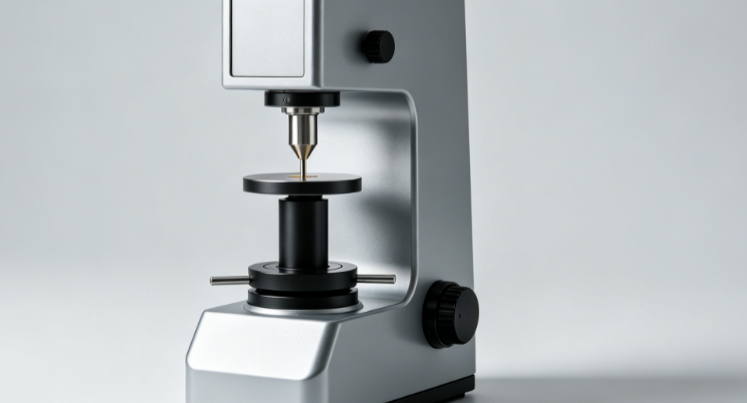
3. International Standards & Compliance
All rockwell hardness tests are performed in strict accordance with the following international standards:
ISO 6508‑1 (Metallic materials – rockwell hardness test – Part 1: Test method) – defines the principle, scales, symbols, test procedures, and requirements for specimen preparation. It covers the standard Rockwell scales (A, B, C, D, E, F, G, H, K, N, T).
ASTM E18 (Standard test methods for rockwell hardness of metallic materials) – the primary US standard for Rockwell testing, specifying direct and indirect verification, scale selection, and reporting for all standard and superficial scales.
GB/T 230.1 (Metallic materials – rockwell hardness test – Part 1: Test method) – Chinese national standard, aligned with ISO 6508‑1.
ISO 6508‑2 (Verification and calibration of testing machines) – defines direct and indirect verification procedures using calibrated reference hardness blocks.
ISO 6508‑3 (Calibration of reference blocks) – specifies the calibration of reference hardness blocks used for routine verification.
ASTM E140 (Hardness conversion tables) – provides conversion relationships between rockwell hardness and other scales (Brinell, Vickers, tensile strength).
4. rockwell hardness Scales – Selection Guide
Selecting the correct Rockwell scale is essential for accurate and valid results. The choice depends on the material type, hardness range, thickness, and surface condition.
Rockwell C scale (HRC) – Indenter: diamond cone (120° conical, rounded tip). Major load: 150 kgf (1471 N). Application: hardened steels (heat‑treated, quenched & tempered), tool steels, die steels, bearing steels, case‑hardened steels (carburised layer), and hard cast irons (chilled iron). Typical range: 20‑70 HRC. For materials below 20 HRC, use HRB.
Rockwell B scale (HRB) – Indenter: 1.588 mm (1/16 inch) steel ball or tungsten carbide ball. Major load: 100 kgf (981 N). Application: soft to medium‑hard steels (annealed, low‑carbon, normalized), aluminium alloys (2xxx, 6xxx, 7xxx), copper alloys (brass, bronze, copper), soft cast iron (gray iron). Typical range: 20‑100 HRB.
Rockwell A scale (HRA) – Indenter: diamond cone. Major load: 60 kgf (588 N). Application: thin hardened steel sheets, cemented carbides (tungsten carbide, titanium carbide), shallow case‑hardened layers (carburised < 0.5 mm), hard brittle materials. Typical range: 40‑85 HRA.
Rockwell D scale (HRD) – Indenter: diamond cone. Major load: 100 kgf (981 N). Application: thin hardened steel (e.g., spring steel), shallow case‑hardened steels where HRC would cause specimen deformation. Typical range: 40‑77 HRD.
Rockwell F scale (HRF) – Indenter: 1.588 mm ball. Major load: 60 kgf (588 N). Application: thin, soft non‑ferrous metals (copper, brass, aluminium sheet), low‑strength steels (annealed), thin sheets. Typical range: 60‑100 HRF.
Rockwell G scale (HRG) – Indenter: 1.588 mm ball. Major load: 150 kgf (1471 N). Application: medium‑hard non‑ferrous alloys, bearing bronze, microalloyed steels. Typical range: 30‑94 HRG.
Superficial Rockwell scales (N and T scales) – Minor load: 3 kgf (29.4 N); major loads: 15 kgf (147 N), 30 kgf (294 N), 45 kgf (441 N). Application: thin sheet metal (< 1 mm), case‑hardened layers (< 0.5 mm effective depth), small components, coated surfaces. Common superficial scales: HR15N, HR30N, HR45N (diamond cone); HR15T, HR30T, HR45T (1.588 mm ball).
General guideline for scale selection: For a given material, the measured hardness should fall within the following approximate ranges to ensure optimal accuracy: HRB 20‑100, HRC 20‑70, HRF 60‑100, HRA 40‑85. Avoid testing at the extremes of a scale because resolution and repeatability degrade near the scale limits. The specimen thickness must be at least 10 times the depth of indentation – use superficial scales for thin components.
5. Test Procedure & Specifications
Our laboratory strictly adheres to the procedural requirements of ISO 6508‑1 and ASTM E18. The key steps and specifications are summarised below:
Specimen preparation – The test surface must be smooth, flat, clean, and free from oxide scale, grease, and machining marks. For Rockwell B and C scales (ball indenters), the surface finish should be Ra ≤ 1.6 μm, achievable by grinding with 240‑600 grit paper. The specimen thickness must be at least 10 times the indentation depth. After testing, the underside of the specimen should show no visible deformation. The specimen must be securely placed on a rigid anvil (flat or V‑shaped) to prevent movement during loading. Surfaces that are curved (e.g., cylindrical shafts) may require specially shaped anvils to ensure proper seating.
Test cycle – The minor load (10 kgf for standard scales, 3 kgf for superficial) is applied, and the dial gauge (or digital display) is set to zero. The major load is then applied smoothly, without impact, in 2‑6 seconds. The dwell time (hold time) is typically 2‑6 seconds for most steels; for soft materials (aluminium, brass, copper), a longer dwell time of up to 10 seconds may be required to allow full creep to stabilise. After dwell, the major load is released, and the permanent indentation depth under the minor load is measured. The Rockwell number is displayed directly. The total test cycle duration is about 5‑15 seconds, making Rockwell one of the fastest hardness methods.
Indentation spacing – The distance between the centre of an indentation and the specimen edge must be at least 2.5 times the indentation diameter. The distance between adjacent indentation centres must be at least 3 times the indentation diameter. This prevents work‑hardening interference from previous indentations.
Number of indentations – For routine quality control, at least 3 indentations are performed at different locations on the specimen (avoiding edges and previous indents), and the average hardness is reported. For material acceptance testing or where high precision is required, 5 indentations are standard.
Temperature – Tests are conducted at ambient temperature (23 ± 5°C). For high‑precision testing (calibration or dispute resolution), 23 ± 1°C is maintained.
Verification of equipment – The Rockwell tester is verified daily (or before each test series) using certified reference hardness blocks covering the relevant hardness range. At least 5 indentations are made on the reference block; the average hardness must be within the certified tolerance (±1.5 HR for most scales), and the repeatability must meet the standard requirements (e.g., ≤ 0.5 HRC for C scale). Annual indirect verification by an accredited calibration laboratory is performed per ISO 6508‑2.
6. Materials & Components Suitable for rockwell hardness Testing
rockwell hardness testing is applicable to a vast range of metallic materials and components. Typical examples include:
Heat‑treated steels – Quenched and tempered steels (HRC 25‑60) – shafts, gears, bearings, dies, tooling, automotive components.
Annealed and normalized steels – Low‑carbon and medium‑carbon steels (HRB 60‑95) – structural steel, machinery parts, fabricated components.
stainless steels – Austenitic (HRB 70‑95), martensitic (HRC 35‑55), precipitation‑hardening (HRC 30‑45).
Cast irons – Gray iron (HRB 70‑100), ductile iron (HRC 20‑40 for hardened grades), white iron (HRC 45‑60).
Non‑ferrous alloys – Aluminium 6061‑T6 (HRB 60‑70), 7075‑T6 (HRB 85‑95); copper (HRB 10‑25 soft); brass (HRB 50‑80); bronze (HRB 60‑90); titanium (HRC 30‑40).
Case‑hardened components – Carburised, carbonitrided, nitrided, or induction‑hardened parts. For effective case depth ≥ 0.3 mm, HRC is appropriate; for shallower cases, use HRA or superficial scales.
Thin sheet metal / strips – Spring steel strips (0.2‑1.5 mm thick) – use superficial Rockwell scales (HR15N, HR30N, HR15T) or convert to standard scales.
7. Advantages & Limitations of rockwell hardness Testing
Understanding the strengths and limitations of the Rockwell method ensures appropriate application and proper interpretation of results.
Advantages: The test is very fast (5‑15 seconds per indentation), making it ideal for high‑volume production quality control. It is non‑destructive – the indentation is small (typically 0.2‑1.0 mm diameter) and often acceptable on finished components. No optical measurement is required; the hardness value is read directly from the dial or digital display. A wide range of hardness levels (from soft aluminium to hardened tool steels) can be measured by selecting an appropriate scale. The procedure is simple and requires minimal operator skill after proper training. The equipment is relatively inexpensive and widely available.
Limitations: The test is sensitive to surface preparation: oxide scale, decarburisation, or rough machining can produce erroneous results. The specimen must be sufficiently thick (≥ 10 × indentation depth). For case‑hardened layers, the effective depth must be at least 10‑15 times the indentation depth to avoid “case‑crushing” (substrate influence). The method cannot be used on materials with high creep (e.g., lead, tin, pure aluminium), as the indentation depth continues to increase during the dwell period, leading to non‑repeatable readings. Rockwell B scale using steel ball indenters may cause deformation of the ball when testing very hard materials (above 100 HRB); therefore, carbide balls are now standard for HRB. The test is less suitable for very thin sections (< 0.1 mm) or extremely hard brittle materials (e.g., ceramics, glass) – use Vickers or Knoop for such materials.
8. Calibration & Verification of rockwell hardness Testers
To ensure measurement accuracy and traceability, rockwell hardness testers are verified by two complementary methods as specified in ISO 6508‑2 and ASTM E18:
Indirect verification (routine operational check) – Performed using certified reference hardness blocks (calibrated according to ISO 6508‑3). The reference block is placed on the tester anvil, and 5 indentations are made under the same test conditions as for specimens. The average hardness is calculated and compared to the certified value of the block. The deviation must be within the tolerance specified in ISO 6508‑2 (e.g., ±1.5 HR for HRC, ±2.0 HR for HRB). The repeatability (range of the 5 readings) must be ≤ 0.5 HR for HRC/HRB.
Direct verification (periodic machine calibration) – Performed by an accredited calibration laboratory (typically every 12 months) to verify: test force accuracy (±1.0%), indenter geometry (diamond cone angle 120° ± 0.35°, tip radius 0.2 mm ± 0.01 mm; ball diameter 1.588 mm ± 0.003 mm), loading mechanism and dwell timing (±0.5 s), and depth measurement system (resolution ≤ 0.001 mm).
Daily / weekly operational checks – For ISO/IEC 17025 compliance, an internal check using one or two reference blocks (covering the working hardness range) is performed each day that tests are conducted. At least 3‑5 indentations are made, and results are recorded on control charts to detect any drift.
9. Reporting & Result Presentation
Our test reports are transparent, detailed, and compliant with ISO/IEC 17025 requirements. Each report includes:
Specimen identification – Material grade, heat number, component description, sampling location, and orientation (if required).
Test conditions – Standard referenced (ISO 6508‑1, ASTM E18, GB/T 230), Rockwell scale used (e.g., HRC, HRB, HRA), indenter type, major load, minor load, dwell time, and any special conditions (anvil type, temperature, specimen support).
Individual indentation data – For each indentation: the measured Rockwell value (e.g., 62.5 HRC, 85.3 HRB).
Statistical summary – Mean Rockwell value, standard deviation, range, coefficient of variation (for high precision). Minimum and maximum readings.
Equipment calibration status – Model and serial number of Rockwell tester, date of last calibration, reference block identification and certified values, verification results (comparison with block, repeatability).
Compliance statement – Pass/fail determination against specification limits, purchase order requirements, or material standard (e.g., “The measured average hardness of 62.5 HRC meets the requirement of 58‑64 HRC per ASTM A574”).
10. Why Choose Our Third‑Party rockwell hardness Testing Services?
As an independent laboratory, we provide unbiased, accurate, and legally defensible hardness data. Our strengths include:
ISO/IEC 17025 accreditation – Our rockwell hardness testing laboratory is CNAS and CMA accredited, with regular participation in proficiency testing (e.g., ASTM E18 round robins).
Comprehensive Rockwell testers – We maintain multiple testers covering all common scales: standard (HRA, HRB, HRC, HRD, HRF, HRG, HRN, HRT), superficial (15N, 30N, 45N, 15T, 30T, 45T), and automatic multi‑scale machines for high‑volume testing.
Wide specimen accommodation – We can test small components (minimum thickness 0.1 mm using superficial scales) up to large parts (1500 kg weight, 1.5 metre dimensions). Curved surfaces accommodated with specialised anvils (V‑shaped, radiused).
Fast turnaround – Routine Rockwell testing (batch of 5‑10 specimens, 3 indentations each) typically completed within 1‑2 business days; large production batches within 3‑5 business days.
Complete supplementary testing – We can perform hardness conversion to Brinell (HBW), Vickers (HV), and approximate tensile strength values (for steels) per ASTM E140. microhardness traverse for case depth measurement, and surface preparation (grinding, polishing) for accurate readings.
Confidentiality – Full protection of your component design, material composition, and quality records.
Consultative support – Our metallurgists assist with scale selection, interpretation of borderline results (e.g., HRB vs. HRC transition), diagnosis of decarburisation or improper heat treatment, and root cause analysis of hardness anomalies.
Whether you need to qualify a heat‑treated steel component, verify the hardness of an incoming material batch, map hardness uniformity across a large forging, or investigate a field failure (e.g., soft spots, excessive hardness leading to brittleness), our rockwell hardness testing experts are ready to deliver reliable, actionable results.
Get Started with Your rockwell hardness Testing Project
Contact our team with your material type, expected hardness range, component dimensions, applicable standard (ISO 6508, ASTM E18, GB/T 230), and any special requirements (superficial scale for thin section, on‑site testing, hardness conversion). We will provide a detailed quotation, sample submission guidelines (including surface preparation and minimum thickness), and a testing schedule. Let us help you ensure that your materials meet the required hardness specifications for safety, durability, and performance.
This article provides an overview of our rockwell hardness testing capabilities. For specific test methods, sample quantity, and pricing, please request a tailored service proposal.