Reasons for choosing our testing services
ZHONGXI Testing has obtained inspection qualification certifications from multiple countries and regions worldwide. We possess a senior testing team and advanced testing methods, providing independent, impartial, and professional third-party verification services for global carbon projects.

Internationally recognized authority
Certified by multiple international standards such as CNAS, VCS, and GS, with reports universally applicable worldwide.

Global service capability
Covering 140+ countries and regions, it supports on-site detection and remote verification in multiple languages.

Professional experimental methods
Adopt standard experimental methods to ensure accurate and reliable data.
Advanced Characterization and Catalytic Performance Testing of MgTi2O5 Nanocatalysts – Specialized Analytical Services
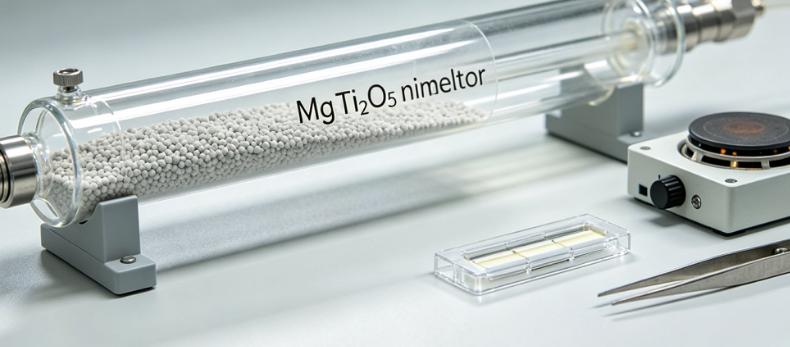
Magnesium dititanate (MgTi2O5) with the pseudobrookite structure has emerged as a highly promising nanomaterial for heterogeneous catalysis, photocatalysis, and electrocatalysis, owing to its remarkable thermal stability, unique Ti4+ coordination geometry, and tunable oxygen vacancy concentration. This material is particularly attractive for oxidative dehydrogenation of alkanes, selective catalytic reduction (SCR) of NOx, photodegradation of organic pollutants, and as a support for single-atom catalysts. However, the catalytic functionality of MgTi2O5 nanocrystals is exquisitely sensitive to Mg/Ti stoichiometric deviations, antisite disorder between octahedral sites, surface oxygen vacancy density, and the presence of amorphous grain boundary phases. If you are searching for MgTi2O5 nanocatalyst testing, you are likely at a stage where precise, multi-scale physicochemical characterization is essential to validate phase-pure synthesis, quantify defect concentrations, correlate structural motifs with activity, or troubleshoot performance degradation under reaction conditions. This article details our comprehensive analytical and catalytic assessment platform, the technical sophistication we apply, and the distinct advantages that make us a premier partner for research institutions and industrial R&D teams working with complex ternary oxide nanomaterials.
The Critical Need for Multi-Technique Evaluation of MgTi2O5 Nanocatalysts
MgTi2O5 crystallizes in an orthorhombic pseudobrookite framework (space group Bbmm), where Mg2+ and Ti4+ are distributed over two distinct octahedral sites (M1 and M2). The catalytic activity is strongly dependent on the degree of Mg–Ti ordering, the presence of Ti3+ defects (which create mid-gap states), and the surface basicity/acidity governed by terminal oxygen species. Furthermore, under harsh reaction conditions (e.g., high-temperature oxidative environments or hydrothermal aging), the material can undergo phase segregation to MgO and TiO2, irreversible loss of surface area, or formation of inert titanium-rich overlayers. A single analytical technique cannot capture this complexity. Therefore, a systematic testing strategy that combines bulk crystallography, local atomic probing, surface chemical speciation, textural analysis, and in-situ reactivity testing is indispensable. Our service is architected to provide exactly this holistic insight, enabling you to build reliable structure-activity correlations and advance your catalyst from laboratory discovery to practical application.
Our Comprehensive Analytical Capabilities for MgTi2O5 Nanocatalysts
We deploy a broad and complementary suite of characterization and testing tools, each optimized to probe a specific facet of MgTi2O5 nanomaterials. Our workflow spans crystal chemistry, defect engineering, surface properties, and catalytic performance under realistic conditions.
1. High-Resolution Crystallographic and Phase Analysis: We perform high-resolution powder X-ray diffraction (HR-XRD) with Cu Kα radiation, coupled with Rietveld refinement to determine precise lattice parameters, atomic site occupancies (Mg/Ti distribution), and crystallite size with microstrain analysis. For detection of trace impurities (e.g., TiO2 anatase or MgO), we offer synchrotron X-ray diffraction with detection limits below 0.1 wt%. To resolve local structural distortions that are invisible to conventional XRD, we employ pair distribution function (PDF) analysis using total scattering data, providing atomic-pair distances up to 20 Å and revealing the true short-range order in nanocrystalline domains.
2. Local Coordination and Oxidation State Speciation (XAS): The catalytic activity of MgTi2O5 is governed by the local environment of Ti. We offer X-ray absorption spectroscopy (XAS) at the Ti K-edge and Mg K-edge—including both XANES and EXAFS—to unambiguously determine the Ti valence state (Ti4+ vs. Ti3+), coordination number, and Ti–O bond lengths. This allows us to quantify the concentration of oxygen vacancies and distinguish between octahedral and possible penta-coordinated Ti species at surfaces. Our access to synchrotron facilities ensures high flux and energy resolution, enabling operando XAS measurements during catalytic reactions to monitor dynamic redox changes.
3. Surface Chemical States and Defect Quantification: Surface oxygen vacancies are critical for adsorption and activation of reactant molecules. We use X-ray photoelectron spectroscopy (XPS) with monochromatic Al Kα radiation to analyze the O 1s, Ti 2p, and Mg 1s core levels. Deconvolution of O 1s spectra distinguishes lattice oxygen (O2−), surface hydroxyl groups, and oxygen vacancies (Ovac). We further employ electron paramagnetic resonance (EPR) at cryogenic temperatures to directly detect and quantify unpaired electrons associated with Ti3+ centers and oxygen vacancies, offering a sensitivity down to 1012 spins per gram—far beyond the reach of conventional XPS.
4. Morphology, Microstructure, and Elemental Mapping: High-resolution transmission electron microscopy (HR-TEM) and aberration-corrected scanning TEM (AC-STEM) are used to visualize individual nanocrystals, grain boundaries, and surface termination planes. We combine this with electron energy loss spectroscopy (EELS) to map the oxidation state of Ti at the sub-nanometer scale across individual particles, revealing heterogeneous defect distribution. Energy-dispersive X-ray spectroscopy (EDS) in STEM mode provides quantitative elemental maps of Mg and Ti, detecting any elemental segregation or secondary phase nucleation at particle edges.
5. Textural Properties and Surface Area Evolution: Nitrogen physisorption at 77 K is performed to determine BET surface area, total pore volume, and pore-size distribution (DFT models) of the nanocatalyst. For mesoporous architectures, we add argon physisorption for improved micropore resolution. We also measure helium pycnometry to determine true skeletal density, allowing calculation of porosity and compactness—parameters that directly influence gas-phase diffusion and active site accessibility.
6. Thermal Stability and Phase Transition Temperatures: We conduct high-temperature XRD (HT-XRD) up to 1100 °C under controlled atmospheres (air, inert, reducing) to track the thermal evolution of the pseudobrookite phase, identifying the onset of decomposition to MgTiO3 or rutile. Complementarily, differential scanning calorimetry (DSC) coupled with Thermogravimetric Analysis (TGA) measures enthalpy changes and mass losses associated with oxygen release, phase transitions, or carbonate decomposition.
7. Catalytic Activity and Selectivity Testing: Our custom-designed high-throughput reactor systems—including fixed-bed, fluidized-bed, and photochemical batch reactors—allow us to evaluate MgTi2O5 nanocatalysts for a range of reactions. For oxidative dehydrogenation and SCR of NOx, we use on-line gas chromatography (GC-FID/TCD) and mass spectrometry (MS) with automated gas sampling. For photocatalytic applications, we employ tunable LED illumination (UV-visible) coupled with liquid-phase HPLC analysis to measure degradation kinetics of organics or H2 evolution rates. We determine turnover frequency (TOF) based on exposed active sites (quantified by chemisorption or XPS), apparent activation energies, and reaction orders to provide a comprehensive kinetic picture.
8. Deactivation and Regeneration Studies: We perform accelerated aging tests under high temperature, steam, and reactive gas mixtures (including SO2 or CO2) to simulate industrial operating conditions. Post-mortem analysis (XRD, XPS, TEM, BET) identifies sintering, poisoning, or phase transformation mechanisms. We then test various regeneration protocols (calcination, acidic washing, or reducing pretreatment) and re-evaluate activity to determine the intrinsic reversibility of deactivation.
Advanced Diagnostics – Beyond Standard Laboratory Analysis
What distinguishes our service is the integration of experimental measurements with first-principles calculations and advanced modeling. We perform density functional theory (DFT+U) calculations to model oxygen vacancy formation energies, Ti4+/Ti3+ redox potentials, and adsorption energies of reactant molecules (NO, O2, hydrocarbons) on different pseudobrookite surfaces. This enables us to correlate observed catalytic activity with predicted binding energetics, offering a mechanistic rationale for performance differences. We also apply multivariate statistical analysis (PCA and PLS) to correlate synthesis parameters (e.g., calcination temperature, Mg/Ti precursor ratio) with final catalyst properties, providing a data-driven roadmap for optimization.
For clients requiring the highest level of scientific rigor, we offer operando Raman spectroscopy and near-ambient pressure XPS (NAP-XPS) during reaction, allowing real-time observation of surface intermediate species, oxygen exchange dynamics, and the evolution of the catalyst under working conditions. This is particularly valuable for elucidating the active site under realistic gas-phase conditions, a key requirement for high-impact publications and patent applications.
Our Distinctive Advantages in MgTi2O5 Nanocatalyst Testing
Our laboratory has established a robust track record in the characterization of complex ternary oxides, and we offer several compelling advantages that set us apart:
Advantage 1 – Fully Integrated, Multi-Modal Analytical Platform: We operate all major characterization tools—including XRD, XPS, TEM, BET, EPR, TGA, and multiple catalytic reactors—within our ISO-accredited facility. This eliminates cross-contamination risks and logistical delays, enabling seamless correlation of structural, chemical, and performance data from a single sample batch.
Advantage 2 – Exceptional Capabilities in Defect Chemistry: Our expertise in oxygen vacancy quantification via combined EPR and XANES is rarely matched in commercial laboratories. We provide absolute vacancy concentrations (per gram) and their distribution between surface and bulk, which are critical for understanding Mars–van Krevelen mechanisms common in titanate catalysts.
Advantage 3 – Customized Protocols for Specific Applications: Whether your focus is photocatalysis, thermal catalysis, or electrochemistry, we tailor the reactor design, feed composition, temperature/pressure window, and analytical detection methods to your precise application. We do not apply a generic "one-size-fits-all" approach but treat each material as a unique scientific challenge.
Advantage 4 – Direct Synchrotron Access and In-Situ Capabilities: Through our established partnerships with synchrotron facilities in the US, Europe, and Japan, we provide prompt access to cutting-edge XAS, PDF, and high-resolution diffraction beamlines. Our team handles all aspects of experiment design, sample mounting, and data reduction, delivering ready-to-interpret results with minimal lead time.
Advantage 5 – Expert Scientific Interpretation and Contextual Benchmarking: Our senior scientists possess deep knowledge of pseudobrookite and related titanate systems. We provide a comprehensive, narrative-style report that interprets your results within the framework of current literature, benchmarks your catalyst against commercial or reference materials, and offers concrete, science-backed recommendations for improvement.
Advantage 6 – Rapid Turnaround and Transparent Communication: Standard projects are completed within 12–16 working days, with express services available for urgent troubleshooting. You are assigned a dedicated project scientist who provides weekly progress updates, shares preliminary data, and consults with you on any adjustments to the testing plan. We also offer interim reports for long-term durability studies.
Advantage 7 – Global Logistics with Secure Data Handling: We accept shipments from all over the world through our logistics hubs. Our secure online client portal allows you to track samples, upload project documentation, and download final reports in multiple formats (PDF, Excel, XML). We guarantee strict confidentiality for all proprietary information and materials.
Who Benefits from Our Services
Our testing solutions are tailored for a diverse range of clients: university research groups seeking to publish high-impact studies on novel titanate catalysts; chemical and petrochemical companies developing new oxidative dehydrogenation or SCR catalysts; nanomaterial manufacturers who need to certify product quality and batch-to-batch consistency; environmental technology firms exploring photocatalysts for water/air purification; and government research laboratories requiring independent verification of catalytic performance for regulatory or benchmarking purposes.
Performance Benchmarks and Technical Specifications
To illustrate the precision and depth of our measurements, we highlight typical performance indicators:
- XRD detection limit for secondary phases: < 0.2 wt% (synchrotron) and < 0.5 wt% (lab source).
- XAS (EXAFS) resolution: k-range up to 16 Å−1, providing accurate bond distances within ± 0.005 Å.
- XPS energy resolution: ≤ 0.45 eV (Ag 3d5/2), enabling clear deconvolution of Ti3+ and Ti4+ 2p peaks.
- EPR sensitivity: detection limit of 1011 spins/g for paramagnetic defects.
- BET surface area reproducibility: ± 0.3 m2/g for standard reference materials.
- Catalytic activity reproducibility: RSD ≤ 2% for conversion rates in replicated runs.
- Thermal analysis (TGA) mass accuracy: ± 0.1 μg.
These capabilities ensure that even subtle variations—such as a 0.02 Å shift in Ti–O bond length or a 3% change in surface oxygen vacancy concentration—are reliably detected and statistically validated.
How to Initiate a Testing Project
Engaging our services is straightforward and designed to minimize disruption to your workflow. The process begins with a complimentary consultation where we discuss your MgTi2O5 material, its synthesis history, your specific scientific questions, and the intended application. Based on this discussion, we propose a tailored testing matrix with a transparent cost breakdown and a realistic timeline. After your approval, we provide comprehensive sample submission guidelines, including recommended mass, particle size, and storage conditions. Upon sample receipt, we perform a preliminary quality check and commence the analytical workflow. You receive regular progress updates throughout the project, and upon completion, we deliver a comprehensive final report that integrates all raw data, processed results, statistical analyses, and expert interpretive commentary, followed by an optional virtual debriefing session.
Quality Assurance and Ethical Standards
Our laboratory operates under ISO 9001:2015 and ISO 17025 quality management systems. All data are recorded in electronic lab notebooks with full audit trails, ensuring complete traceability. We handle all materials—including nanopowders and potential toxic reagents—in accordance with strict environmental, health, and safety (EHS) protocols. We are firmly committed to unbiased, truthful reporting and to the protection of your intellectual property through comprehensive non-disclosure agreements.
Conclusion – Advance Your MgTi2O5 Nanocatalyst Research with Unparalleled Analytical Depth
The pseudobrookite MgTi2O5 system offers a rich playground for catalytic science, but its complexity demands a characterization partner with both breadth of instrumentation and depth of physicochemical understanding. Our comprehensive testing service delivers the structural clarity, defect quantification, and performance validation required to move your catalyst confidently from synthesis to application. We combine state-of-the-art synchrotron-based methods with in-house expertise in oxide catalysis to provide insights that are both scientifically rigorous and practically relevant.
We invite you to contact our specialist team to discuss your MgTi2O5 testing needs. With our proven track record in complex ternary oxide characterization, we are well-positioned to support your R&D milestones, optimize your synthesis protocols, and help you achieve breakthrough catalytic performance.
Request your free initial consultation today and discover how our integrated, expert-led characterization services can accelerate your MgTi2O5 nanocatalyst development.