Reasons for choosing our testing services
ZHONGXI Testing has obtained inspection qualification certifications from multiple countries and regions worldwide. We possess a senior testing team and advanced testing methods, providing independent, impartial, and professional third-party verification services for global carbon projects.

Internationally recognized authority
Certified by multiple international standards such as CNAS, VCS, and GS, with reports universally applicable worldwide.

Global service capability
Covering 140+ countries and regions, it supports on-site detection and remote verification in multiple languages.

Professional experimental methods
Adopt standard experimental methods to ensure accurate and reliable data.
Advanced Analytical Testing of Strontium Zirconate Catalysts: Comprehensive Characterisation for Performance Optimisation
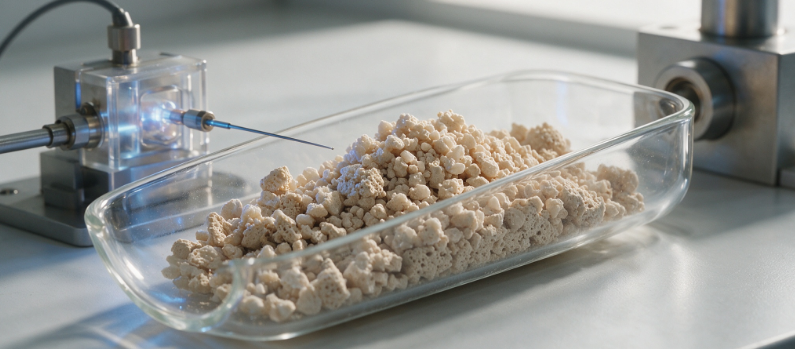
Strontium zirconate (SrZrO₃)—a perovskite‑type oxide with high thermal stability, mixed ionic‑electronic conductivity, and tunable surface acidity—has gained prominence as a catalyst or catalyst support in methane reforming, solid oxide fuel cells, oxidative coupling of methane, and photocatalytic applications. Its functional performance is intrinsically linked to phase purity, crystallinity, surface area, grain boundary chemistry, oxygen vacancy concentration, and the distribution of dopants (e.g., Y, Ce, Ni). Minor deviations in stoichiometry, secondary phase formation, or surface contamination can drastically alter catalytic activity, selectivity, and long‑term durability. Our laboratory offers a fully integrated, multi‑technique testing platform specifically designed for strontium zirconate‑based catalysts, combining high‑resolution structural analysis, quantitative elemental mapping, surface chemistry profiling, thermal stability assessment, and catalytic activity evaluation under realistic reaction conditions. We deliver quantitative, diagnostic, and predictive data that supports material synthesis optimisation, quality assurance, failure analysis, and scale‑up for academic research and industrial catalyst development.
Why Specialised Testing of SrZrO₃ Catalysts Is Critical for Reliable Performance
Researchers and catalyst manufacturers seeking SrZrO₃ testing often encounter challenges such as unexpected selectivity drift, rapid deactivation, or poor reproducibility between batches. These issues frequently originate from non‑stoichiometric cation ratios, incomplete perovskite phase formation, surface segregation of SrO or ZrO₂, or sintering of active sites. Furthermore, the oxygen non‑stoichiometry and defect chemistry of SrZrO₃ are highly sensitive to synthesis conditions (calcination temperature, precursor purity, doping level) and play a decisive role in catalytic performance. Our service provides a systematic characterisation that quantifies crystal structure (lattice parameters, phase purity), elemental composition (bulk and surface), specific surface area (BET), pore architecture, oxidation states of cations, and acid‑base properties. By identifying the root causes of performance deviations—such as Sr/Zr imbalance, carbon deposition, or phase transformation—we enable clients to refine synthesis protocols, select optimal dopants, and validate catalyst consistency for demanding catalytic processes.
Our Analytical Capabilities: From Crystal Structure to Catalytic Function
Our testing programme is structured into five interconnected modules, each addressing a critical dimension of SrZrO₃ catalyst behaviour:
Phase and structural analysis—We employ powder X‑ray diffraction (PXRD) with Rietveld refinement to determine the lattice parameters, crystallite size, and phase composition, detecting any secondary phases (Sr₂ZrO₄, ZrO₂, SrCO₃) down to 0.5 % w/w. High‑temperature XRD (up to 1000 °C) monitors phase stability and thermal expansion, while synchrotron XRD (available on request) provides enhanced sensitivity to local disorder and microstrain. Raman spectroscopy probes phonon modes and oxygen vacancy concentrations, complementing the structural analysis.
Elemental and chemical composition—We quantify bulk elemental composition (Sr, Zr, and dopants such as Y, Ce, Ni) using inductively coupled plasma optical emission spectrometry (ICP‑OES) after acid digestion, with accuracy ±0.5 % relative. X‑ray fluorescence (XRF) provides rapid non‑destructive screening. X‑ray photoelectron spectroscopy (XPS) with depth profiling (Ar⁺ sputtering) reveals surface enrichment or depletion of cations, oxidation states (Sr 3d, Zr 3d, O 1s), and the presence of adventitious carbon. Secondary ion mass spectrometry (SIMS) offers ultra‑trace impurity mapping and isotopic distribution.
Textural and surface characterisation—We measure specific surface area (BET) and pore size distribution (DFT/BJH) via N₂ physisorption at 77 K. Mercury intrusion porosimetry evaluates macroporosity. Scanning electron microscopy (SEM) with energy‑dispersive X‑ray spectroscopy (EDS) and high‑resolution transmission electron microscopy (HR‑TEM) visualise grain morphology, particle size, and any surface coatings or precipitates. Temperature‑programmed desorption (TPD) of NH₃ or CO₂ quantifies acidic and basic site densities—critical for understanding reaction mechanisms.
Thermal and reducibility testing—We perform Thermogravimetric Analysis (TGA) coupled with differential scanning calorimetry (DSC) in air and inert atmospheres (up to 1400 °C) to assess thermal stability, dehydration, and phase transitions. Temperature‑programmed reduction (TPR) with H₂ and oxygen storage capacity (OSC) measurements evaluate redox behaviour and oxygen mobility, which directly correlate with catalytic activity in oxidation‑reduction cycles.
Catalytic activity and stability assessment—We customise fixed‑bed or plug‑flow reactors to evaluate conversion, selectivity, and turnover frequency (TOF) for your target reaction (e.g., CO₂ reforming, methane oxidation, water‑gas shift). Operating conditions (temperature, pressure, space velocity, feed composition) are precisely controlled. Long‑term stability tests (up to 500 hours) are conducted to assess coking resistance, sintering, and deactivation mechanisms. Post‑reaction characterisation (XRD, BET, SEM, TGA) identifies structural and chemical changes, linking performance loss to specific degradation pathways.
High‑Level Mechanistic and Predictive Modelling
We integrate experimental data with density functional theory (DFT) calculations and microkinetic modelling to identify active sites and rate‑determining steps, providing mechanistic insights that guide catalyst design. Using multivariate statistical analysis (PCA, PLS), we correlate synthesis parameters (calcination temperature, doping level, ageing time) with catalytic performance metrics, enabling quality‑by‑design (QbD) optimisation. For diagnostic investigations, we combine post‑use characterisation with performance history to differentiate between sintering, phase segregation, carbon deposition, and poison accumulation as deactivation mechanisms.
Regulatory Compliance and Quality Assurance
All test methods adhere to ASTM, ISO, and relevant IUPAC guidelines for catalyst characterisation. Our laboratory is ISO/IEC 17025:2017 accredited for a broad scope of physicochemical testing. We issue certified test reports with full measurement uncertainty, traceability to NIST standards, and quality control data (reference materials, blanks, duplicates). For intellectual property or patent submissions, we provide comprehensive data packages with detailed experimental protocols.
Our Distinctive Advantages in Strontium Zirconate Catalyst Testing
Comprehensive perovskite expertise: Our team has decades of experience with perovskite‑based catalysts, including defect chemistry, doping strategies, and phase equilibria. We understand the subtle interplay between synthesis conditions and performance, enabling us to provide not just data, but targeted recommendations for formulation improvement.
Integrated structural‑chemical‑functional workflow: We perform all key analyses on identical sample batches, ensuring direct correlation between phase purity (XRD), surface composition (XPS), textural properties (BET), and catalytic activity. This holistic approach eliminates cross‑batch variability and provides a complete catalyst fingerprint.
Realistic reaction simulation: Our catalytic tests use realistic feed mixtures and process conditions to replicate industrial or application‑specific environments, ensuring that activity and selectivity data are directly transferable to your target process.
Advanced oxygen vacancy and redox characterisation: We combine TPR, TGA‑DSC, and in‑situ XPS to quantify oxygen non‑stoichiometry and redox dynamics—parameters that are often overlooked but critically govern catalytic function.
Fast turnaround and flexible sample requirements: Our standard full characterisation package is delivered within 10‑14 working days, with expedited 72‑hour service for key parameters (phase purity, BET, and basic activity screening). We handle powders, pellets, washcoated monoliths, and even spent catalysts, with sample masses as low as 100 mg.
End‑to‑End Service Workflow
We initiate each project with a complimentary technical consultation to define your catalyst composition, synthesis route, target reaction, and performance goals. We design a tailored test plan, advising on sampling and shipping (including inert atmosphere for air‑sensitive materials). Upon sample receipt, we perform inspection and preconditioning (drying, degassing). All tests are executed with strict QA/QC—reference standards, blanks, and replicate measurements. Data are integrated and reviewed by our lead materials scientist, then compiled into a comprehensive report containing XRD patterns, XPS spectra, BET isotherms, TPR profiles, catalytic activity curves, and a clear executive summary with optimisation recommendations. A post‑report meeting is offered to discuss findings and plan further development or scale‑up.
Partner with Us for Reliable, High‑Performance SrZrO₃ Catalysts
Strontium zirconate offers a robust platform for advanced catalysis, but its full potential can only be realised through rigorous, multi‑faceted characterisation. Our testing service provides the scientific depth, practical relevance, and regulatory support necessary to ensure your catalyst performs reliably and efficiently. We have supported industrial catalyst manufacturers, academic research groups, and national laboratories in optimising SrZrO₃‑based materials for methane reforming, SOFC, and environmental catalysis.
We invite you to contact our technical experts to discuss your specific testing needs—whether for new catalyst development, quality control, or failure analysis. With our advanced analytical instruments, accredited protocols, and specialised expertise, we provide the insights you need to perfect your strontium zirconate catalyst technology. Request a detailed proposal or schedule a technical consultation today and take the next step towards superior, data‑driven catalytic solutions.