Reasons for choosing our testing services
ZHONGXI Testing has obtained inspection qualification certifications from multiple countries and regions worldwide. We possess a senior testing team and advanced testing methods, providing independent, impartial, and professional third-party verification services for global carbon projects.

Internationally recognized authority
Certified by multiple international standards such as CNAS, VCS, and GS, with reports universally applicable worldwide.

Global service capability
Covering 140+ countries and regions, it supports on-site detection and remote verification in multiple languages.

Professional experimental methods
Adopt standard experimental methods to ensure accurate and reliable data.
Comprehensive Performance Testing of Porous Semi‑Coke Adsorbent Materials: Advanced Characterisation and Application Validation
Porous semi‑coke adsorbent materials—derived from the low‑temperature pyrolysis (carbonisation) of coal, lignite, biomass, or oil shale, followed by physical or chemical activation—have emerged as cost‑effective and sustainable adsorbents for wastewater treatment, flue gas desulphurisation, mercury capture, and organic pollutant removal. The semi‑coke matrix offers a unique combination of well‑developed micropore/mesopore structure, oxygen‑containing surface functional groups, and high mechanical strength, distinguishing it from conventional activated carbons. However, the performance of semi‑coke adsorbents is critically influenced by pyrolysis temperature, activation conditions, feedstock properties, and the degree of surface oxidation. Even minor variations in these parameters can lead to inconsistent adsorption capacity, poor resistance to attrition, or undesirable leaching of metals. Our laboratory offers a fully integrated, multi‑scale testing platform specifically designed for the rigorous characterisation of porous semi‑coke adsorbents, combining textural and structural analysis, surface chemical profiling, batch and dynamic adsorption studies, and mechanical durability assessment. We deliver quantitative, diagnostic, and predictive data that supports material development, quality assurance, process optimisation, and environmental compliance for water treatment, power generation, and industrial emission control sectors.
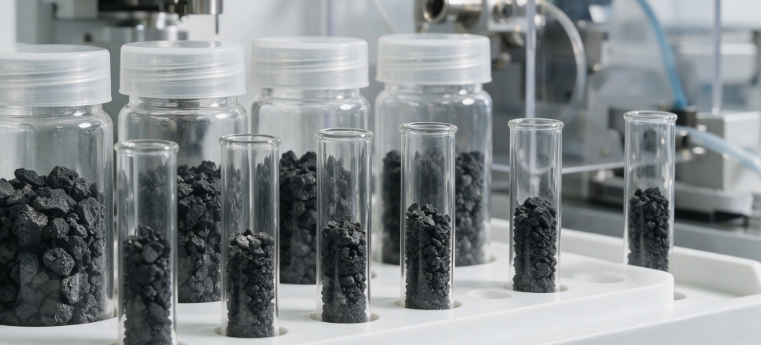
Why Rigorous Testing of Porous Semi‑Coke Adsorbents Is Essential for Reliable Performance in Challenging Environments
Clients seeking semi‑coke adsorbent testing often encounter challenges such as unexpectedly low contaminant uptake, rapid pressure‑drop build‑up in fixed‑bed systems, or high levels of ash‑related leaching. These issues frequently stem from incomplete activation leaving unreacted char, non‑uniform pore development, or the presence of volatile matter that blocks pores during use. Moreover, the heterogeneity of feedstocks (e.g., different coal ranks or biomass sources) makes batch‑to‑batch consistency a significant concern. Our service provides a systematic characterisation that quantifies specific surface area (BET), micropore and mesopore distribution, surface oxygen functional groups (XPS, Boehm titration), elemental composition (ash, volatile matter, fixed carbon), and adsorption performance for model pollutants (iodine number, methylene blue, heavy metals, phenols). By identifying the root causes of performance deficits—such as insufficient activation, pore blockage by tar residues, or surface oxidation—we enable clients to optimise pyrolysis and activation protocols, select appropriate feedstocks, and establish robust quality control parameters for consistent, high‑performance semi‑coke products.
Our Analytical Capabilities: From Feedstock Quality to Adsorption Dynamics and Mechanical Integrity
Our testing framework is structured into five interconnected modules, each addressing a critical aspect of porous semi‑coke adsorbent behaviour:
Proximate, ultimate, and mineralogical characterisation—We perform proximate analysis (moisture, ash, volatile matter, fixed carbon) per ASTM D7582, and ultimate analysis (CHNS/O) by combustion‑gas chromatography. X‑ray fluorescence (XRF) and inductively coupled plasma optical emission spectrometry (ICP‑OES) quantify major and trace inorganic elements (e.g., Si, Al, Fe, Ca, Mg, Na, K, S) that influence ash behaviour and potential leachability. X‑ray diffraction (XRD) identifies mineral phases in the ash (e.g., quartz, clay, pyrite). Thermogravimetric Analysis (TGA) in air and inert atmospheres (up to 1000 °C) evaluates thermal stability and oxidation reactivity.
Textural and surface characterisation—We determine specific surface area (BET), total pore volume, and pore size distribution (DFT/BJH for micropores and mesopores) via N₂ physisorption at 77 K, with special attention to the micropore contribution that governs adsorption of small molecules (e.g., SO₂, Hg⁰). Mercury intrusion porosimetry evaluates macroporosity and bulk density. Scanning electron microscopy (SEM) with EDS visualises particle morphology and elemental distribution. Boehm titration and temperature‑programmed desorption (TPD) quantify acidic and basic surface oxygen groups (carboxyl, phenolic, lactone, carbonyl), which are critical for polar and heavy metal adsorption.
Adsorption equilibrium and kinetics—We conduct batch equilibrium experiments using model pollutants: iodine (ASTM D4607) for total surface area assessment, methylene blue for mesopore accessibility, heavy metals (Pb²⁺, Cd²⁺, Cu²⁺, Hg²⁺) for cation adsorption, and phenol or methyl orange for organic removal. Tests are performed at controlled pH (3‑10), temperature (10‑50 °C), and background electrolyte to simulate real water matrices. Isotherms (Langmuir, Freundlich, Sips) are fitted to determine maximum capacity (Qₘ) and affinity constants, while kinetic data are fitted to pseudo‑first‑order, pseudo‑second‑order, and intraparticle diffusion models to identify rate‑limiting steps.
Dynamic column performance and hydraulic testing—We operate computer‑controlled fixed‑bed columns with variable flow rates, bed depths, and influent concentrations, using spiked groundwater or simulated flue gas streams to generate breakthrough curves. We extract exhaustion capacity, mass transfer zone (MTZ) length, and bed utilisation fraction. Pressure drop as a function of flow rate is measured to evaluate packing density and particle shape effects. We also assess the effect of particle size distribution on hydraulic performance.
Mechanical durability, attrition, and leachability testing—We perform attrition resistance using a rotating drum (ASTM D4058) or air‑jet attrition tester, measuring fines generation (mass % < 45 µm) and particle size degradation. Crush strength of individual particles is measured using a texture analyser. Leaching of metals (As, Pb, Cd, Cr, etc.) is conducted per EPA Method 1311 (TCLP) and EN 12457 to assess environmental safety in disposal or reuse scenarios.
High‑Level Predictive Modelling and Diagnostic Interpretation
We integrate adsorption and characterisation data with transport‑reaction models to predict column performance under variable operational conditions. Using multivariate statistical analysis (PCA, PLS), we correlate pyrolysis/activation parameters (temperature, time, activation agent) with key performance metrics (BET, adsorption capacity, attrition resistance), enabling quality‑by‑design (QbD) optimisation. For failure diagnosis, we combine post‑use characterisation (XRD, SEM, BET, TGA) with performance decline profiles to distinguish between pore blockage by metals/organics, ash sintering, and mechanical breakdown as degradation mechanisms.
Regulatory Compliance and Quality Assurance
All test methods are aligned with ASTM, ISO, and US EPA standards for activated carbon and adsorbent characterisation. Our laboratory is ISO/IEC 17025:2017 accredited for a wide scope of physicochemical and environmental testing. We provide certified test reports with full measurement uncertainty, traceability to NIST/CRM standards, and quality control data (reference materials, blanks, duplicates). For product certification and environmental compliance, we supply data packages meeting NSF/ANSI 61, EU REACH, and EPA Land Disposal Restrictions requirements.
Our Distinctive Advantages in Porous Semi‑Coke Adsorbent Testing
Feedstock‑to‑performance traceability: We link proximate/ultimate analysis and mineralogy (XRF, XRD) with activation behaviour and final adsorption performance, enabling you to select the best raw material and activation conditions for your target application. This end‑to‑end approach is rarely offered by standard testing labs.
Comprehensive pore characterisation for mixed adsorbates: We combine N₂ physisorption, mercury porosimetry, and probe molecule adsorption (iodine, methylene blue) to provide a complete picture of the pore hierarchy—from ultramicropores to macropores—essential for predicting performance in complex, multi‑pollutant streams.
Realistic dynamic testing with real matrices: Our column breakthrough tests use actual groundwater, wastewater, or simulated flue gases with relevant pH, ionic strength, and competing ions, ensuring that capacity and hydraulic data directly translate to field conditions.
Expert guidance for process optimisation: Our team includes fuel scientists and environmental engineers with deep experience in coal and biomass conversion. We provide specific, actionable recommendations—for example, optimising activation temperature to maximise BET without over‑oxidising the carbon surface, or adjusting particle size to balance adsorption kinetics and pressure drop.
Fast turnaround and flexible sample formats: Our standard full characterisation package is delivered within 10‑14 working days, with expedited 72‑hour screening for key parameters (BET, iodine number, and leachable metals). We handle powders, granules, pellets, and bulk samples with masses from 5 g to 5 kg.
End‑to‑End Service Workflow
We begin with a complimentary technical consultation to define your feedstock, activation method, target pollutants, and performance goals. We design a tailored test plan, advising on sample handling and shipping (e.g., sealed containers to prevent moisture uptake). Upon sample receipt, we perform preconditioning (drying, homogenisation). All tests are executed with strict QA/QC—reference materials, blanks, and replicates. Data are integrated and reviewed by our lead materials scientist, then compiled into a comprehensive report containing proximate/ultimate analysis, BET isotherms, adsorption isotherms/breakthrough curves, attrition data, leaching profiles, and a clear executive summary with optimisation recommendations. A post‑report meeting is offered to discuss findings and plan further development or scale‑up.
Partner with Us for Reliable, High‑Performance Semi‑Coke Adsorbent Solutions
Porous semi‑coke adsorbents offer a cost‑effective route to sustainable pollution control, but their performance hinges on thorough, science‑based characterisation. Our testing service provides the scientific depth, practical relevance, and regulatory support necessary to ensure your material performs effectively, safely, and consistently. We have supported coal conversion plants, water treatment companies, and environmental consultancies in developing and qualifying semi‑coke products for diverse applications.
We invite you to contact our technical experts to discuss your specific testing needs—whether for material screening, quality assurance, or troubleshooting. With our advanced analytical arsenal, accredited protocols, and deep domain expertise, we provide the insights you need to perfect your porous semi‑coke adsorbent technology. Request a detailed proposal or schedule a technical consultation today and take the next step towards superior, data‑driven adsorbent solutions.