Reasons for choosing our testing services
ZHONGXI Testing has obtained inspection qualification certifications from multiple countries and regions worldwide. We possess a senior testing team and advanced testing methods, providing independent, impartial, and professional third-party verification services for global carbon projects.

Internationally recognized authority
Certified by multiple international standards such as CNAS, VCS, and GS, with reports universally applicable worldwide.

Global service capability
Covering 140+ countries and regions, it supports on-site detection and remote verification in multiple languages.

Professional experimental methods
Adopt standard experimental methods to ensure accurate and reliable data.
Advanced Performance Testing of Porous Hydrogen Storage Materials: Comprehensive Characterisation for Energy Applications
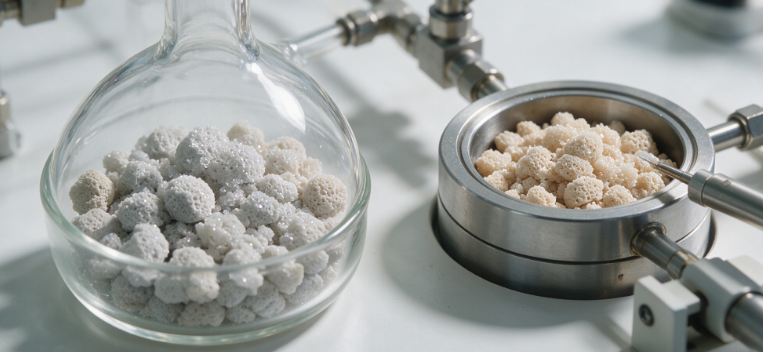
Porous hydrogen storage materials—including metal‑organic frameworks (MOFs), activated carbons, zeolites, covalent organic frameworks (COFs), and porous polymers—are at the forefront of solid‑state hydrogen storage for clean energy applications. The efficiency and viability of these materials depend on a delicate balance of gravimetric and volumetric hydrogen uptake, adsorption/desorption kinetics, working capacity, cyclic stability, and thermal management. Even minor variations in synthesis, activation, or pore architecture can lead to reduced storage capacity, poor reversibility, or slow charge/discharge rates, undermining their practical deployment. Our laboratory offers a fully integrated, multi‑scale testing platform specifically designed for the rigorous characterisation of porous hydrogen storage materials, combining high‑pressure gas adsorption, cryogenic surface area analysis, thermogravimetric differential scanning calorimetry, and advanced kinetic modelling. We deliver quantitative, diagnostic, and predictive data that supports material development, quality control, process optimisation, and system design for automotive, stationary, and portable energy storage applications.
Why Comprehensive Testing of Porous Hydrogen Storage Materials Is Essential for Reliable Performance and Commercial Viability
Clients seeking testing of these materials often encounter challenges such as lower‑than‑expected hydrogen uptake under operating conditions, slow adsorption kinetics, or irreversible capacity loss after cycling. These issues frequently arise from incomplete activation, pore collapse, metal clustering, or surface contamination. Furthermore, the trade‑off between gravimetric capacity and volumetric density, along with the influence of temperature, pressure, and impurity gases (e.g., H₂O, CO₂), makes accurate and comprehensive characterisation indispensable. Our service provides a systematic evaluation that quantifies excess and total hydrogen adsorption isotherms (0‑100 bar, 77‑300 K), isosteric heat of adsorption, surface area (BET) and micropore volume (DFT), kinetic uptake curves, and cyclic stability over hundreds of charge‑discharge cycles. By identifying the root causes of sub‑optimal performance—such as micropore blocking, insufficient activation, or thermal degradation—we enable clients to optimise synthesis conditions, select appropriate activation protocols, and screen candidate materials efficiently for targeted storage applications.
Our Analytical Capabilities: From Micropore Architecture to Dynamic Charge‑Discharge Performance
Our testing framework is structured into five interconnected modules, each addressing a critical dimension of hydrogen storage material behaviour:
Textural and structural characterisation—We determine specific surface area (BET), micropore volume, and pore size distribution (DFT/NLDFT) via N₂ and Ar physisorption at 77 K and 87 K, respectively, with particular focus on the ultramicropore (< 0.7 nm) region that governs H₂ binding at ambient temperatures. X‑ray diffraction (XRD) confirms crystallinity and phase purity of MOFs and COFs, while scanning electron microscopy (SEM) and transmission electron microscopy (TEM) visualise crystal morphology and textural defects. Thermogravimetric Analysis (TGA) coupled with mass spectrometry verifies solvent removal and thermal stability, and quantifies guest molecule content.
High‑pressure hydrogen adsorption and desorption—We operate state‑of‑the‑art volumetric (Sieverts) and gravimetric (magnetic suspension balance) instruments capable of measuring hydrogen adsorption isotherms at pressures from vacuum to 200 bar and temperatures from 77 K to 500 K. We generate excess and absolute adsorption isotherms, from which we derive gravimetric and volumetric storage capacities under practical operating conditions (e.g., 300 K, 100 bar). We also determine isosteric heat of adsorption (Qst) via Clausius‑Clapeyron analysis, providing insight into the strength of H₂ binding and the potential for ambient‑temperature storage.
Kinetic and cyclic performance evaluation—We perform pressure‑step and temperature‑step adsorption/desorption kinetics to quantify uptake rates and release profiles under realistic charge/discharge scenarios. Accelerated cycling tests (typically 100‑500 cycles) assess working capacity retention, hysteresis, and structural integrity under repeated pressure and temperature swings. Post‑cycling characterisation (BET, XRD, TEM) identifies degradation mechanisms such as framework collapse, metal oxidation, or pore contamination.
Low‑pressure and cryogenic H₂ adsorption—For fundamental characterisation, we measure H₂ isotherms at 77 K (and optionally 87 K) over the low‑pressure range (0‑1 bar) to calculate Langmuir surface area and micropore volume from the Dubinin‑Astakhov equation. This provides a direct benchmark of the material’s intrinsic H₂ affinity, complementing the high‑pressure data.
Impurity and contaminant tolerance testing—We evaluate the effect of trace water vapour, oxygen, and carbon dioxide on hydrogen uptake by exposing materials to controlled impurity levels and re‑measuring isotherms. This is crucial for assessing performance in real‑world gas streams where feed purity is not ideal.
High‑Level Diagnostic and Predictive Modelling
We integrate experimental isotherms and kinetics with molecular simulation (GCMC) and adsorption models (e.g., Langmuir, Tóth, Dubinin‑Astakhov) to predict storage performance under varied conditions and to guide material design. Using multivariate statistical analysis (PCA, PLS), we correlate synthesis parameters (linker/metal ratio, activation temperature, solvent choice) with key performance indicators (gravimetric capacity, working capacity, Qst), enabling quality‑by‑design (QbD) optimisation. For root‑cause failure analysis, we combine post‑cycling characterisation (XRD, BET, TGA‑MS) with performance data to distinguish between framework distortion, guest retention, and metal centre oxidation as primary degradation pathways.
Regulatory Compliance and Quality Assurance
All test methods are aligned with ASTM, ISO, and IEC standards for hydrogen storage materials, including ASTM D3953 (gas sorption) and ISO 1608 (vacuum measurement). Our laboratory is ISO/IEC 17025:2017 accredited for a broad scope of gas adsorption and materials characterisation. We issue certified test reports with full measurement uncertainty, traceability to NIST reference materials, and quality control data (reference adsorbents, blanks, duplicates). For system design and safety case submissions, we provide comprehensive data packages with full experimental protocols and raw data archives.
Our Distinctive Advantages in Porous Hydrogen Storage Material Testing
Wide pressure and temperature range: Our instruments cover vacuum to 200 bar and 77‑500 K, enabling full characterisation from fundamental low‑temperature screening to application‑relevant high‑pressure, ambient‑temperature measurements. This flexibility allows us to test a diverse range of materials—from cryogenic‑focused MOFs to ambient‑temperature metal hydrides and modified carbons.
Integrated gravimetric and volumetric capability: We operate both high‑pressure gravimetric (magnetic suspension) and volumetric (Sieverts) instruments, providing cross‑validated data and enabling accurate determination of excess and absolute adsorption—essential for interpreting storage performance in practical tanks.
Advanced cycling and stability diagnostics: Our automated cycling rigs allow long‑term operation without user intervention, generating statistically significant data on capacity fade and hysteresis. Coupled with post‑cycle characterisation, we provide a complete picture of material durability, which is often overlooked in routine screening.
Expert interpretation and material guidance: Our team includes adsorption scientists and chemists with decades of experience in porous materials. We provide specific, actionable recommendations—for example, identifying optimal activation temperature to maximise micropore accessibility, or suggesting linker functionalisation to enhance Qst without reducing pore volume.
Fast turnaround and flexible sample formats: Our standard full characterisation package (BET, high‑pressure isotherms at two temperatures, and basic kinetics) is delivered within 10‑14 working days, with expedited 72‑hour screening for key parameters (BET surface area and low‑pressure H₂ uptake). We handle powders, pellets, monoliths, and composites, with sample masses from 50 mg to 50 g.
End‑to‑End Service Workflow
We initiate each project with a complimentary technical consultation to define your material type, synthesis route, target operating conditions, and performance targets. We design a tailored test plan, including handling and shipping guidelines (e.g., inert atmosphere for moisture‑sensitive MOFs). Upon sample receipt, we perform receipt inspection and preconditioning (degassing, activation). All tests are executed with strict QA/QC—reference materials, blanks, and duplicates. Data are integrated and reviewed by our lead scientist, then compiled into a comprehensive report containing isotherms, kinetic curves, cycling data, and a clear executive summary with optimisation recommendations. A post‑report meeting is offered to discuss findings and plan further development or scale‑up.
Partner with Us for Reliable, High‑Performance Hydrogen Storage Solutions
Hydrogen storage materials are critical enablers of a clean energy future, and their development requires accurate, comprehensive, and predictive characterisation. Our testing service provides the scientific depth, practical relevance, and regulatory support necessary to accelerate your material development, improve quality, and reduce time‑to‑market. We have supported major automotive OEMs, energy companies, and research institutes in advancing their hydrogen storage technologies.
We invite you to contact our technical experts to discuss your specific testing needs—whether for material screening, quality control, or system optimisation. With our advanced analytical instruments, accredited protocols, and deep adsorption expertise, we provide the insights you need to unlock the full potential of your porous hydrogen storage materials. Request a detailed proposal or schedule a technical consultation today and take the next step towards superior, data‑driven storage solutions.