Reasons for choosing our testing services
ZHONGXI Testing has obtained inspection qualification certifications from multiple countries and regions worldwide. We possess a senior testing team and advanced testing methods, providing independent, impartial, and professional third-party verification services for global carbon projects.

Internationally recognized authority
Certified by multiple international standards such as CNAS, VCS, and GS, with reports universally applicable worldwide.

Global service capability
Covering 140+ countries and regions, it supports on-site detection and remote verification in multiple languages.

Professional experimental methods
Adopt standard experimental methods to ensure accurate and reliable data.
Comprehensive Analytical Testing of Silica‑Modified Silica Sand: Advanced Characterisation for Performance and Quality Assurance
Silica‑modified silica sand—produced by controlled surface deposition or coating of amorphous or crystalline silica (SiO₂) onto natural silica sand grains—is a critical engineered material for water filtration, foundry moulding, oil and gas proppants, glass manufacturing, and high‑performance concrete aggregates. The modification process aims to enhance properties such as surface chemistry, abrasion resistance, thermal stability, and chemical inertness. However, the efficacy of the modification depends on a complex interplay of coating uniformity, thickness, adhesion strength, porosity, and the preservation of grain integrity. Even minor deviations in coating conditions can lead to inconsistent surface functionality, reduced mechanical strength, or undesired leaching of impurities, compromising the material's performance in its target application. Our laboratory provides a fully integrated, multi‑technique testing platform specifically designed for the rigorous characterisation of silica‑modified silica sand, combining surface and morphological analysis, chemical composition profiling, mechanical property evaluation, and application‑specific performance testing. We deliver quantitative, diagnostic, and predictive data that supports material development, quality control, process optimisation, and regulatory compliance for the mining, construction, oilfield, and industrial materials sectors.
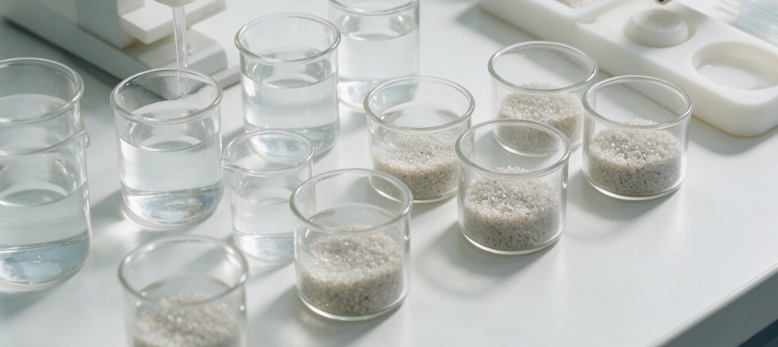
Why Dedicated Testing of Silica‑Modified Silica Sand Is Essential for Ensuring Product Consistency and Performance
Clients seeking testing of silica‑modified sand often encounter challenges such as unexpected loss of coating integrity during handling, poor performance in filtration or proppant applications, or batch‑to‑batch variability in surface properties. These issues frequently stem from non‑uniform silica deposition, inadequate bonding between the coating and the substrate, or contamination from unreacted precursors. Moreover, the presence of residual organics, metal oxides, or crystalline silica phases can affect reactivity and safety (e.g., respirable crystalline silica). Our service provides a systematic characterisation that quantifies coating thickness and morphology (SEM‑EDS, TEM), surface area and pore structure (BET), surface chemistry (XPS, FTIR), elemental composition (XRF, ICP‑OES), attrition resistance, particle size distribution, and leachability (TCLP). By identifying the root causes of sub‑standard performance—such as incomplete coverage, excessive porosity, or phase transformation—we enable clients to optimise deposition parameters, select appropriate precursor materials, and establish robust quality control metrics for consistent, high‑quality modified sand products.
Our Analytical Capabilities: From Surface Coating Integrity to Bulk Mechanical Behaviour
Our testing framework is structured into five interconnected modules, each addressing a critical dimension of silica‑modified sand quality and functionality:
Surface and morphological characterisation—We employ field‑emission scanning electron microscopy (FE‑SEM) with energy‑dispersive X‑ray spectroscopy (EDS) to visualise the silica coating morphology, measure film thickness, and assess coverage uniformity at the micro‑scale. Transmission electron microscopy (TEM) provides cross‑sectional views of the coating‑substrate interface, revealing adhesion quality and any interfacial defects. Atomic force microscopy (AFM) quantifies surface roughness and topographical changes after modification. X‑ray photoelectron spectroscopy (XPS) with depth profiling provides the chemical state of surface silicon and oxygen, and identifies any organic residues or contaminants.
Compositional and phase analysis—We determine bulk elemental composition (Si, O, Al, Fe, Ca, etc.) by X‑ray fluorescence (XRF) and inductively coupled plasma optical emission spectrometry (ICP‑OES) after acid digestion. X‑ray diffraction (XRD) identifies the crystalline phases (quartz, cristobalite, or amorphous silica) and detects any new phases formed during modification. Thermogravimetric Analysis (TGA) quantifies the amount of amorphous silica coating (via weight loss upon etching or thermal treatment) and identifies volatile components.
Textural and surface area assessment—We measure specific surface area (BET) and pore size distribution (DFT/BJH) via N₂ physisorption at 77 K. This is crucial for understanding the accessibility of the modified surface and predicting adsorption behaviour in filtration and chromatography applications. Mercury intrusion porosimetry evaluates macroporosity and the inter‑particle void structure.
Mechanical and attrition resistance testing—We quantify coating adhesion by performing scratch testing or ultrasonic immersion followed by re‑characterisation (SEM, XPS) to assess delamination. Attrition resistance is measured using a rotating drum (ASTM D4058) or fluidised‑bed attrition tester, quantifying fines generation and particle degradation. Crush strength of individual grains is determined using a micro‑compression tester, providing insight into the mechanical robustness of the coated particles.
Application‑oriented performance and leaching tests—We conduct dynamic flow tests in columns to simulate filtration or proppant performance, measuring pressure drop and fines migration. For water treatment applications, we evaluate adsorption capacity for model contaminants (e.g., heavy metals, oils). Leaching of trace metals and silica is performed per EPA Method 1311 (TCLP) and EN 12457 to assess environmental safety and compliance with drinking water standards. We also measure pH change and conductivity of water in contact with the modified sand to evaluate chemical stability.
High‑Level Diagnostic and Predictive Modelling
We integrate coating morphology, surface chemistry, and mechanical data to build structure‑property‑performance relationships—for example, linking coating thickness to attrition resistance, or correlating surface silanol density (from XPS) with contaminant adsorption capacity. Using multivariate statistical analysis (PCA, PLS), we identify the critical synthesis parameters (precursor concentration, deposition time, curing temperature) that govern final product quality, enabling quality‑by‑design (QbD) optimisation. For failure analysis, we combine post‑use characterisation (SEM, XPS, BET) with performance history to differentiate between coating abrasion, chemical degradation, and particle breakage as failure mechanisms.
Regulatory Compliance and Quality Assurance
All test methods are aligned with ASTM, ISO, and US EPA standards for silica sand, coated materials, and environmental leaching. Our laboratory is ISO/IEC 17025:2017 accredited for a wide scope of materials and environmental testing. We provide certified test reports with full measurement uncertainty, traceability to NIST/CRM standards, and quality control data (reference materials, blanks, duplicates). For product certification (e.g., NSF/ANSI 61 for water contact), we supply comprehensive data packages meeting regulatory requirements.
Our Distinctive Advantages in Silica‑Modified Silica Sand Testing
Comprehensive surface‑to‑bulk characterisation: We combine XPS, FE‑SEM, TEM, and BET on the same sample batch, enabling direct correlation between surface chemistry, morphology, porosity, and mechanical integrity—a holistic view essential for understanding the coating performance under real‑world conditions.
Realistic performance simulation: Our dynamic column tests and attrition simulators replicate handling and in‑service conditions, ensuring that our data accurately predict field behaviour, not just laboratory‑scale properties.
Advanced coating integrity diagnostics: We offer ultrasonic and thermal cycling tests followed by quantitative imaging (SEM) to assess coating adhesion under accelerated stress, providing predictive insight into long‑term durability.
Expert guidance for process improvement: Our team includes surface and colloid chemists with extensive industrial experience. We provide specific, actionable recommendations—for example, optimising the sol‑gel reaction pH to achieve maximum surface coverage, or adjusting the curing temperature to enhance coating density without causing particle agglomeration.
Fast turnaround and flexible sample formats: Our standard full characterisation package is delivered within 7‑10 working days, with expedited 48‑hour screening for key parameters (coating thickness, BET, and attrition). We handle sands, gravels, and powders with particle sizes from 100 µm to 5 mm, and sample masses from 100 g to 10 kg.
End‑to‑End Service Workflow
We initiate each project with a complimentary technical consultation to define your modification process, target application, and critical quality attributes. We design a tailored test plan, advising on sampling, packaging, and shipping. Upon sample receipt, we perform receipt inspection and preconditioning (drying, homogenisation). All tests are executed with strict QA/QC—reference materials, blanks, and replicates. Data are integrated and reviewed by our lead materials scientist, then compiled into a comprehensive report containing SEM images, XPS spectra, BET isotherms, attrition data, leaching profiles, and a clear executive summary with optimisation recommendations. A post‑report meeting is offered to discuss findings and plan further development or scale‑up.
Partner with Us for Reliable, High‑Performance Silica‑Modified Sand Solutions
Silica‑modified silica sand is a versatile engineered material, but its successful deployment hinges on thorough, multi‑dimensional characterisation. Our testing service provides the scientific depth, practical realism, and regulatory support necessary to ensure your product meets the highest standards of performance and safety. We have supported mining companies, water treatment equipment manufacturers, and oilfield service providers in qualifying and optimising their coated sand products.
We invite you to contact our technical experts to discuss your specific testing needs—whether for material screening, quality assurance, or troubleshooting. With our advanced analytical arsenal, accredited protocols, and specialised expertise, we provide the insights you need to perfect your silica‑modified sand technology. Request a detailed proposal or schedule a technical consultation today and take the next step towards superior, data‑driven materials solutions.