Reasons for choosing our testing services
ZHONGXI Testing has obtained inspection qualification certifications from multiple countries and regions worldwide. We possess a senior testing team and advanced testing methods, providing independent, impartial, and professional third-party verification services for global carbon projects.

Internationally recognized authority
Certified by multiple international standards such as CNAS, VCS, and GS, with reports universally applicable worldwide.

Global service capability
Covering 140+ countries and regions, it supports on-site detection and remote verification in multiple languages.

Professional experimental methods
Adopt standard experimental methods to ensure accurate and reliable data.
Comprehensive Performance Testing of Carbon‑Based Mycotoxin Adsorbents: Advanced Characterisation and Application Validation
Carbon‑based mycotoxin adsorbents—including activated carbons, biochars, modified carbon blacks, and composite carbon‑clay materials—are critical for the detoxification of aflatoxins, ochratoxin A, zearalenone, deoxynivalenol (DON), fumonisins, and other mycotoxins in animal feed, food processing, and fermentation streams. The effectiveness of these adsorbents hinges on a precise combination of high surface area, appropriate pore size distribution (to match toxin molecular dimensions), surface functional groups capable of hydrogen bonding and π‑π stacking, and resistance to gastrointestinal pH and enzymatic attack. However, the complexity of mycotoxin mixtures, the presence of co‑contaminants, and the variability of feed matrices present significant challenges in adsorbent selection and performance prediction. Our laboratory offers a fully integrated, multi‑scale testing platform specifically designed for the rigorous evaluation of carbon‑based mycotoxin adsorbents, combining physicochemical characterisation, single‑ and multi‑toxin adsorption isotherms, competitive binding studies, in‑vitro gastrointestinal simulation, and long‑term stability/regeneration testing. We deliver quantitative, diagnostic, and predictive data that supports product development, quality control, feed safety compliance, and regulatory approval for the animal nutrition, food safety, and biotechnology industries.
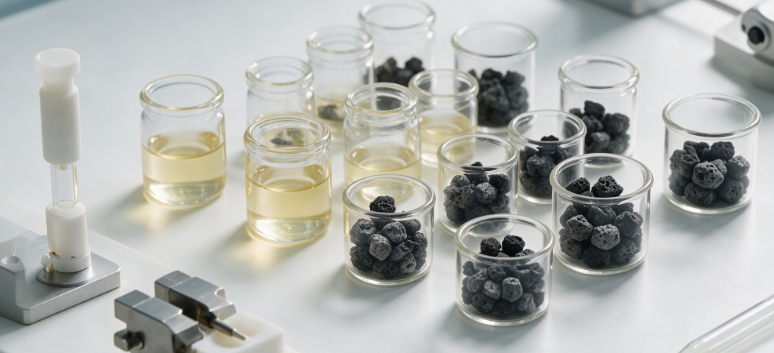
Why Dedicated Testing of Carbon‑Based Mycotoxin Adsorbents Is Essential for Feed and Food Safety
Clients seeking mycotoxin adsorbent testing frequently encounter challenges such as unexpectedly low aflatoxin binding under acidic pH, poor DON adsorption due to size exclusion, or rapid desorption of toxins in the intestinal tract. These issues often stem from sub‑optimal pore architecture that cannot accommodate larger mycotoxins, insufficient surface polarity, or inadequate binding strength. Moreover, the competitive adsorption of vitamins, amino acids, and other feed components can compromise the efficacy of the adsorbent. Our service provides a systematic characterisation that quantifies equilibrium binding capacities (mg/g) for individual and mixed mycotoxins, affinity constants, desorption rates in simulated gastrointestinal fluids, and the effect of feed matrix components on binding efficiency. By identifying the root causes of performance deficits—such as pore blockage, electrostatic repulsion, or weak hydrophobic interactions—we enable clients to optimise carbon‑activation processes, tailor surface chemistry, and develop effective formulation strategies for reliable and safe mycotoxin management.
Our Analytical Capabilities: From Pore Architecture to Dynamic Gut Simulation and Multi‑Toxin Competition
Our testing framework is structured into five interconnected modules, each addressing a critical dimension of mycotoxin adsorbent behaviour:
Physicochemical and textural characterisation—We determine specific surface area (BET), total pore volume, and pore size distribution (DFT/BJH) via N₂ physisorption at 77 K, paying special attention to the micropore (< 2 nm) and mesopore (2‑50 nm) ranges that correspond to mycotoxin molecular dimensions (e.g., aflatoxin B₁ ~0.7 nm, zearalenone ~1.2 nm). X‑ray photoelectron spectroscopy (XPS) and Fourier‑transform infrared spectroscopy (FTIR‑ATR) characterise surface functional groups (carboxyl, hydroxyl, lactone, carbonyl) that govern binding affinity. X‑ray diffraction (XRD) identifies graphitic and amorphous carbon phases. Thermogravimetric Analysis (TGA) quantifies volatile and ash content, while Boehm titration provides acidic/basic functional group densities.
Single‑toxin adsorption isotherms and kinetics—We perform batch equilibrium experiments with individual mycotoxins (aflatoxin B₁, ochratoxin A, zearalenone, DON, fumonisin B₁, and T‑2 toxin) at pH conditions simulating both stomach (pH 2‑3) and intestine (pH 6‑7). Using HPLC‑MS/MS or ELISA for quantification, we generate isotherms (Langmuir, Freundlich, Sips) and kinetic profiles (pseudo‑first‑order, pseudo‑second‑order, intraparticle diffusion) to determine maximum binding capacity (Q₀), affinity constants, and rate‑limiting steps. We also evaluate the effect of temperature (4‑40 °C) to assess adsorption thermodynamics.
Multi‑toxin competitive adsorption and matrix interference—We conduct binary and ternary competition experiments to measure selectivity coefficients and binding reduction factors in the presence of co‑occurring mycotoxins. We also evaluate the influence of typical feed matrix components (proteins, carbohydrates, minerals, vitamins) on toxin binding, using spiked feed extracts to simulate real‑world conditions. In‑vitro gastrointestinal simulation (with pepsin at pH 2, then pancreatin/bile at pH 6.5) is used to assess desorption and stability of the toxin‑adsorbent complex under conditions mimicking monogastric digestion.
Dynamic flow‑through and column performance—We operate packed‑bed columns with mycotoxin‑spiked feed extract or buffer, measuring breakthrough curves to derive dynamic capacity, mass transfer zone (MTZ) length, and utilisation efficiency. This simulates the actual passage of feed through the adsorbent, providing data relevant to in‑feed applications or downstream processing.
Regeneration, reusability, and stability testing—We evaluate thermal, solvent, or pH‑swing regeneration methods, measuring capacity recovery and structural integrity over multiple cycles by post‑cycle BET, XRD, and XPS. Accelerated ageing under elevated temperature and humidity assesses shelf‑life stability. We also test leaching of carbon fines or chemical components into aqueous media by TOC and ICP‑MS to ensure safety and compliance.
High‑Level Predictive Modelling and Diagnostic Interpretation
We integrate equilibrium, kinetic, and competitive adsorption data with molecular modelling (DFT, Monte Carlo) to predict binding mechanisms and to guide the design of optimal pore structures and surface functionalities. Using multivariate statistical analysis (PCA, PLS), we correlate synthesis parameters (activation temperature, chemical treatment, particle size) with key performance indicators (aflatoxin capacity, DON selectivity, gut stability), enabling quality‑by‑design (QbD) optimisation. For failure diagnosis, we combine post‑use characterisation (XPS, FTIR, BET) with binding decline profiles to differentiate between pore blockage, functional group deactivation, and surface oxidation as primary degradation mechanisms.
Regulatory Compliance and Quality Assurance
All test methods are aligned with ISO, AOAC, and EU/US regulatory guidelines for mycotoxin analysis and feed additive testing, including Commission Regulation (EC) No 401/2006 and US FDA CPG Sec 683.100. Our laboratory holds ISO/IEC 17025:2017 accreditation for a wide scope of food and feed safety testing. We issue certified test reports with full measurement uncertainty, traceability to NIST/CRM reference materials, and quality control data (reference adsorbents, blanks, duplicate runs). For product registration (e.g., EU Feed Additive Authorisation, FDA GRAS), we provide comprehensive data packages with detailed protocols and raw data archives.
Our Distinctive Advantages in Carbon‑Based Mycotoxin Adsorbent Testing
Comprehensive multi‑toxin and gut simulation capability: We uniquely combine competitive multi‑toxin binding, matrix interference assessment, and in‑vitro gastrointestinal simulation in a single workflow, providing a true measure of real‑world efficacy—not just single‑toxin, buffer‑only capacities. This depth is essential for feed additive qualification.
Integrated structure‑activity‑stability correlation: We perform XPS, FTIR, BET, and binding assays on the same sample batch, enabling direct correlation between surface functional groups, pore structure, and mycotoxin affinity. This holistic approach eliminates cross‑batch variability and provides robust design parameters.
Realistic matrix simulation: Our binding tests are conducted in actual feed extracts and simulated gastrointestinal fluids with controlled enzymatic activity, ensuring that performance data directly translates to field conditions, not idealised laboratory buffers.
Expert guidance for product optimisation: Our team includes food chemists, animal nutritionists, and adsorption scientists with deep experience in mycotoxin management. We provide specific, actionable recommendations—for example, optimising activation conditions to enhance mesoporosity for DON binding, or adjusting surface polarity to improve affinity for zearalenone without compromising aflatoxin capacity.
Fast turnaround and flexible sample formats: Our standard full characterisation and performance package is delivered within 10‑14 working days, with expedited 48‑hour screening for key parameters (aflatoxin binding capacity and gut stability). We handle powders, granules, and encapsulated formulations with sample masses as low as 1 g.
End‑to‑End Service Workflow
We begin with a complimentary technical consultation to define your target mycotoxin profile, feed matrix, and performance targets. We design a customised test plan, advising on handling and shipping (e.g., sealed containers to prevent contamination). Upon sample receipt, we perform preconditioning (drying, degassing). All tests are executed with strict QA/QC—reference adsorbents, blanks, and duplicates. Data are integrated and reviewed by our lead scientist, then compiled into a comprehensive report containing isotherms, competitive binding matrices, gut simulation profiles, and a clear executive summary with optimisation recommendations. A post‑report meeting is offered to discuss findings and plan further development or regulatory submission.
Partner with Us for Reliable Mycotoxin Management Solutions
Mycotoxin contamination poses serious health risks and economic losses, and the performance of carbon‑based adsorbents is central to effective detoxification. Our testing service provides the scientific depth, practical realism, and regulatory support needed to select, qualify, and optimise adsorbents for feed and food safety applications. We have supported leading animal nutrition companies, feed additive developers, and regulatory bodies in ensuring the efficacy and safety of mycotoxin adsorbent products.
We invite you to contact our technical experts to discuss your specific testing needs—whether for product development, quality control, or regulatory approval. With our advanced analytical capabilities, accredited protocols, and deep domain expertise, we provide the clarity and confidence you need to protect animal health and human food chains. Request a detailed proposal or schedule a technical consultation today and take the next step towards robust, science‑based mycotoxin adsorbent solutions.