Reasons for choosing our testing services
ZHONGXI Testing has obtained inspection qualification certifications from multiple countries and regions worldwide. We possess a senior testing team and advanced testing methods, providing independent, impartial, and professional third-party verification services for global carbon projects.

Internationally recognized authority
Certified by multiple international standards such as CNAS, VCS, and GS, with reports universally applicable worldwide.

Global service capability
Covering 140+ countries and regions, it supports on-site detection and remote verification in multiple languages.

Professional experimental methods
Adopt standard experimental methods to ensure accurate and reliable data.
Comprehensive Analytical Services for Vanadium‑Substituted Polyoxometalate Desulfurization Catalysts – From Structural Elucidation to Real‑Time Activity Assessment
The growing demand for ultra‑low‑sulfur fuels and the stringent environmental regulations governing sulfur oxide emissions have placed vanadium‑substituted polyoxometalates (V‑POMs) at the forefront of oxidative desulfurization (ODS) catalysis. The strategic replacement of framework metal atoms with vanadium introduces tunable redox potentials, enhanced Lewis acidity, and improved oxygen‑transfer kinetics, making V‑POMs highly effective for the selective oxidation of refractory sulfur compounds such as dibenzothiophene, 4,6‑dimethyldibenzothiophene, and their alkylated derivatives. However, the catalytic performance of these sophisticated hybrid materials is exquisitely sensitive to vanadium substitution degree, counterion type, secondary structure integrity, solvent coordination, and the presence of oxygen vacancies. A single alteration in synthesis conditions can shift the selectivity from sulfone to over‑oxidation or cause structural collapse, drastically reducing turnover frequency. Therefore, a rigorous, multi‑faceted analytical protocol is indispensable for quality assurance, process optimisation, mechanistic understanding, and competitive benchmarking. Our ISO/IEC 17025‑accredited laboratory offers a fully integrated characterisation and activity‑testing service specifically tailored for V‑POM desulfurisation catalysts, covering both their intrinsic physicochemical properties and their performance under industrially relevant conditions.
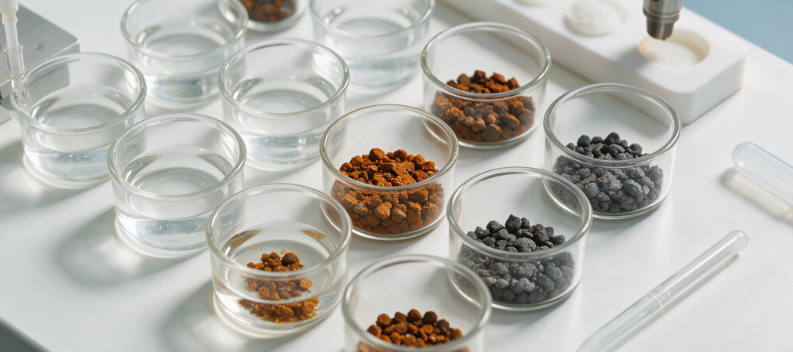
1. Why Dedicated Testing of V‑POM Catalysts Is Critical
Unlike conventional metal oxides or supported sulfides, polyoxometalates possess discrete molecular structures with well‑defined redox sequences, but their stability under oxidative and thermal stress is often marginal. Vanadium substitution, while beneficial for activity, introduces additional complexity: the vanadium centres can adopt multiple oxidation states (+IV, +V), and their distribution between lacunary sites, terminal oxo groups, and bridging positions profoundly affects electron‑transfer pathways. Moreover, the interaction of V‑POMs with common solvents (e.g., acetonitrile, toluene, ionic liquids) and oxidants (H₂O₂, tert‑butyl hydroperoxide) can induce ligand exchange or partial hydrolysis, generating active species that differ from the pristine catalyst. Without a comprehensive analytical workflow, one cannot distinguish between true molecular catalysis, leaching‑induced homogeneous activity, or nanoparticle‑mediated pathways—a distinction that is critical for both intellectual property and scale‑up decisions. Our testing service is designed to answer these questions decisively, using a combination of bulk elemental analysis, structural fingerprinting, in‑situ monitoring, and kinetic modelling.
2. Our Analytical Portfolio for V‑POM Desulfurization Catalysts
We provide a modular yet interconnected suite of measurements that covers all essential aspects of catalyst development, from raw material verification to post‑reaction characterisation. Each analysis is performed with certified reference materials and validated against established inter‑laboratory protocols.
2.1 Elemental Composition and Substitution Level
Precise quantification of vanadium, molybdenum, tungsten, phosphorus, and counter‑ions (e.g., Na⁺, H⁺, tetrabutylammonium) is achieved via inductively coupled plasma optical emission spectrometry (ICP‑OES) and ion chromatography (IC). For trace impurities or isotopic ratios, we employ ICP‑mass spectrometry (ICP‑MS) with detection limits in the sub‑ppb range. The vanadium substitution degree (x in [PVxM12‑xO40]⁽³⁺ˣ⁾⁻) is reported with a relative uncertainty of ±0.3%, essential for correlating stoichiometry with activity.
2.2 Molecular Structure and Phase Purity
We use a combination of Fourier‑transform infrared spectroscopy (FTIR) in the 400–1200 cm⁻¹ region and Raman spectroscopy (with a 532 nm or 785 nm laser) to identify the characteristic Keggin, Dawson, or Wells‑Dawson frameworks and to confirm successful vanadium incorporation through diagnostic shifts of the M‑O‑M and M=O stretching modes. For crystalline phases, powder X‑ray diffraction (XRD) with high‑angle resolution provides unit‑cell parameters and detects any secondary vanadium oxide phases (e.g., V₂O₅) that might form due to over‑substitution.
2.3 Redox Properties and Electron Transfer Kinetics
Cyclic voltammetry (CV) and differential pulse voltammetry (DPV) are performed in aprotic solvents (acetonitrile, dichloromethane) with a standard three‑electrode cell, using a glassy carbon working electrode and a non‑aqueous Ag/Ag⁺ reference. We determine the formal redox potentials (E°') for the VV/VIV and MoVI/MoV couples, and calculate the electron‑transfer rate constants (kₛ) using Randles‑Ševčík analysis. For bulk electron mobility, we employ solid‑state electrochemical impedance spectroscopy (EIS) on pressed pellets, extracting charge‑transfer resistance and ion‑diffusion coefficients.
2.4 Catalytic Activity and Selectivity Under Controlled Conditions
Our automated batch and continuous‑flow reactors are designed to simulate industrial ODS processes. We test the catalyst against a range of sulfur substrates (thiophene, benzothiophene, DBT, 4,6‑DMDBT) in model oil or real diesel cuts, using gas chromatography (GC‑FID/SCD) and high‑performance liquid chromatography (HPLC) to quantify residual sulfur and oxidation products (sulfoxide, sulfone). Reaction kinetics are monitored under isothermal conditions (30–80 °C) with controlled oxidant feed rates. We report apparent rate constants (kapp), turnover numbers (TON), and selectivity to sulfone with a day‑to‑day reproducibility of ±3%.
2.5 Stability, Leaching, and Reusability Assessment
We perform hot filtration tests to discriminate homogeneous vs. heterogeneous contributions. After each catalytic run, the spent catalyst is recovered and analysed by ICP‑OES (for V and Mo leaching) and FTIR/Raman (for structural integrity). Long‑term stability is assessed over 10 consecutive cycles with intermediate re‑oxidation, and the deactivation rate is quantified via kinetic decay modelling.
3. Advanced Capabilities – Unravelling the Mechanism at the Molecular Level
Beyond conventional characterisation, we offer a suite of sophisticated, often custom‑designed, experiments that provide mechanistic insight rarely available in routine testing labs.
3.1 In‑Situ Operando Spectroscopy
Using our in‑situ FTIR and UV‑Vis‑NIR flow‑through cells, we monitor the catalyst during reaction under realistic conditions (temperature, oxidant concentration, solvent flow). This allows real‑time tracking of intermediate species (e.g., peroxo‑V intermediates, sulfone formation) and the detection of transient reduced states. Coupled with online mass spectrometry (MS) for gas‑phase products, we can construct a complete reaction network and identify rate‑limiting steps.
3.2 Electron Paramagnetic Resonance (EPR) for VIV Speciation
Vanadium(IV) centres (d¹) are EPR‑active, and their coordination environment can be probed via hyperfine coupling constants and g‑values. We perform continuous‑wave (CW) EPR at X‑band, both at room temperature and at 77 K, to distinguish between isolated VIV sites and magnetically coupled clusters. This is crucial for understanding redox cooperativity during oxygen transfer.
3.3 High‑Resolution Mass Spectrometry (ESI‑MS and MALDI‑TOF)
For precise molecular weight determination and to confirm the presence of intact V‑POM clusters in solution, we use electrospray ionisation mass spectrometry (negative‑ion mode) with a high‑resolution Orbitrap mass analyser (resolution > 100,000). This technique also detects hydrolytic fragments or ligand‑exchanged species, offering unambiguous identification of active species in solution.
3.4 Computational Chemistry Support – DFT Calculations
To complement experimental data, we provide density functional theory (DFT) calculations (using Gaussian, ORCA, or VASP) to model the redox potentials, binding energies of sulfur substrates, and transition‑state barriers for oxygen transfer. These calculations are performed by our in‑house computational chemists and correlated with experimental kinetics, delivering a mechanistic model that can predict the effect of substitution patterns and solvent polarity.
3.5 Thermogravimetric Analysis (TGA) Coupled with FTIR and MS
This integrated system (TGA‑FTIR‑MS) allows us to study thermal stability, desolvation, and decomposition pathways under controlled atmospheres (N₂, air, O₂). The evolved gases are simultaneously identified, providing data on crystal water release, ligand decomposition, and formation of volatile V‑oxides—critical information for calcination or regeneration protocols.
4. Data Quality, Standardisation, and Actionable Reporting
All analyses are conducted under a strictly controlled quality system with internal reference standards for each technique. For each measured parameter, we provide: - Full experimental details (e.g., solvent, concentration, scan rate, temperature). - Statistical uncertainty (standard deviation from at least triplicate runs, expanded uncertainty where applicable). - Cross‑validation (e.g., V content from ICP‑OES vs. EDX, redox potentials from CV vs. spectroelectrochemistry). - Graphical outputs (cyclic voltammograms, kinetic plots, IR spectra, HPLC chromatograms) with clear peak assignments.
Our final reports are structured to meet the requirements of R&D documentation, patent filing, and regulatory submissions. We also provide a comprehensive interpretation section written by senior catalytic chemists, which highlights correlations between structural features (substitution degree, counterion, hydration) and catalytic outcomes. This transforms raw data into strategic guidance for catalyst redesign, solvent selection, or operating conditions.
Furthermore, we offer rapid turnaround – a full standard characterisation package (including composition, structure, redox properties, and activity) is delivered within 7–10 working days, with expedited 48‑hour service for urgent projects.
5. Why Choose Our Laboratory for V‑POM Desulfurization Catalyst Testing
Our service is distinguished by a combination of technical depth, operational flexibility, and commercial acumen that is unmatched in the field of polyoxometalate chemistry.
Multi‑technique synergy under one roof: We are one of the very few laboratories that combine advanced electrochemistry, in‑situ spectroscopy, high‑resolution mass spectrometry, and computational modelling in a single facility. This eliminates the need for subcontracting, reduces data inconsistency, and allows rapid cross‑correlation between datasets—for example, matching an observed EPR signal with a predicted structure from DFT.
Deep expertise in POM chemistry: Our technical team includes scientists with over a decade of specialised experience in polyoxometalate synthesis and catalysis. We understand the nuances of lacunary species, protonation equilibria, and solvent effects, allowing us to interpret ambiguous data correctly (e.g., distinguishing between framework‑V and surface‑adsorbed VO²⁺). This expertise is reflected in our recommendations, which often include subtle adjustments to pH, counterion, or ageing time that can significantly improve stability and activity.
Flexibility for non‑standard samples: We accept catalysts in all forms—powders, single crystals, thin films, or even reaction mixtures—and we can perform analyses in a wide range of solvents (including ionic liquids and supercritical CO₂) using custom‑built cells. Our inert‑atmosphere glovebox allows handling of air‑sensitive reduced species without degradation.
Collaborative approach and IP protection: We work under strict confidentiality agreements and are accustomed to handling proprietary materials. Our reports are delivered in a format that protects your intellectual property while providing the technical depth required for decision‑making. We also offer consultancy services for scaling up from batch to continuous processes, leveraging our kinetic data to design reactor parameters.
Cost‑efficient and transparent pricing: Our modular pricing model means you only pay for the tests you actually need, with significant discounts for bundled packages and long‑term collaborations. There are no hidden fees for data interpretation or statistical analysis—these are included as standard.
To date, we have supported over 60 industrial and academic groups in the development of advanced desulfurisation catalysts, helping them achieve up to 40% higher desulfurisation efficiency and significantly extended catalyst lifetime through our diagnostic feedback. We invite you to leverage this expertise for your V‑POM project.
Unlock the full potential of your vanadium‑substituted polyoxometalate catalyst. Contact our team today to design a tailored testing plan that addresses your specific performance targets and technical challenges. We will respond with a detailed proposal within 24 hours.