Reasons for choosing our testing services
ZHONGXI Testing has obtained inspection qualification certifications from multiple countries and regions worldwide. We possess a senior testing team and advanced testing methods, providing independent, impartial, and professional third-party verification services for global carbon projects.

Internationally recognized authority
Certified by multiple international standards such as CNAS, VCS, and GS, with reports universally applicable worldwide.

Global service capability
Covering 140+ countries and regions, it supports on-site detection and remote verification in multiple languages.

Professional experimental methods
Adopt standard experimental methods to ensure accurate and reliable data.
creep limit Testing Services: Determining Material Resistance to Time‑Dependent Deformation
As an independent third-party testing service provider, we offer comprehensive creep limit testing for metallic materials, superalloys, polymers, and composites used in high‑temperature applications. Creep is the time‑dependent plastic deformation that occurs when a material is subjected to a constant stress (or load) at elevated temperatures – typically above 0.4× the melting point for metals. Unlike tensile testing, which measures instantaneous strength, creep testing quantifies how materials slowly deform over hours, days, or even years under sustained loading. The creep limit (or creep strength) is the maximum stress that a material can withstand without exceeding a specified creep strain (e.g., 0.1%, 0.2%, or 1%) after a given time (e.g., 1,000 hours, 10,000 hours, or 100,000 hours) at a defined temperature. This parameter is critical for designing pressure vessels, steam turbines, jet engine components, nuclear reactors, power plant piping, and other high‑temperature structural applications where long‑term dimensional stability is essential. Our accredited laboratory follows international standards (ISO 204, ASTM E139, GB/T 2039, EN 10291) using state‑of‑the‑art creep testing machines (lever‑arm or direct‑loading) equipped with high‑precision extensometers and temperature‑controlled furnaces. This article outlines our creep limit testing capabilities – including scope, key test items, and standard test methods – to help manufacturers, design engineers, and quality assurance teams validate material performance for extended service life under sustained stress and elevated temperature.
1. Our Testing Scope for creep limit
We cover a wide range of materials, test conditions, and industry applications:
By material type: Ferrous alloys (carbon steel, low‑alloy steel – e.g., 1Cr‑0.5Mo, 2.25Cr‑1Mo, 9Cr‑1Mo; stainless steels – austenitic 304, 316, 321, 347; martensitic 12Cr; ferritic steels for power plant components); Nickel‑based superalloys (Inconel 600/625/718, Incoloy 800/825, Hastelloy X, Waspaloy, Nimonic alloys); Cobalt‑based alloys; Titanium alloys (Ti‑6Al‑4V, Ti‑6242); Aluminum alloys (for low‑temperature creep, e.g., 2xxx, 6xxx, 7xxx series – limited use); Copper alloys; Refractory metals (molybdenum, tungsten – by arrangement); Polymers and polymer composites (creep under ambient or moderate temperature, e.g., polypropylene, HDPE, PEEK, epoxy composites).
By product form: Uniaxial smooth round bar specimens (standard: diameter 6‑10 mm, gauge length 50‑100 mm); Notched round bar specimens (for creep rupture); Plate and sheet specimens (flat, reduced section); Small‑scale specimens (sub‑size, for limited material); Weld specimens (cross‑weld, longitudinal weld); Thin‑walled tube specimens.
By test condition / environment: Elevated temperature (typically 400‑1200°C for metals, up to 2000°C for refractory metals by arrangement); Constant load (dead weight lever arm) or constant stress (computer‑controlled servo‑hydraulic); Air environment (standard); Inert atmosphere (argon, nitrogen) – for oxidation‑sensitive materials; Controlled vacuum (by arrangement); Corrosive environment (salt, steam, hydrogen – limited capability).
By test duration: Short‑term (up to 1,000 hours) – for screening and material development; Medium‑term (1,000‑10,000 hours) – for qualification and specification compliance; Long‑term (10,000‑100,000 hours) – for life assessment and design allowables (by arrangement, may be subcontracted to specialized facilities).
By industry application: Power generation (steam turbine rotors, casings, boiler tubes, superheater headers, piping); Aerospace (turbine discs, blades, combustion chambers, afterburner parts); Petrochemical (reformer tubes, cracker coils, high‑temperature reactors); Nuclear (reactor pressure vessels, cladding, fuel rod assemblies); Automotive (turbocharger housings, exhaust manifold components).
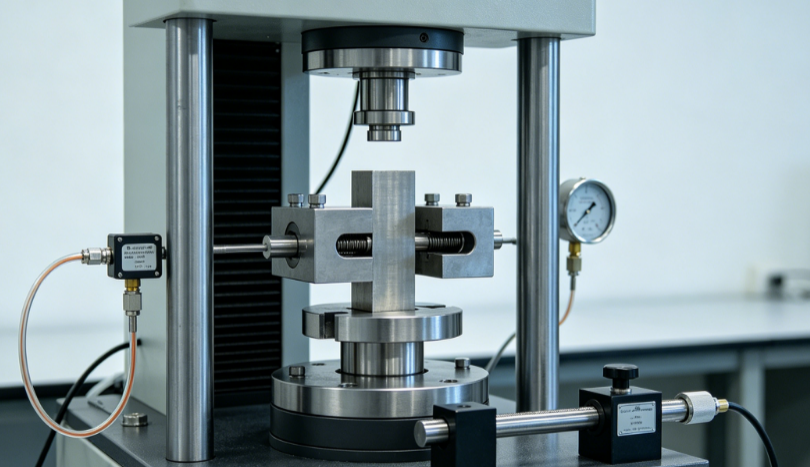
2. Key Test Items & Measurements We Perform
Our creep limit testing services deliver quantitative creep deformation data and time‑to‑failure characteristics, enabling material grading and life prediction.
2.1 Creep Strain vs. Time Curve (Primary, Secondary, Tertiary Creep)
During a constant load creep test, the elongation of the specimen is continuously or periodically recorded. The resulting strain‑time curve typically exhibits three distinct stages:
Primary (transient) creep – strain rate decreases with time due to work hardening; characterized by the primary creep strain (εp) and the primary creep time (tp).
Secondary (steady‑state) creep – strain rate becomes constant (minimum creep rate, ε̇min), where the rate of work hardening balances the rate of recovery (dynamic equilibrium). This stage dominates most of the service life. The minimum creep rate (in % per hour or 1/s) is a key design parameter.
Tertiary creep – strain rate accelerates due to damage accumulation (cavitation, necking, grain boundary sliding), leading to final fracture. The onset of tertiary creep (ttert) is recorded, and the time to rupture (tr) is the total test duration.
We report the complete creep curve (strain vs. time) and provide fitted parameters (ε̇min, times to defined strain levels, rupture time).
2.2 creep limit (Creep Strength) – Stress for Given Creep Strain at Given Time
The creep limit is defined as the stress that causes a specified creep strain (e.g., 0.1%, 0.2%, 1.0%) after a specified time (e.g., 1,000 h, 10,000 h, 100,000 h) at a given temperature. It is denoted as, for example, σ1/1000T (stress for 1% creep strain at 1000 hours and temperature T). We determine creep limits by conducting a series of tests at different stress levels at the same temperature, plotting the time to reach the defined strain vs. applied stress, and interpolating (using Larson‑Miller or other parametric methods).
Typical values (illustrative): For a typical 2.25Cr‑1Mo steel at 540°C, the 1% creep strain limit at 10,000 h may be approximately 120 MPa. For Inconel 718 at 650°C, the 0.2% creep strain limit at 1,000 h may be 200 MPa.
2.3 Creep Rupture Strength (Stress Rupture Limit)
The creep rupture strength (or stress rupture limit) is the stress that causes fracture after a specified time at a given temperature, without a specific strain limit. It is denoted as σrupture, tT. This parameter is used for components where some deformation is acceptable but complete failure must be avoided (e.g., pressure vessels). We report the rupture time for each test and generate a stress‑rupture curve (log σ vs. log tr). Extrapolation to long times (100,000 h or 10⁵ h) is performed using the Larson‑Miller parameter (LMP = T(C + log tr), with C typically 20 for steels).
2.4 Creep Ductility (Elongation & Reduction of Area at Rupture)
After each creep test, we measure the final elongation (%), reduction of area (%), and fracture mode (intergranular or transgranular). These indicators reflect the material‘s damage tolerance and help distinguish creep‑dominated failures from other mechanisms.
2.5 Creep Life Fraction (Miner‘s Rule for Creep)
For complex service histories involving multiple stress/temperature levels, we can perform creep‑fatigue interaction tests by arrangement. Creep life fraction (sum of ti/tri for each dwell period) is calculated using Miner‘s linear cumulative damage rule (with caution, as interactions may be non‑linear).
3. Standard Test Methods We Apply
All tests are performed according to internationally recognised standards. Our laboratory is ISO/IEC 17025 accredited and equipped with creep testing machines (dead‑weight lever‑arm, 5‑50 kN, up to 1200°C with multi‑zone furnaces), high‑temperature extensometers (resolution 0.001 mm, gauge lengths 25‑100 mm), and data acquisition systems.
3.1 Creep Testing Standards (Metals)
ISO 204 (Metallic materials – Uniaxial creep testing in tension – Method of test). – Specifies test equipment, specimen preparation, test procedure (constant load), temperature measurement (±3°C over gauge length), strain measurement (accuracy ±0.1% strain or ±1 μm, whichever larger), test duration categories (short‑term ≤ 10,000 h, long‑term > 10,000 h), and data reduction. The standard includes guidance on creep curve analysis (determination of minimum creep rate, rupture time, and strain at rupture).
ASTM E139 (Standard test method for creep, creep‑rupture, and stress‑rupture of metallic materials). – The primary US standard for uniaxial creep testing. Specifies test conditions for constant load (lever‑arm) or constant stress (computer‑controlled). Defines preferred specimen geometries (round bar with shoulder or threaded ends), extensometer attachment (must not affect specimen alignment), and temperature control (≤ ±2°C).
GB/T 2039 (Metallic materials – Uniaxial creep testing method in tension). – Chinese national standard, equivalent to ISO 204.
EN 10291 (Creep rupture testing of metallic materials). – European standard for stress‑rupture testing.
3.2 Creep Testing Standards (Polymers & Composites)
ASTM D2990 (Standard test method for tensile, compressive, and flexural creep and creep‑rupture of plastics). – For polymer creep at ambient or moderately elevated temperatures. Typically conducted with constant force (dead weight) or constant stress (lever‑arm). Strain is measured with extensometers or optical methods.
ISO 899‑1 (Plastics – Determination of creep behaviour – Part 1: Tensile creep).
4. Why Choose Our Third‑Party creep limit Testing Services?
As an independent laboratory, we provide unbiased, accurate, and legally defensible creep data. Our strengths include:
ISO/IEC 17025 accreditation – Our creep testing conforms to ISO 204 and ASTM E139, with regular proficiency testing (e.g., ASTM round‑robins, LNE intercomparisons).
Dedicated creep test fleet – We operate multiple creep frames (up to 10 units) with capacities of 10‑50 kN, temperatures up to 1200°C (air), and optional inert atmosphere chambers. Each frame is equipped with independent temperature control (±1°C) and a continuous data logging system (strain, time, temperature).
Long‑duration monitoring – Our data acquisition systems are capable of running tests for > 10,000 hours with automatic shutdown on rupture and remote monitoring.
Creep curve fitting and life prediction – We provide not only raw creep curves but also parametric analysis using the Larson‑Miller, Orr‑Sherby‑Dorn, or Manson‑Haferd methods for extrapolation beyond test durations.
Post‑test metallography – After creep testing, we can examine the fracture surface (SEM) and longitudinal cross‑sections to identify cavitation, grain boundary sliding, and other creep damage mechanisms.
Fast turnaround for short‑term tests – Typical creep limit screening (up to 1,000 hours) completed in 2‑4 weeks (depending on required stress levels). Long‑term tests are scheduled based on customer timelines.
Detailed reporting – Reports include creep strain‑time plots, minimum creep rate, time to rupture, creep ductility parameters, stress‑rupture curves (if multiple tests), and comparisons with published design data (e.g., ASME Boiler & Pressure Vessel Code Section II, Part D).
Confidentiality – Full protection of your material composition, process history, and component design details.
Consultative support – Our materials engineers assist in selecting test stresses, interpreting creep curves (e.g., irregular primary stage, accelerated tertiary), and applying creep data to finite element modelling or life assessment.
Whether you need to qualify a new alloy for a turbine disc, validate a weld procedure for a high‑temperature pipeline, generate design data for a pressure vessel, or investigate a premature creep failure in a superheater tube, our creep limit testing experts are ready to deliver reliable, actionable results.
Get Started with Your creep limit Testing Project
Contact our team with your material grade, expected service temperature, target stress range, required test duration (e.g., 1,000 h, 10,000 h, or rupture), and applicable standard (ISO 204, ASTM E139, GB/T 2039). We will provide a detailed quotation, specimen preparation guidelines (machining, surface finish, optional notch), and a testing schedule. Let us help you determine the long‑term deformation behaviour of your materials for safe, reliable, and durable high‑temperature components.
This article provides an overview of our creep limit testing capabilities. For specific test methods, sample quantity, and pricing, please request a tailored service proposal.