Reasons for choosing our testing services
ZHONGXI Testing has obtained inspection qualification certifications from multiple countries and regions worldwide. We possess a senior testing team and advanced testing methods, providing independent, impartial, and professional third-party verification services for global carbon projects.

Internationally recognized authority
Certified by multiple international standards such as CNAS, VCS, and GS, with reports universally applicable worldwide.

Global service capability
Covering 140+ countries and regions, it supports on-site detection and remote verification in multiple languages.

Professional experimental methods
Adopt standard experimental methods to ensure accurate and reliable data.
Comprehensive Performance and Quality Assessment of Silica Gel Desiccant Adsorbents: Advanced Analytical Services for Drying Efficiency and Process Reliability
Silica gel desiccants – including regular pore, wide pore, and indicating types – are widely used in industrial drying, gas dehydration, breathing air systems, moisture-controlled packaging, and humidity control in electronics, pharmaceuticals, and food storage. Their efficiency is governed by a combination of dynamic water vapor adsorption capacity, pore architecture, surface chemistry (silanol group density), specific surface area, particle size and mechanical strength, regeneration energy requirements, and the presence of impurities (e.g., sodium, iron, or alumina). Even minor deviations in these parameters can lead to insufficient drying, premature saturation, increased pressure drop, or contamination of the product stream. Consequently, a rigorous, multi-parameter analytical regime is essential for incoming inspection, quality control, process optimisation, and troubleshooting of field performance issues. Our ISO/IEC 17025-accredited laboratory offers a dedicated, high-depth testing service specifically tailored for silica gel desiccants, integrating advanced physisorption, thermal, spectroscopic, and mechanical methods to deliver a complete adsorption, stability, and purity profile – far beyond simple moisture content or static equilibrium tests.
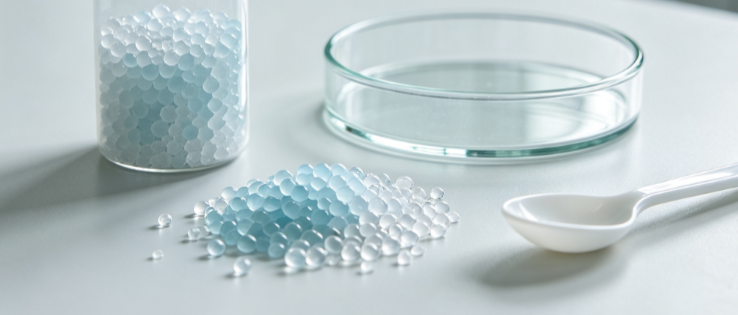
Why Comprehensive Characterization of Silica Gel Desiccants Is Critical for Industrial Quality and Process Efficiency
Clients seeking our testing services typically aim to: (i) determine the water vapor adsorption capacity and the equilibrium isotherm under relevant temperature and humidity conditions, (ii) measure the specific surface area (BET), pore volume, and pore size distribution to predict the adsorption kinetics and the optimal pore size for a given application, (iii) quantify the surface silanol group density, which correlates with the hydrophilicity and adsorption affinity, (iv) evaluate the particle size distribution, mechanical crush strength, and attrition resistance to ensure low dusting and long service life, (v) assess the moisture content as received and the loss on ignition to determine the thermal stability and the organic content, (vi) detect the presence of leachable impurities (e.g., Na, Ca, Fe, Al) that could contaminate the product being dried, (vii) determine the regeneration temperature and the energy required for complete reactivation, and (viii) generate robust data for product certification, supplier qualification, and regulatory compliance. Standard single-parameter tests such as a simple desiccant capacity test (e.g., static equilibrium in a closed chamber) are insufficient because the real-world performance is governed by the interplay of pore structure, surface chemistry, and particle physical properties, which require a suite of complementary techniques. Our integrated platform combines dynamic water vapor adsorption (DVS) and static gravimetric isotherm measurements, N₂ physisorption (BET, BJH, NLDFT), mercury porosimetry, Thermogravimetric Analysis (TGA) coupled with differential scanning calorimetry (DSC), Fourier-transform infrared (FTIR) spectroscopy with diffuse reflectance (DRIFTS), X-ray diffraction (XRD) for amorphous/crystalline assessment, laser diffraction particle sizing, mechanical crush strength and attrition testing (ASTM D4058), inductively coupled plasma optical emission spectrometry (ICP‑OES) for trace metals, and Karl Fischer coulometric titration for initial moisture content – providing a complete functional and quality fingerprint.
Our Comprehensive Analytical Framework for Silica Gel Desiccants
1. Water Vapor Adsorption Isotherms and Dynamic Capacity
We measure the equilibrium water vapor adsorption isotherms at multiple temperatures (20 °C, 25 °C, 40 °C) and over a full relative humidity (RH) range (0–98% RH) using a gravimetric dynamic vapor sorption (DVS) system with an ultra-microbalance (precision ±0.1 µg) and a humidity generator (±1% RH). The adsorption and desorption branches are recorded, and we report the monolayer capacity (from BET) on the adsorbed water layer, the total water uptake at 80% RH, and the hysteresis loop area. In parallel, we perform static desiccator tests (ASTM E104) using saturated salt solutions for cross-validation. From the isotherm data, we calculate the heat of adsorption (via the Clausius–Clapeyron equation) and the effective pore filling pressure. These data are essential for predicting the desiccant’s performance under variable humidity conditions and for sizing the required bed volume.
2. Textural Properties: Surface Area, Pore Volume, and Pore Size Distribution
We determine the specific surface area (BET), total pore volume, and micropore volume by N₂ physisorption at 77 K over a wide relative pressure range (10⁻⁶–0.995), with a reproducibility of ±1.5% for surface area and ±2% for pore volume. The pore size distribution is derived using NLDFT, QSDFT, and BJH models, covering micropores (<2 nm), mesopores (2–50 nm), and macropores. For a comprehensive pore structure assessment, we also perform mercury intrusion porosimetry (up to 600 MPa) to characterize the macroporosity and interparticle voids, providing the pore throat distribution and the bulk density. We report the microporosity percentage and the median pore diameter, which are critical for predicting the diffusion kinetics and the susceptibility to pore blockage by contaminants.
3. Surface Chemistry: Silanol Group Density and Hydrophilicity
We quantify the silanol group (Si–OH) density using a combination of diffuse reflectance infrared Fourier transform spectroscopy (DRIFTS) to measure the intensity of the Si–OH stretching band (around 3700 cm⁻¹) and Thermogravimetric Analysis to determine the mass loss due to dehydroxylation (typically above 400 °C). We also perform hydroxyl group titration with a standard base (LiAlH₄ or n-butyllithium) for a direct chemical measurement. The silanol density is expressed in mmol OH/g and is correlated with the equilibrium water uptake at low RH, where the hydrophilic silanol groups dominate. The surface chemistry is further characterized by contact angle measurements on compressed pellets (sessile drop method) to evaluate the wettability and the interaction with various solvents.
4. Particle Size, Morphology, and Mechanical Integrity
We measure the particle size distribution by laser diffraction (dry and wet methods) from 0.1 to 3500 µm, reporting D10, D50, D90, and the span. The particle morphology and surface texture are examined by field-emission scanning electron microscopy (FE‑SEM) with energy-dispersive X‑ray spectroscopy (EDS) for elemental mapping. The mechanical strength of the granules is assessed by a single‑pellet crush strength test (with a precision of ±0.5 N) and by attrition resistance (ASTM D4058) to quantify the fines generation (%) and the dusting tendency. These mechanical properties are essential for predicting the loss of desiccant material during handling, transportation, and continuous cycling in packed beds.
5. Moisture and Volatile Content; Thermal Stability
We determine the initial moisture content (as received) by Karl Fischer coulometric titration (LOD: 0.01%) and by loss on drying at 105 °C (ASTM D2216). The total volatile matter (including adsorbed organics and structural water) is measured by Thermogravimetric Analysis (TGA) from 25 °C to 900 °C under nitrogen, identifying distinct mass-loss steps: desorption of physisorbed water (up to 200 °C), dehydroxylation (200–600 °C), and any decomposition of organic impurities. We also perform simultaneous DSC to identify endothermic events (evaporation, dehydroxylation) and exothermic events (combustion). The regeneration temperature window is determined as the temperature at which 90% of the adsorbed moisture is removed, and we report the specific regeneration energy (kJ/kg of desiccant).
6. Purity and Trace Impurity Profiling
We screen for metallic impurities (Na, K, Ca, Mg, Fe, Al, Cu, Zn, Pb, etc.) by inductively coupled plasma optical emission spectrometry (ICP‑OES) after microwave‑assisted acid digestion (HF + HNO₃), with detection limits in the sub‑ppm range. For non‑metallic contaminants, we perform ion chromatography (IC) on aqueous extracts to quantify chloride, sulfate, nitrate, and phosphate. The total carbon content (organic contamination) is determined by combustion analysis (LECO). The impurity profile is compared against the specification for the intended application (e.g., food‑grade, pharmaceutical‑grade, or electronics‑grade), and we provide a compliance summary with pass/fail indications.
7. Regeneration Efficiency and Cycling Stability
We perform accelerated cyclic adsorption‑regeneration tests (up to 50 cycles) using a thermogravimetric analyser coupled to a humidity generator, or in a fixed‑bed reactor with a defined flow of humidified air and a subsequent regeneration step at 150–300 °C. After each cycle, we measure the adsorption capacity at a fixed RH (60% RH) to determine the capacity retention and the deactivation rate. The regenerated samples are also characterized by BET and DRIFTS to monitor any loss of surface area or silanol groups. This provides a lifetime prediction and a recommended regeneration protocol for industrial operation.
8. Leachable and Extractable Contaminants (for Sensitive Applications)
For desiccants used in pharmaceutical or food packaging, we perform extraction tests with deionized water and with a 10% ethanol/water mixture, at 40 °C for 24 hours. The extracts are analysed for total organic carbon (TOC), pH, conductivity, and specific metals by ICP‑MS. The results are compared against USP <661> or other relevant standards to ensure the material does not contaminate the product being dried.
Our Distinctive Advantages in Silica Gel Desiccant Testing
1. Fully Integrated Adsorption‑Structure‑Stability Platform: We uniquely combine dynamic water vapor isotherm measurements, detailed textural characterisation (BET, porosimetry, mercury intrusion), surface chemistry (DRIFTS, silanol titration), mechanical strength testing, and thermal analysis in a single workflow. This integration allows us to correlate the pore architecture with the adsorption capacity, the silanol density with the low‑RH performance, and the crush strength with the lifetime in cycling. Such a comprehensive correlation is essential for diagnosing performance variability and for guiding the selection of the optimal silica gel grade for a given process.
2. Expertise in Handling Hygroscopic and Fragile Materials: Silica gels are often hygroscopic and can crack or pulverise during handling. We perform all sample preparation (division, crushing, and loading) using gentle, non‑destructive techniques (e.g., using a sample splitter and avoiding high‑energy milling) to preserve the native particle size and structure. Our degassing protocols for BET and TGA are carefully calibrated to avoid the collapse of the pore structure due to over‑heating. Our methods have been validated on over 100 commercial silica gel products, with inter‑laboratory reproducibility within 2% RSD for BET and water capacity.
3. Advanced Data Modeling and Process Simulation: We employ breakthrough curve modeling (using the linear driving force approximation) based on the measured isotherm and diffusion data to predict the performance in a fixed‑bed adsorber under various flow rates and inlet humidity conditions. We also use machine learning algorithms to correlate the measured material properties (pore volume, silanol density, particle size) with the observed adsorption kinetics and with the expected service life. This predictive capability is offered as a consulting service to help our clients design efficient drying systems and to schedule regeneration cycles optimally.
4. Regulatory‑Grade Quality and Full Traceability: Our facility is accredited under ISO/IEC 17025:2017 for BET, water vapor sorption (DVS), particle sizing, ICP‑OES, and TGA. We use NIST‑traceable standards for moisture (Karl Fischer), for pore size calibration (certified reference silicas), and for elemental analysis. All measurement uncertainties are reported with expanded uncertainties (k=2) typically <2% for BET and water capacity, <3% for particle size, and <5% for trace metals, ensuring the data are defensible in quality audits, regulatory submissions, and customer certifications.
5. Consultative Partnership and Application Support: Each project is overseen by a senior adsorption scientist with extensive industrial experience in desiccant applications. We provide interpretative reports that not only present the analytical data but also explain the implications for your specific application – for example, linking a high micropore volume to fast adsorption but a slower regeneration, or identifying a high iron impurity as a potential source of discoloration in food contact applications. We also offer co‑authorship support for academic and technical publications and assist in drafting material specifications.
Report Deliverables and Client Empowerment
Our final comprehensive report includes: (a) water vapor adsorption and desorption isotherms at 25 °C and 40 °C, with calculated monolayer capacity, total uptake at 80% RH, and heat of adsorption; (b) BET surface area, micropore volume, mesopore volume, and pore size distribution (NLDFT/BJH) from N₂ physisorption, plus macroporosity from mercury intrusion; (c) surface silanol group density and hydrophilicity index; (d) particle size distribution, SEM images, crush strength, and attrition index; (e) initial moisture content, volatile content, dehydroxylation temperature, and regeneration energy; (f) trace metallic and anionic impurity profile with compliance flagging; (g) cyclic capacity retention and recommended regeneration temperature; (h) extractables and leachables assessment (if requested); (i) a benchmarking summary comparing your desiccant with industry references and competitor products; and (j) a process design guide with recommended bed dimensions, flow rates, and regeneration intervals. All raw data (isotherms, chromatograms, diffractograms, thermograms, and images) are supplied in open, machine‑readable formats (CIF, JCAMP‑DX, .csv, .tiff, .mzML) for independent verification and long‑term data archiving.
We also offer subscription‑based monitoring programs for regular quality surveillance, with trend analysis and statistical process control (SPC) charts. Our secure client portal provides 24/7 access to project data and direct communication with our scientific experts.
Conclusion: Precision Characterization for High‑Performance Silica Gel Desiccants
Silica gel desiccants are essential for maintaining product integrity and process efficiency in countless drying applications, and their performance depends on a precise understanding of their adsorption, structural, mechanical, and chemical properties. Our testing service delivers that understanding – integrating state‑of‑the‑art water vapor isotherm measurements, pore architecture analysis, surface chemistry profiling, mechanical testing, and purity assessment with expert interpretation. By choosing our laboratory, you gain a trusted partner that ensures your silica gel consistently meets the most stringent specifications, enabling you to achieve reliable drying, extended service life, and optimal process economics. Partner with our expert team today to design a customized testing protocol – we are committed to advancing your drying technology with unmatched analytical depth and scientific rigour.