Reasons for choosing our testing services
ZHONGXI Testing has obtained inspection qualification certifications from multiple countries and regions worldwide. We possess a senior testing team and advanced testing methods, providing independent, impartial, and professional third-party verification services for global carbon projects.

Internationally recognized authority
Certified by multiple international standards such as CNAS, VCS, and GS, with reports universally applicable worldwide.

Global service capability
Covering 140+ countries and regions, it supports on-site detection and remote verification in multiple languages.

Professional experimental methods
Adopt standard experimental methods to ensure accurate and reliable data.
Comprehensive Performance and Quality Assessment of Filter Adsorbents: Advanced Analytical Services for Water, Air, and Industrial Purification
Filter adsorbents – including activated carbons, zeolites, silica gels, activated alumina, and composite media – are essential for removing contaminants from water, air, and process streams in industries ranging from municipal water treatment to pharmaceutical manufacturing and petrochemical refining. The efficiency, capacity, and longevity of these materials are governed by a complex interplay of specific surface area, pore size distribution, surface chemistry (functional groups, charge), particle morphology, mechanical strength, and adsorption kinetics. Even minor variations in these parameters can lead to premature breakthrough, reduced service life, or secondary contamination. Therefore, a rigorous, multi-parameter analytical evaluation is indispensable for material selection, quality assurance, process optimisation, and troubleshooting. Our ISO/IEC 17025‑accredited laboratory offers a dedicated, high‑depth testing service specifically tailored for filter adsorbents, integrating advanced physical, chemical, and dynamic performance methods to deliver a complete material fingerprint – far beyond routine iodine number or single‑point BET measurements.
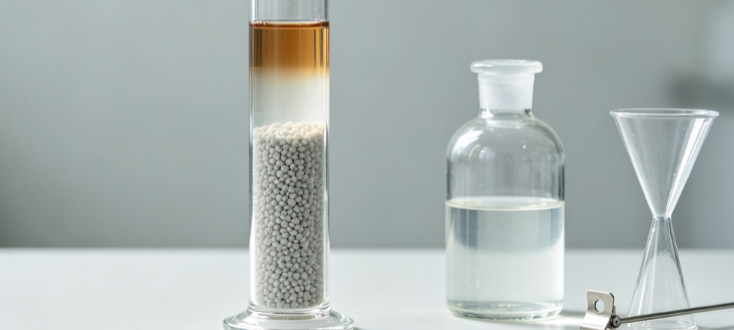
Why Comprehensive Characterization of Filter Adsorbents Is Critical for Industrial and Environmental Applications
Clients seeking our testing services typically aim to: (i) determine the maximum adsorption capacity and the equilibrium isotherm for target contaminants (organic compounds, heavy metals, chlorine, VOCs, etc.) under realistic operating conditions, (ii) measure the breakthrough curve and the dynamic adsorption capacity in a fixed‑bed or filter configuration, (iii) evaluate the specific surface area, pore volume, and pore size distribution to predict the accessibility of active sites, (iv) assess the mechanical crush strength, attrition resistance, and particle size distribution to ensure durability and low pressure drop, (v) quantify surface functional groups (e.g., acidic/basic sites) that govern the selectivity and affinity for specific pollutants, (vi) detect leachable impurities or extractable organic compounds that may contaminate the treated fluid, (vii) evaluate the regeneration efficiency and the loss of capacity over multiple cycles, and (viii) generate robust data for product certification, regulatory compliance, and supplier qualification. Single‑parameter tests such as a static equilibrium capacity or a simple BET surface area are insufficient because real‑world performance depends on the coupled effects of pore architecture, surface chemistry, hydrodynamics, and mass transfer. Our integrated platform combines static and dynamic adsorption isotherms, fixed‑bed breakthrough testing, N₂/Ar physisorption (BET, BJH, NLDFT), mercury intrusion porosimetry, Thermogravimetric Analysis (TGA), Fourier‑transform infrared spectroscopy (FTIR) with diffuse reflectance (DRIFTS), X‑ray photoelectron spectroscopy (XPS) for surface chemical states, X‑ray diffraction (XRD) for phase identification, laser diffraction particle sizing, mechanical crush strength and attrition tests (ASTM), inductively coupled plasma mass spectrometry (ICP‑MS) for trace metals, and ion chromatography (IC) for anions – providing a complete performance, stability, and safety profile.
Our Comprehensive Analytical Framework for Filter Adsorbents
1. Static and Dynamic Adsorption Capacity Determination
We conduct batch equilibrium adsorption studies using a wide range of target adsorbates (e.g., methylene blue, iodine, phenol, toluene, heavy metal ions, or custom contaminants) at multiple concentrations and temperatures. The data are fitted to Langmuir, Freundlich, Sips, and Dubinin–Radushkevich models, and we report the maximum monolayer capacity (Qm), affinity constants, and the heterogeneity parameter, with full confidence intervals. For dynamic performance, we operate a custom‑built fixed‑bed breakthrough system with online UV‑Vis, GC‑FID, or ICP‑MS detection, simulating real filter conditions (flow rate, bed height, influent concentration). We derive the breakthrough capacity (at 5% and 10% of influent), the mass transfer zone (MTZ) length, and the utilization efficiency of the bed. These data are essential for designing filter vessels and predicting replacement intervals.
2. Textural Properties: Surface Area, Pore Volume, and Pore Size Distribution
We measure the BET‑specific surface area and the total pore volume by N₂ physisorption at 77 K (or Ar at 87 K for micropore analysis) over a relative pressure range of 10⁻⁶–0.995, with a reproducibility of ±1.5%. The pore size distribution is derived using NLDFT, QSDFT, BJH, and Horvath–Kawazoe models, covering micropores, mesopores, and macropores. For a complete porosity assessment, we perform mercury intrusion porosimetry up to 600 MPa to characterize the macroporosity, bulk density, and pore throat distribution. We report the micropore volume, mesopore volume, and the external surface area, which are critical for predicting the accessibility of the adsorbent to molecules of different sizes.
3. Surface Chemical Characterization and Functional Group Analysis
The surface chemistry of adsorbents is a key determinant of selectivity and affinity. We use diffuse reflectance infrared Fourier transform spectroscopy (DRIFTS) to identify and semi‑quantify the surface functional groups (hydroxyl, carboxyl, carbonyl, amine, etc.). For carbonaceous materials, we determine the surface acidity/basicity by the Boehm titration method, reporting the concentrations of carboxylic, phenolic, lactonic, and basic groups. For a detailed surface chemical state, we apply X‑ray photoelectron spectroscopy (XPS) to quantify the elemental composition and the bonding states (e.g., C‑C, C‑O, C=O, O‑C=O, and for metals, the oxidation state). We also measure the point of zero charge (pHPZC) by the potentiometric mass titration method, which predicts the adsorbent’s performance at different pH values.
4. Particle Size, Morphology, and Mechanical Strength
We measure the particle size distribution by laser diffraction (wet or dry dispersion) from 0.1 to 3500 µm, reporting D10, D50, D90, and the span. The morphology and surface texture are examined by field‑emission scanning electron microscopy (FE‑SEM) with energy‑dispersive X‑ray spectroscopy (EDS) for elemental mapping. The mechanical crush strength of individual granules is determined using a precision compression tester, and the attrition resistance is evaluated according to ASTM D4058 or D5757, reporting the fines generation percentage and the attrition index. These mechanical properties are essential for predicting the loss of material during handling, backwashing, and long‑term service.
5. Thermal Stability and Regeneration Behavior
We perform Thermogravimetric Analysis (TGA) coupled with differential scanning calorimetry (DSC) and evolved gas mass spectrometry (MS) from 25 °C to 900 °C under inert and oxidizing atmospheres. The TGA curve reveals the moisture content, the decomposition of organic matter, the dehydroxylation or decarbonation, and the thermal stability limit. We also conduct accelerated cycling tests to simulate multiple adsorption‑regeneration cycles (thermal, steam, or chemical) and we monitor the loss of capacity, surface area, and mechanical strength. The regeneration efficiency and the energy consumption per cycle are reported, enabling a lifecycle cost analysis.
6. Purity and Leachability Assessment
We screen for trace metallic impurities (e.g., Fe, Cu, Zn, Pb, Cd, As, Cr) by inductively coupled plasma mass spectrometry (ICP‑MS) after acid digestion, with detection limits in the sub‑ppb range. For anions (chloride, sulfate, nitrate), we use ion chromatography (IC) on aqueous extracts. For organic extractables, we perform solvent extraction (dichloromethane or hexane) followed by GC‑MS analysis to identify and quantify potential contaminants that could leach into the product stream. These data are essential for food‑grade, pharmaceutical, and drinking‑water applications.
7. Selective and Competitive Adsorption Studies
In multi‑component systems (e.g., mixed VOCs, heavy metals with competing cations), we determine the selectivity coefficients and the competitive adsorption isotherms using a combination of batch and column tests. The data are modelled using the extended Langmuir or ideal adsorbed solution theory (IAST) to predict the performance in real‑world feed streams. This service is critical for designing filters for complex wastewaters or contaminated air streams.
8. Advanced Imaging and 3D Pore Network Analysis (Optional)
For research and development applications, we offer focused ion beam‑scanning electron microscopy (FIB‑SEM) and X‑ray computed tomography (XCT) to reconstruct the 3D pore network and to quantify the tortuosity, connectivity, and pore‑throat distribution. This provides a fundamental understanding of the mass‑transfer limitations and the performance at the microscale.
Our Distinctive Advantages in Filter Adsorbent Testing
1. Fully Integrated Multi‑Technique Platform: We uniquely combine dynamic and static adsorption measurements, comprehensive textural characterisation (BET, porosimetry, mercury intrusion), surface chemical analysis (DRIFTS, XPS, Boehm titration), mechanical testing, thermal stability, and impurity profiling in a single workflow. This enables us to correlate, for example, the pore structure with the breakthrough curve, the surface functional groups with the selectivity, and the crush strength with the cyclic stability – providing a holistic fitness‑for‑purpose assessment that is rarely available from conventional testing services.
2. Expertise in a Broad Range of Adsorbent Materials: Our scientists have extensive experience with activated carbons (coal‑based, coconut shell, wood), zeolites (natural and synthetic), silica gels, activated alumina, clay minerals, polymeric adsorbents, and novel composite materials. We have developed customised sample preparation and degassing protocols to handle diverse physical forms – powders, granules, pellets, monoliths, and fibres – ensuring that the measurements reflect the true native state. Our inter‑laboratory reproducibility for key parameters (BET, capacity, strength) is within 2‑3% RSD, validated on over 300 commercial products.
3. Advanced Data Modelling and Process Scale‑Up Support: We employ finite‑element modelling and computational fluid dynamics (CFD) to simulate the flow distribution and the concentration profile in full‑scale filters, based on the measured breakthrough and kinetic data. We provide design recommendations for bed height, flow rate, particle size, and backwashing frequency. We also use machine learning to correlate the material descriptors (pore volume, surface chemistry, particle size) with the observed capacity and longevity, enabling a rapid screening of candidate materials.
4. Regulatory‑Grade Quality and Full Traceability: Our facility is accredited under ISO/IEC 17025:2017 for all relevant test methods (BET, mercury porosimetry, TGA, particle sizing, elemental analysis). We use NIST‑traceable standards and certified reference materials (e.g., activated carbon standards, metal standards). All uncertainties are reported with expanded uncertainties (k=2) typically <2% for surface area, <3% for breakthrough capacity, and <5% for trace impurities, ensuring the data are defensible in quality audits, regulatory submissions, and legal challenges.
5. Consultative Partnership and Rapid Turnaround: Each project is led by a senior adsorption specialist who provides regular progress updates and a final comprehensive report with clear conclusions and actionable recommendations. We offer emergency testing for urgent process deviations, with preliminary results within 48 hours. Our client portal enables 24/7 access to data and direct communication with our experts.
Report Deliverables and Client Empowerment
Our final comprehensive report includes: (a) static isotherm data and model parameters (Qm, KL, n, etc.) for the target contaminant; (b) dynamic breakthrough curves with calculated capacities, MTZ length, and utilization efficiency; (c) BET surface area, total pore volume, micropore volume, and pore size distribution from N₂ physisorption and mercury intrusion; (d) surface functional group quantification (Boehm titration, DRIFTS), pHPZC, and XPS surface composition; (e) particle size distribution, SEM images with EDS maps, crush strength, and attrition index; (f) thermal stability profile (TGA‑DSC‑MS) and recommended regeneration temperature; (g) trace metal and anion impurity profile with leachability assessment; (h) selectivity coefficients and competitive adsorption data (if requested); (i) optional 3D pore network analysis; (j) a benchmarking summary comparing your material with competitor products and industry standards; and (k) a process optimisation guide with recommended operational parameters and maintenance schedules. All raw data (isotherms, breakthrough logs, diffractograms, spectra, thermograms, images) are supplied in open, machine‑readable formats (CIF, JCAMP‑DX, .csv, .tiff, .mzML) for independent verification and long‑term archiving.
We also offer subscription‑based quality surveillance programs for regular production monitoring, with trend analysis and statistical quality control (SQC) charts. Our secure client portal provides 24/7 access to historical data and direct communication with our technical team.
Conclusion: Precision Characterization for Reliable and Efficient Filtration
Filter adsorbents are the backbone of modern purification systems, and their performance and safety depend on a thorough understanding of their structural, chemical, physical, and dynamic properties. Our testing service provides that understanding – integrating state‑of‑the‑art adsorption measurements, pore architecture analysis, surface chemistry profiling, mechanical testing, and purity assessment with expert interpretation and predictive modelling. By choosing our laboratory, you gain a trusted partner that ensures your adsorbent consistently meets the most demanding specifications, enabling you to achieve superior contaminant removal, extended service life, and optimal process economics. Partner with our expert team today to design a customized testing protocol – we are committed to advancing your filtration technology with unmatched analytical depth and scientific rigor.