Reasons for choosing our testing services
ZHONGXI Testing has obtained inspection qualification certifications from multiple countries and regions worldwide. We possess a senior testing team and advanced testing methods, providing independent, impartial, and professional third-party verification services for global carbon projects.

Internationally recognized authority
Certified by multiple international standards such as CNAS, VCS, and GS, with reports universally applicable worldwide.

Global service capability
Covering 140+ countries and regions, it supports on-site detection and remote verification in multiple languages.

Professional experimental methods
Adopt standard experimental methods to ensure accurate and reliable data.
Comprehensive Performance and Quality Assessment of Sea Pumice Filter Media: Advanced Analytical Services for Water Treatment and Biological Filtration
Sea pumice (marine pumice or floating pumice) is a highly porous volcanic glass material that has gained widespread use in water treatment, aquarium biofiltration, aquaculture, and municipal wastewater applications due to its exceptional lightweight, high porosity, favorable surface roughness, and biocompatibility. Unlike synthetic or clay-based media, sea pumice offers a unique combination of macroporous structure, large specific surface area, and stable mineral composition, which supports both mechanical filtration and the growth of beneficial microbial biofilms. However, the performance and reliability of sea pumice as a filter medium depend critically on its physical integrity (particle size distribution, hardness, and abrasion resistance), pore architecture (total porosity, pore size distribution, and permeability), chemical composition (presence of soluble elements, carbonate content, and trace metals), and biological compatibility (surface charge, leachables, and toxicity). Even minor deviations in these properties can lead to premature media degradation, poor biofilm development, or the release of harmful substances into the treated water. A rigorous, multi-parameter analytical regime is therefore essential for raw material acceptance, process optimization, quality assurance, and troubleshooting of filtration systems. Our ISO/IEC 17025-accredited laboratory offers a dedicated, high-depth testing service specifically tailored for sea pumice filter media, integrating advanced physical, chemical, mineralogical, and performance-based methods to deliver a complete material profile – far beyond simple visual inspection or bulk density measurements.
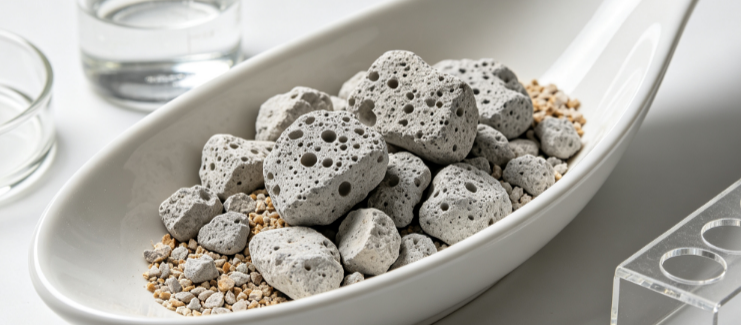
Why Comprehensive Characterization of Sea Pumice Filter Media Is Critical for Water Treatment and Aquaculture Applications
Clients seeking our testing services typically aim to: (i) verify the particle size distribution and uniformity coefficient to ensure consistent hydraulic loading and backwashing efficiency, (ii) measure the total porosity, effective pore volume, and permeability to predict the hydraulic resistance and the residence time for biofilm formation, (iii) quantify the mechanical resistance (abrasion and crushing strength) to assess the media’s durability and the production of fines during handling and operation, (iv) determine the mineralogical composition and the content of soluble substances (e.g., silica, calcium, sodium, and trace metals) that could affect water chemistry or aquatic life, (v) evaluate the surface charge and the capacity to support microbial adhesion, (vi) assess the leachability of potentially toxic elements (As, Pb, Cd, Cr, etc.) under relevant pH and contact time conditions, (vii) measure the long-term stability in terms of loss of porosity or structural degradation, and (viii) generate robust data for product certification, regulatory compliance, and supplier qualification. Routine tests such as simple sieve analysis or loss-on-ignition are insufficient because the biological and physical filtration performance depends on the interplay of pore geometry, surface chemistry, and mechanical integrity. Our integrated platform combines laser diffraction and mechanical sieving for particle sizing, image analysis for shape characterization, mercury intrusion porosimetry and gas physisorption for pore structure, X-ray fluorescence (XRF) and inductively coupled plasma mass spectrometry (ICP-MS) for elemental composition, X-ray diffraction (XRD) for mineralogy, scanning electron microscopy (SEM) with energy-dispersive X-ray spectroscopy (EDS) for morphology and elemental mapping, Thermogravimetric Analysis (TGA) for volatile and carbonate content, abrasion and attrition testing (ASTM D4058), surface charge measurement by zeta potential, leachate testing under batch and column conditions, and microbiological adhesion assays (optional) – providing a complete functional and safety profile.
Our Comprehensive Analytical Framework for Sea Pumice Filter Media
1. Physical Properties: Particle Size Distribution, Uniformity, and Shape
We determine the particle size distribution using a combination of mechanical sieving (for larger fractions) and laser diffraction (for fine particles), covering a range from 0.1 µm to 100 mm, with a precision of ±1%. We report the D10, D50, D90, uniformity coefficient (Cu = D60/D10), and the coefficient of gradation (Cc). The particle shape and roundness are quantified by dynamic image analysis (DIA) and by qualitative SEM imaging, providing the aspect ratio, circularity, and convexity. These parameters are essential for predicting the filter bed permeability, backwash efficiency, and head loss development over time.
2. Porosity, Pore Size Distribution, and Permeability
We measure the total porosity (including both intraparticle and interparticle voids) by a combination of mercury intrusion porosimetry (MIP) (for macropores and mesopores) and helium pycnometry (for skeletal density). The effective pore size distribution is derived from the MIP intrusion curve over the pressure range 0.001–600 MPa, providing the median pore diameter, the pore throat distribution, and the tortuosity factor. We also determine the air permeability using a custom permearimeter, and we calculate the permeability coefficient (k) according to Darcy’s law. These data are directly correlated with the hydraulic conductivity and the biofilm formation potential.
3. Mechanical Strength and Abrasion Resistance
We evaluate the single-grain crush strength using a precision universal tester (with a load cell of 0.1 N accuracy) on at least 50 individual particles, reporting the mean crush force and the distribution. The abrasion resistance is assessed by the Mohs hardness scale and, more quantitatively, by the tumble drum test (ASTM D4058) or the attrition index (ASTM D5757), which measures the percentage of fines generated after a defined agitation period. We also perform repeated freeze-thaw and wet-dry cycling (optional) to simulate the seasonal or operational stress, followed by re-measurement of the particle size and crush strength to assess the durability.
4. Mineralogical and Elemental Composition
We determine the bulk elemental composition (Si, Al, Fe, Ca, Mg, Na, K, Ti, P, etc.) by X-ray fluorescence (XRF) spectrometry on fused beads, with detection limits in the 0.01–0.1 wt% range. For trace elements and potential contaminants, we use inductively coupled plasma mass spectrometry (ICP-MS) after microwave-assisted acid digestion, achieving sub-ppm limits for As, Pb, Cd, Cr, Cu, Zn, Ni, and other regulated metals. The mineralogical phases (quartz, feldspar, volcanic glass, clay minerals, carbonates) are identified and semi-quantified by powder X-ray diffraction (XRD) with Rietveld refinement, reporting the weight percentages of the major crystalline components. We also measure the loss on ignition (LOI) at 1000 °C to estimate the organic matter, carbonate, and water content.
5. Soluble Substances and Leachability
We perform batch leaching tests in deionized water and in synthetic freshwater (with controlled pH, hardness, and alkalinity) at a solid-to-liquid ratio of 1:10, for contact times of 24 hours and 7 days. The leachate is analyzed by ICP-MS for metals and by ion chromatography (IC) for anions (chloride, sulfate, nitrate, fluoride). We also measure the pH change and the electrical conductivity of the leachate, and we compare the results with the relevant environmental quality standards (e.g., US EPA, EU Drinking Water Directive) and with the guidelines for aquaculture. For media used in drinking water applications, we follow the EPA Method 1311 (TCLP) or the NSF/ANSI 61 extraction protocol to certify the material as safe.
6. Surface Charge and Biofilm Compatibility
We measure the zeta potential of the crushed pumice powder as a function of pH (2–12) using a zetameter with a micro-electrophoresis cell, to determine the point of zero charge (PZC) and the surface charge density at the typical operating pH. This is correlated with the adhesion of microorganisms and with the adsorption of charged pollutants. Optionally, we conduct a microbial adhesion assay using a model bacterium (e.g., E. coli or Pseudomonas) under controlled conditions, followed by plate counting or ATP quantification, to directly assess the biofilm formation potential on the pumice surface.
7. Permeability and Hydraulic Performance
We perform constant-head and falling-head permeability tests on packed columns of sea pumice with controlled compaction, following ASTM D2434 or the equivalent, to determine the hydraulic conductivity (K) at different porosities and grain sizes. We also measure the head loss as a function of filtration velocity and the porosity reduction after clogging with synthetic or real wastewater solids, simulating the operational fouling. These data are used to predict the media’s service life and the frequency of backwashing.
8. Thermal and Chemical Stability
We conduct Thermogravimetric Analysis (TGA) from 25 °C to 1000 °C under air and nitrogen to identify the temperature of dehydroxylation, decarbonation, and any phase transitions. The thermal expansion coefficient is determined by dilatometry on a compacted pellet (optional). For chemical stability, we perform acid and alkali resistance tests by immersing the pumice in 1 M HCl and 1 M NaOH for 7 days, and we measure the mass loss and the change in pore structure (by BET and MIP). This is critical for applications involving aggressive water chemistries or chemical regeneration.
9. Optical and Qualitative Characterization
We provide high-resolution SEM imaging (with EDS mapping) to visualize the surface texture, the presence of secondary minerals, and the attachment of particles. We also conduct optical microscopy to identify the glassy and crystalline domains. These qualitative data support the interpretation of the quantitative measurements and provide a clear visual record of the material’s quality.
Our Distinctive Advantages in Sea Pumice Filter Media Testing
1. Fully Integrated Physical–Chemical–Biological Platform: We uniquely combine particle sizing, pore architecture, mechanical strength, elemental composition, leachability, surface charge, and permeability testing in a single coordinated workflow. This allows us to correlate the pore structure with the permeability, the mineralogy with the leachate chemistry, and the surface charge with the biofilm adhesion – providing a complete fitness-for-purpose assessment that is essential for both quality control and process design. Such integration is rarely available in standard filtration media testing laboratories.
2. Expertise in Natural Volcanic Materials and Their Variability: Sea pumice is a naturally heterogeneous material whose properties can vary significantly depending on the quarry source and the processing method. We have developed statistically robust sampling and sub-sampling protocols to ensure that the analytical sample is representative of the bulk delivery. Our scientists have deep knowledge of volcanic glass geochemistry and can detect subtle differences in composition or structure that may affect performance. Our inter-laboratory reproducibility for key parameters (particle size D50, porosity, crush strength) is within 2–3% RSD, validated on over 100 commercial pumice samples from different origins.
3. Advanced Leaching and Compliance Testing: Our leaching protocols are designed to simulate the actual service conditions – including the pH and the ionic strength of the water – and we offer customizable leaching schemes for specific applications (e.g., aquaculture, drinking water, industrial wastewater). We provide a certificate of conformance with the relevant regulatory limits and can advise on potential mitigation measures if any exceedance is detected.
4. Predictive Modeling and Process Support: We use the measured permeability, porosity, and particle size data to simulate the filter bed performance using a validated mathematical model that predicts the head loss evolution and the particle retention efficiency as a function of time. We also provide recommendations for the optimal backwashing schedule, the allowable filtration velocity, and the media replacement interval, based on the specific quality of the influent water.
5. Regulatory-Grade Quality and Full Traceability: Our facility is accredited under ISO/IEC 17025:2017 for particle size analysis, mercury porosimetry, XRF, ICP-MS, TGA, and mechanical testing. We use NIST-traceable standards for elemental analysis and certified reference materials for porosity calibration. All measurement uncertainties are reported with expanded uncertainties (k=2) typically <2% for particle size, <3% for porosity, and <5% for trace element concentrations, ensuring the data are defensible in quality audits, regulatory submissions, and customer certifications.
Report Deliverables and Client Empowerment
Our final comprehensive report includes: (a) particle size distribution and uniformity coefficients, with shape descriptors; (b) total and effective porosity, pore size distribution, and permeability coefficients; (c) single-grain crush strength, abrasion resistance, and attrition index; (d) elemental composition (major and trace) and mineralogical phase quantification; (e) leachate chemistry (metals, anions, pH, conductivity) and compliance assessment; (f) zeta potential and surface charge characteristics; (g) hydraulic conductivity and head loss data under simulated operating conditions; (h) thermal and chemical stability profiles; (i) high-quality SEM images and optical micrographs; (j) a benchmarking summary comparing your pumice with industry standards and competitor products; and (k) a recommendation guide for the optimal media use, backwashing parameters, and expected service life. All raw data (diffractograms, spectra, thermograms, images, and hydraulic logs) are supplied in open, machine-readable formats (CIF, JCAMP‑DX, .csv, .tiff, .mzML) for independent verification and integration into your quality management system.
We also offer subscription‑based monitoring programs for regular batch inspection, with trend analysis and statistical quality control (SQC) charts. Our secure client portal provides 24/7 access to project data and direct communication with our technical experts.
Conclusion: Precision Characterization for Reliable and Durable Sea Pumice Filtration
Sea pumice filter media offers a sustainable and highly efficient solution for water and wastewater treatment, but its performance and safety depend on a thorough understanding of its physical, chemical, mechanical, and biological properties. Our testing service delivers that understanding – integrating state‑of‑the‑art physical analysis, chemical speciation, mechanical durability testing, and hydraulic performance simulation with expert interpretation and practical recommendations. By choosing our laboratory, you gain a trusted partner that ensures your sea pumice media consistently meets the most stringent specifications, enabling you to achieve stable filtration, robust biofilm development, and reliable effluent quality. Partner with our expert team today to design a customized testing protocol – we are committed to advancing your water treatment efficiency with unmatched analytical depth and scientific rigor.