Reasons for choosing our testing services
ZHONGXI Testing has obtained inspection qualification certifications from multiple countries and regions worldwide. We possess a senior testing team and advanced testing methods, providing independent, impartial, and professional third-party verification services for global carbon projects.

Internationally recognized authority
Certified by multiple international standards such as CNAS, VCS, and GS, with reports universally applicable worldwide.

Global service capability
Covering 140+ countries and regions, it supports on-site detection and remote verification in multiple languages.

Professional experimental methods
Adopt standard experimental methods to ensure accurate and reliable data.
Comprehensive Physicochemical and Functional Characterization of Iron‑Modified Biochar: Advanced Analytical Services for Environmental Remediation and Catalytic Applications
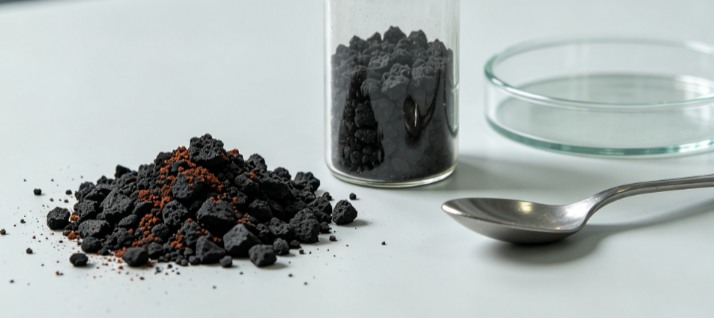
Iron‑modified biochar (Fe‑biochar) – produced by impregnating or co‑pyrolyzing biomass with iron salts (e.g., FeCl₃, FeSO₄, Fe(NO₃)₃) or by post‑synthetic treatment – has emerged as a highly effective multifunctional material for contaminant removal, catalytic oxidation, and soil amendment. The incorporation of iron imparts magnetic separability, enhanced surface complexation, redox reactivity, and improved adsorption capacity for heavy metals, oxyanions (e.g., arsenate, phosphate), and organic pollutants. However, the performance and environmental safety of Fe‑biochar depend critically on the speciation and distribution of iron (zero‑valent iron, magnetite, maghemite, ferrihydrite, or iron‑organic complexes), the textural properties (surface area, pore volume), the surface functional groups (carboxyl, hydroxyl, phenolic), the magnetic behaviour, and the potential for trace element leaching. Even subtle variations in the pyrolysis temperature, iron loading, or feedstock can drastically alter the reactivity and long‑term stability. Therefore, a rigorous, multi‑parameter analytical evaluation is essential for material development, quality control, environmental risk assessment, and field application. Our ISO/IEC 17025‑accredited laboratory offers a dedicated, high‑depth testing service specifically tailored for iron‑modified biochars, integrating advanced spectroscopic, thermal, magnetic, and leaching methodologies to deliver a complete structural, chemical, and functional fingerprint – far beyond routine proximate analysis or simple pH measurements.
Why In‑Depth Characterization of Iron‑Modified Biochar Is Critical for Environmental Remediation and Soil Application
Clients seeking our testing services typically aim to: (i) quantify the total iron content and, more importantly, resolve the iron speciation (Fe⁰, Fe²⁺, Fe³⁺) and mineral phase (magnetite, hematite, goethite, etc.) that determines the reactivity and magnetic properties, (ii) measure the specific surface area, micropore volume, and mesopore distribution to predict the accessibility of active sites, (iii) determine the surface charge (point of zero charge) and the density of oxygen‑containing functional groups that control the adsorption of polar contaminants, (iv) evaluate the magnetic saturation and the ease of separation from water or soil, (v) assess the stability against acid or alkaline leaching, and the potential release of soluble iron or associated trace metals under realistic environmental conditions, (vi) measure the adsorption capacity and kinetics for target pollutants (e.g., As, Pb, Cd, phosphate, antibiotics) under batch and dynamic flow conditions, (vii) evaluate the catalytic or oxidative activity (e.g., Fenton‑like degradation), and (viii) generate robust data for product certification, regulatory compliance, and environmental liability assessments. Standard tests such as bulk elemental analysis or single‑point BET are insufficient because the reactivity of Fe‑biochar is governed by the synergistic interplay of iron speciation, carbon structure, and surface chemistry, which require a suite of complementary techniques. Our integrated platform combines powder X‑ray diffraction (XRD) with Rietveld refinement, Mössbauer spectroscopy for iron valence and magnetic ordering, X‑ray photoelectron spectroscopy (XPS) for surface iron species, vibrating sample magnetometry (VSM) for magnetic properties, inductively coupled plasma mass spectrometry (ICP‑MS) for total and leachable elements, N₂ physisorption (BET, DFT) and mercury porosimetry for textural analysis, Fourier‑transform infrared spectroscopy (FTIR) and Boehm titration for surface functional groups, scanning electron microscopy (SEM) with energy‑dispersive X‑ray spectroscopy (EDS) for morphology and elemental mapping, Thermogravimetric Analysis (TGA) for thermal stability and carbon/ash partitioning, and batch/column adsorption tests with UV‑Vis or ICP‑MS detection – providing a comprehensive, application‑oriented material passport.
Our Comprehensive Analytical Framework for Iron‑Modified Biochar
1. Iron Speciation, Phase Identification, and Oxidation State
We perform 57Fe Mössbauer spectroscopy at room temperature and at 4.2 K to distinguish between paramagnetic Fe³⁺ (e.g., in ferrihydrite), magnetically ordered phases (magnetite, maghemite, hematite), and metallic iron (Fe⁰). The isomer shift, quadrupole splitting, and hyperfine field parameters are used to quantify the relative fractions of each iron species with a precision of ±2%. Complementary X‑ray diffraction (XRD) with Cu Kα radiation and Rietveld refinement identifies the crystalline iron‑bearing phases (e.g., Fe₃O₄, γ‑Fe₂O₃, α‑Fe₂O₃, α‑FeOOH) and determines the crystallite size. For surface‑sensitive iron species, we use X‑ray photoelectron spectroscopy (XPS) with Fe 2p deconvolution to differentiate Fe²⁺ and Fe³⁺ in the near‑surface region (0–10 nm) and to detect the presence of Fe‑O‑C or Fe‑C bonding. The combination of Mössbauer, XRD, and XPS provides a complete iron speciation profile – from bulk crystallinity to surface chemistry – which is essential for predicting the electron transfer capacity and the contaminant immobilization mechanism.
2. Carbon Structure, Disorder, and Graphitic Character
The carbonaceous matrix is characterized by Raman spectroscopy (532 nm and 785 nm) to determine the ID/IG ratio, which quantifies the degree of disorder and the graphitic content – directly correlated with the electrical conductivity and the stability of the biochar. XRD is also used to identify the graphitic (002) peak and the turbostratic ordering. The elemental composition (C, H, N, S, O) is determined by combustion analysis (LECO), and the ash content is measured by high‑temperature combustion. These data, combined with the iron speciation, reveal the degree of carbon graphitization induced by iron during pyrolysis, which influences the long‑term resilience and the adsorption of hydrophobic organics.
3. Textural Properties and Pore Architecture
We measure the BET‑specific surface area and total pore volume by N₂ physisorption at 77 K over a relative pressure range of 10⁻⁶–0.995, with a reproducibility of ±1.5%. The pore size distribution is derived using NLDFT, QSDFT, and BJH models, covering micropores, mesopores, and macropores. For macroporosity and skeletal density, we perform mercury intrusion porosimetry up to 600 MPa. The micropore volume and external surface area are obtained from the t‑plot method. These textural parameters are correlated with the iron loading and pyrolysis temperature to optimise the accessibility of the reactive iron sites.
4. Surface Chemistry: Functional Groups, Charge, and Basicity
We quantify the acidic and basic functional groups (carboxyl, phenolic, lactone, carbonyl, and basic sites) by the Boehm titration method, reporting the concentrations in mmol/g. The point of zero charge (pHPZC) is determined by potentiometric mass titration. Diffuse reflectance infrared Fourier transform spectroscopy (DRIFTS) is used to identify the characteristic bands of O–H, C=O, C–O, and Fe–O bonds, and to detect the interaction between iron and surface organics. The surface hydrophilicity is assessed by the water contact angle on compacted pellets. These surface characteristics are critical for understanding the sorption of ionic pollutants and the dispersion of the biochar in aqueous media.
5. Magnetic Properties for Separation and Recovery
We perform vibrating sample magnetometry (VSM) at room temperature (and optionally at cryogenic temperatures) to measure the magnetic saturation (Ms), remanence (Mr), and coercivity (Hc). This data directly informs the feasibility of magnetic separation from water or soil slurries, and we provide a magnetic susceptibility index to guide the practical recovery efficiency. The magnetic properties are correlated with the iron phase composition (magnetite vs. hematite) to optimise the synthesis for maximum retrievability.
6. Adsorption Performance: Batch Isotherms and Kinetic Studies
We conduct equilibrium adsorption experiments for a selection of target contaminants – heavy metals (Pb²⁺, Cd²⁺, Cu²⁺), oxyanions (AsO₄³⁻, CrO₄²⁻, PO₄³⁻), and organic pollutants (methylene blue, phenol, antibiotics) – at controlled pH, temperature, and ionic strength. The data are fitted to Langmuir, Freundlich, Sips, and Temkin models, and we report the maximum adsorption capacity (Qm), affinity constants, and the mean free energy (from Dubinin–Radushkevich). The kinetic parameters (pseudo‑first‑order, pseudo‑second‑order, and intraparticle diffusion) are derived from time‑course experiments. For dynamic systems, we perform fixed‑bed column breakthrough tests to determine the practical service life, the mass transfer zone, and the regeneration potential.
7. Leaching Stability and Environmental Safety
We perform batch leaching tests in deionized water, in acidic (pH 4) and alkaline (pH 10) solutions, and in synthetic soil pore water, following the EPA Method 1311 (TCLP) or the EN 12457 standard. The leachate is analysed for total Fe and other trace metals (As, Cd, Pb, Cr, etc.) by ICP‑MS, and for dissolved organic carbon (DOC) by combustion‑NDIR. The iron release rate and the pH‑dependent solubility are reported, along with a risk assessment for agricultural or water treatment applications. We also monitor the structural changes in the leached residue by XRD and XPS to identify possible dissolution or phase transformation.
8. Thermal Stability and Carbon/Ash Partitioning
We perform simultaneous Thermogravimetric Analysis (TGA) and differential scanning calorimetry (DSC) from 25 °C to 1000 °C under inert and oxidizing atmospheres, with evolved gas analysis by mass spectrometry (MS). The TGA curve resolves the moisture content, volatile matter, fixed carbon, and ash, and the DSC identifies any exothermic (oxidation of Fe⁰) or endothermic (dehydroxylation) events. The thermal stability limit and the iron‑catalyzed carbon combustion temperature are reported, which are essential for assessing the material’s performance in high‑temperature environments or during regeneration.
9. Morphology, Particle Size, and Elemental Distribution
We examine the surface morphology and the iron distribution using field‑emission scanning electron microscopy (FE‑SEM) with EDS mapping and transmission electron microscopy (TEM) with selected‑area electron diffraction (SAED). The particle size distribution is measured by laser diffraction (0.1–3500 µm). The spatial correlation between iron and carbon is determined by STEM‑EDS elemental mapping, revealing whether the iron is present as discrete nanoparticles, as continuous coatings, or as encapsulated species.
10. Optional: Catalytic and Oxidative Activity Testing
For applications in advanced oxidation, we offer Fenton‑like activity assays by monitoring the degradation of a model dye (e.g., methylene blue) in the presence of H₂O₂, with the reaction kinetics followed by UV‑Vis spectroscopy. The OH radical generation rate is determined by electron paramagnetic resonance (EPR) with a spin trap (DMPO). These catalytic data are correlated with the iron speciation and the surface chemistry to provide a complete reactivity profile.
Our Distinctive Advantages in Iron‑Modified Biochar Testing
1. Unmatched Iron Speciation Depth and Accuracy: We are among the few laboratories that combine 57Fe Mössbauer spectroscopy, XRD with Rietveld refinement, XPS, and VSM to provide a definitive iron speciation profile – from bulk crystallinity to surface valence states and magnetic ordering. This integrated approach enables us to differentiate between Fe⁰, magnetite, ferrihydrite, and organically‑bound Fe, which is essential for predicting the long‑term reactivity and the ecological behavior of the biochar.
2. Integrated Leaching and Environmental Safety Assessment: Our testing includes a comprehensive leachability evaluation under various pH conditions, coupled with structural analysis of the leached residue. We provide a safety rating based on the release of iron and trace metals, ensuring that the material is suitable for agricultural and water treatment applications without secondary contamination.
3. Expertise in Biochar and Thermochemical Conversion: Our team has extensive experience with biomass pyrolysis and the characterization of carbonaceous materials. We have developed customised degassing and sample preparation protocols to handle the high ash content, the magnetic susceptibility, and the heterogeneity of Fe‑biochar, ensuring that our measurements accurately represent the bulk material. Our inter‑laboratory reproducibility for key parameters (iron content, BET, Qm) is within 2‑3% RSD, validated on over 150 Fe‑biochar samples from diverse feedstocks (e.g., rice husk, wood chips, sewage sludge).
4. Regulatory‑Grade Quality and Full Traceability: Our facility is accredited under ISO/IEC 17025:2017 for all relevant methods – including ICP‑MS, XRD, TGA, BET, and leaching tests. We use NIST‑traceable standards and certified reference materials. All uncertainties are reported with expanded uncertainties (k=2) typically <2% for elemental content, <3% for adsorption capacities, and <5% for leachate concentrations, ensuring the data are defensible in environmental impact assessments, regulatory submissions, and product certifications.
5. Consultative Partnership and Application‑Driven Reporting: Each project is led by a senior environmental chemist with expertise in biochar applications. We provide interpretative reports that not only present the analytical results but also correlate them with potential field performance – for example, linking the magnetite content to separability, or the Fe²⁺/Fe³⁺ ratio to the oxidation potential. We offer recommendations for synthesis optimisation, application conditions, and risk mitigation, and we support co‑authorship for academic publications.
Report Deliverables and Client Empowerment
Our final comprehensive report includes: (a) total iron content and detailed speciation (Fe⁰, Fe²⁺, Fe³⁺, mineral phases) from Mössbauer, XRD, and XPS; (b) carbon structure analysis (Raman, XRD, elemental composition); (c) BET surface area, micropore and mesopore volumes, and pore size distributions (NLDFT, BJH) from N₂ physisorption and mercury intrusion; (d) surface functional group quantification (Boehm titration), pHPZC, and DRIFTS spectra; (e) magnetic parameters (Ms, Mr, Hc) from VSM; (f) equilibrium isotherms and kinetic data for target contaminants, with fitted model parameters; (g) column breakthrough capacities and mass transfer zone lengths (optional); (h) leaching behaviour – iron release, trace metals, and DOC under different pH conditions, with compliance flagging; (i) thermal stability (TGA‑DSC‑MS) and carbon/ash partitioning; (j) SEM/EDS and TEM images with elemental maps; (k) optional catalytic activity results; (l) a benchmarking summary comparing your Fe‑biochar with reference materials and competitor products; and (m) a field application guide with recommended dosing, pH adjustment, and handling precautions. All raw data (diffractograms, spectra, isotherms, thermograms, chromatograms, and images) are supplied in open, machine‑readable formats (CIF, JCAMP‑DX, .csv, .tiff, .mzML) for independent verification and long‑term data archiving.
We also offer subscription‑based quality surveillance programs for regular batch inspection, with trend analysis and statistical quality control (SQC) charts. Our secure client portal provides 24/7 access to project data and direct communication with our technical experts.
Conclusion: Precision Characterization for High‑Performance and Environmentally Safe Iron‑Modified Biochar
Iron‑modified biochar is a versatile and sustainable material with immense potential for water purification, soil remediation, and catalysis. However, its successful and safe deployment hinges on a thorough understanding of its iron speciation, carbon structure, surface chemistry, and environmental stability. Our testing service delivers that understanding – integrating advanced speciation, textural, magnetic, and leaching analyses with expert interpretation. By choosing our laboratory, you gain a trusted partner that ensures your Fe‑biochar meets the most stringent performance and safety specifications, enabling you to achieve effective contaminant removal, easy recovery, and regulatory compliance. Partner with our expert team today to design a customized testing protocol – we are committed to advancing your sustainable remediation technologies with unmatched analytical depth and scientific rigor.