Reasons for choosing our testing services
ZHONGXI Testing has obtained inspection qualification certifications from multiple countries and regions worldwide. We possess a senior testing team and advanced testing methods, providing independent, impartial, and professional third-party verification services for global carbon projects.

Internationally recognized authority
Certified by multiple international standards such as CNAS, VCS, and GS, with reports universally applicable worldwide.

Global service capability
Covering 140+ countries and regions, it supports on-site detection and remote verification in multiple languages.

Professional experimental methods
Adopt standard experimental methods to ensure accurate and reliable data.
Comprehensive Material and Performance Testing for Silver Alloy Bonding Wires – Advanced Analytical Services
Silver alloy bonding wires have emerged as a compelling alternative to gold and copper interconnects in semiconductor packaging, driven by their superior electrical conductivity, lower cost, and enhanced reliability in high-frequency and high-power applications. However, the transition to silver alloys introduces a new set of challenges: susceptibility to electrochemical corrosion, sensitivity to halogen-containing molding compounds, and complex intermetallic formation at the ball bond interface. For semiconductor assembly houses, wire suppliers, and R&D engineers, the rigorous characterization of silver alloy wires – spanning mechanical properties, metallurgical structure, corrosion resistance, and high-temperature storage stability – is indispensable for process qualification, supplier auditing, and long-term reliability assurance. Clients seeking such testing services typically aim to: (i) verify compliance with JEDEC, AEC-Q100, and automotive-grade reliability requirements, (ii) optimize bonding parameters (ultrasonic power, force, and temperature) to achieve consistent ball shear and stitch pull strengths, (iii) detect subtle variations in alloy composition (Ag–Au–Pd–Pt–etc.) that affect corrosion behavior, (iv) evaluate the interaction with different pad metallizations (Al, Cu, or Au), and (v) generate robust data for technical datasheets and customer submission. Our laboratory offers a fully integrated, ISO-accredited silver alloy wire testing service that combines mechanical, electrical, microstructural, and corrosion analyses into a unified reliability assessment, delivering actionable insights that go far beyond standard QC testing.
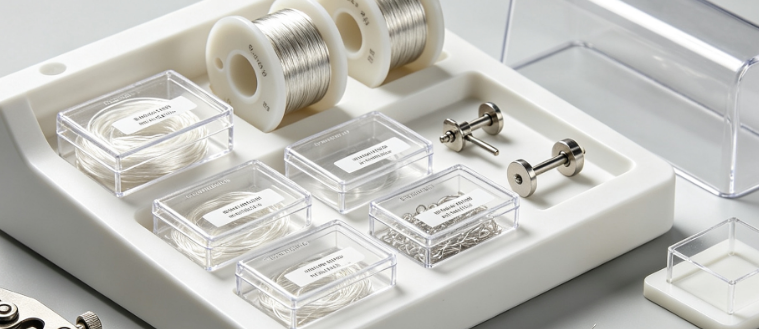
Mechanical Performance – Tensile, Shear, and Micro-Tensile Analysis
The mechanical integrity of silver alloy wires directly impacts bondability, loop stability, and package robustness. Our testing platform includes a high-precision wire tensile tester (Instron 5943 with pneumatic grips) capable of measuring break load, elongation, and tensile strength on wire segments as short as 10 mm, with a force resolution of ±0.01 mN. We perform stress-strain analysis on as-received and aged wires, deriving key parameters including yield strength (at 0.2% offset), ultimate tensile strength (UTS), and uniform elongation. For fine wires (≤25 μm diameter), we employ a micro-tensile stage integrated with a digital image correlation (DIC) system to capture strain localization and necking behavior, providing insights into the ductile-to-brittle transition that may occur due to grain coarsening or impurity segregation.
Bond integrity is assessed via ball shear and stitch pull tests on a Dage 4000 bond tester, compliant with ASTM F1269 and JESD22-B116. We perform these tests at multiple bond parameters (ultrasonic power, time, and bond force) to generate a process window map that identifies the optimal settings for maximum shear strength and failure mode analysis (e.g., bulk fracture, interface delamination, or lift-off). Our system records force-displacement curves, allowing the extraction of stiffness and work-of-fracture metrics that correlate with bond quality and reliability. Furthermore, we conduct high-speed ball pull (HSBP) and wire pull (destructive and non-destructive) tests, with automated data logging and statistical process control (SPC) charts for production monitoring.
Metallurgical Microstructure and Compositional Analysis
The performance and reliability of silver alloy wires are profoundly influenced by their microstructure – grain size, texture, second-phase precipitates, and solute distribution. Our microstructural suite includes scanning electron microscopy (SEM) with electron backscatter diffraction (EBSD) for grain orientation mapping, grain size measurement, and twin boundary analysis. We provide inverse pole figure (IPF) maps, grain size distribution histograms, and texture index values that reveal the drawing-induced fiber texture typical of silver alloys, which affects ultrasonic energy transfer during bonding. For precipitated phases (e.g., Pd-rich or Au-rich particles), we perform energy-dispersive X-ray spectroscopy (EDS) and wavelength-dispersive X-ray spectroscopy (WDS) to identify stoichiometry and spatial distribution, correlating these features with mechanical properties.
For bulk composition, we employ inductively coupled plasma optical emission spectrometry (ICP-OES) and glow discharge mass spectrometry (GDMS) to quantify major alloying elements (Ag, Au, Pd, Pt, Cu, Zn, etc.) with accuracy up to 0.01 wt% and trace impurities down to 0.1 ppm. This is complemented by X-ray fluorescence (XRF) for rapid, non-destructive screening of spools. For surface and near-surface contamination, we use Auger electron spectroscopy (AES) and time-of-flight secondary ion mass spectrometry (ToF-SIMS) to detect organic residues, oxides, and halides that may impair bond adhesion or promote corrosion. All chemical data are benchmarked against industry specifications (e.g., SEMI G62, ASTM E1552).
Corrosion Resistance and Environmental Stability Assessment
Silver is intrinsically susceptible to tarnishing and galvanic corrosion, especially in the presence of sulfur, chlorine, or moisture – a major concern for automotive and industrial electronics. We conduct a series of accelerated corrosion tests tailored to silver alloy wires:
(i) Mixed flowing gas (MFG) testing according to IEC 60068-2-60, exposing wires to controlled concentrations of H₂S, SO₂, NO₂, and Cl₂ at elevated humidity and temperature, with periodic measurement of resistance change and visual inspection for tarnish film thickness.
(ii) Hastelloy (or humidity-thermal-bias) test at 85 °C/85% RH with or without bias voltage to evaluate electrochemical migration and dendritic growth, particularly important for fine-pitch applications.
(iii) Salt spray (fog) testing per ASTM B117 for chlorine resistance, with post-exposure EDS mapping of corrosion products.
Beyond environmental tests, we perform potentiodynamic polarization and electrochemical impedance spectroscopy (EIS) in simulated mold compound leachates (pH-adjusted, containing halides) to quantify corrosion current density, pitting potential, and polarization resistance. These electrochemical parameters allow us to rank the corrosion resistance of different alloy compositions and to predict failure time under field conditions using the Peibart–Wagner model. Our reports include corrosion rate in mpy (mils per year) and comprehensive micrographs of attacked regions, with recommendations for protective coatings or alloy modifications.
Intermetallic Compound (IMC) Growth and Thermal Stability
The interface between the silver alloy ball bond and the aluminum or copper pad evolves over time at elevated temperatures, forming intermetallic compounds (IMCs) such as Ag₃Al, Ag₂Al, or Ag–Cu intermetallics. Excessive IMC growth can lead to Kirkendall voids, increased electrical resistance, and brittle fracture. Our thermal aging and IMC characterization service includes:
– Isothermal aging of bonded samples at temperatures ranging from 150 °C to 300 °C for up to 2,000 hours, with periodic focused ion beam (FIB) cross-sectioning and SEM imaging to measure IMC layer thickness and morphological evolution.
– Transmission electron microscopy (TEM) with selected area electron diffraction (SAED) for nanoscale identification of IMC phases and crystallographic orientation relationships.
– Nanoindentation of IMC layers to determine their hardness and reduced modulus, correlating with embrittlement risk.
– Electrical contact resistance (ECR) measurements using a four-point probe on aged ball bonds, detecting any increase that signals interfacial degradation.
Using the measured IMC growth kinetics, we apply Arrhenius and diffusion-controlled growth models to extrapolate lifetime at typical use temperatures (e.g., 125 °C for automotive). This predictive capability enables our clients to confidently qualify their wire/pad system for extended warranty periods.
High-Temperature Storage Life (HTSL) and Thermal Cycling
Long-term reliability under thermal stress is assessed via high-temperature storage life (HTSL) at 150 °C, 175 °C, and 200 °C for up to 3,000 hours, with intermediate bond pull, shear, and ECR measurements. We also perform thermal cycling from −55 °C to +125 °C (or −65 °C to +150 °C) per JESD22-A104, with 1,000 cycles, monitoring for cracks in the bond or wire heel due to thermal expansion mismatch. All thermal tests are conducted in dedicated multi-chamber ovens with independent temperature controls and continuous logging. We provide Weibull analysis of failure times, yielding characteristic life (η) and shape parameter (β) that guide field reliability projections.
Electrical Resistivity and Signal Integrity
For high-frequency and power applications, the electrical resistivity of the silver alloy wire must be precisely characterized as a function of temperature and aging time. We measure resistivity using a four-point probe system with a temperature-controlled chuck (from −40 °C to +200 °C), deriving the temperature coefficient of resistance (TCR) and the residual resistivity ratio (RRR). These parameters are essential for ohmic loss calculations and EMI/EMC modeling. We also perform impedance spectroscopy (1 MHz to 1 GHz) on bonded loops to evaluate parasitic inductance and capacitance, which become critical for high-speed applications (e.g., 5G, optical transceivers).
Our Distinctive Competencies and Added Value
Our silver alloy wire testing service is defined by technical depth, inter-technique correlation, and a consultative approach. Unlike generic test houses that provide isolated test results, we deliver a unified reliability assessment that links composition, microstructure, mechanical performance, and corrosion susceptibility. For example, we can correlate a slight increase in Pd content (detected by GDMS) with improved corrosion resistance in MFG, but a decrease in ductility observed in tensile tests – allowing clients to trade off properties quantitatively.
Our facility houses a comprehensive set of complementary instruments – from field-emission SEM/EBSD to dual-beam FIB-SEM, high-resolution TEM, and state-of-the-art electrochemical workstations – all under one roof. This eliminates cross-lab variability and accelerates turnaround (typically 5–7 business days for a full characterization package). We are ISO/IEC 17025 accredited for mechanical, electrical, and corrosion testing of metal wires, and we participate in ASTM and JEDEC interlaboratory studies to ensure global comparability.
Our scientific team includes metallurgists and materials engineers with deep expertise in noble metal alloys and wire bonding processes. We offer custom-designed test plans for specific failure modes – e.g., chloride-induced stress corrosion cracking, or palladium-rich precipitate coarsening – and we provide interpretive guidance that translates laboratory data into process improvements (e.g., adjusting the forming gas composition, optimizing bond pad cleanliness, or selecting a more robust alloy grade). We also offer supplier comparison studies, where we benchmark multiple wire lots against your internal specifications, with statistical ranking and risk scoring.
Comprehensive Service Modules – Customizable to Your Application
We structure our testing into modular packages, allowing clients to select the most relevant tests for their stage of development:
Module 1 – Mechanical and Dimensional Characterization: Tensile test (UTS, elongation, yield), micro-tensile, ball shear, stitch pull, wire pull, and diameter uniformity measurement – essential for process window definition.
Module 2 – Microstructural and Compositional Analysis: SEM/EBSD for grain texture, FIB/TEM for IMC analysis, ICP-OES/GDMS for bulk composition, and AES/ToF-SIMS for surface chemistry – critical for material qualification.
Module 3 – Corrosion and Environmental Reliability: MFG (mixed flowing gas), HAST, salt spray, and electrochemical polarization (potentiodynamic, EIS) – for automotive and industrial grade certification.
Module 4 – Thermal Stability and IMC Kinetics: Isothermal aging (up to 300 °C), thermal cycling, HTSL, and IMC thickness measurement with diffusion modeling – for lifetime prediction and failure analysis.
Module 5 – Electrical Performance: Resistivity vs. temperature, TCR, RRR, and high-frequency impedance (up to 1 GHz) – for power and RF applications.
Module 6 – Comprehensive Qualification Package: All modules combined into a single study, including full data analysis, statistical summaries, and a final report with expert commentary and recommendations – ideal for product release, customer audits, or supplier approval.
We accept wire samples in various forms – spools of continuous wire, bonded test coupons, or bare wire segments. Our minimum sample requirement is 10 m of wire per test type, but we can accommodate smaller volumes for exploratory studies.
Data Integrity and Regulatory Compliance
All measurements are conducted under strict quality control, with NIST-traceable calibration of all instruments. Our data management system maintains full audit trails, including operator logs, environmental conditions, and instrument settings. We provide GLP-compliant documentation for clients requiring regulatory submissions (e.g., AEC-Q100, ISO 26262). Our reports include detailed uncertainty budgets, enabling customers to assess measurement reliability for statistical process control. We also ensure confidentiality of proprietary alloy compositions and test results through signed NDAs and secure file transfer protocols.
Client Engagement and Workflow
Our process begins with a consultation to understand your alloy type, intended application (e.g., automotive IC, power module, LED packaging), and specific concerns (e.g., corrosion from sulfur-rich underfills, or IMC overgrowth at high currents). We then propose a tailored test plan, including a fixed-price quote and timeline. Upon sample receipt, we conduct incoming visual inspection, log samples, and initiate testing. Clients receive progressive updates through a secure portal, with raw data available upon request. The final report delivers integrated analysis, graphical summaries, and actionable recommendations. We also offer a post-report debrief via teleconference to discuss implications and further steps.
Conclusion – Empowering Your Silver Alloy Wire Qualification with Unrivaled Analytical Excellence
Silver alloy bonding wires are driving the future of high-performance packaging, but their successful deployment hinges on rigorous, multi-faceted characterization that addresses mechanical, metallurgical, chemical, and electrical aspects in a correlated manner. Our comprehensive testing service provides exactly that – a one-stop, ISO-accredited solution that transforms raw data into predictive intelligence. With our advanced instrumentation, deep metallurgical expertise, and client-centric approach, we empower semiconductor and automotive companies to confidently select and qualify silver alloy wires, ensuring robust bonds, extended lifetimes, and compliance with the most stringent industry standards. Whether you are validating a new alloy composition, troubleshooting field failures, or qualifying a new supplier, our service delivers the clarity and confidence you need to move forward.
We invite you to contact our wire bonding materials specialists to discuss your specific silver alloy testing requirements. Let us help you achieve optimal interconnect reliability – from the wire's crystalline texture to its long-term bond integrity. Your journey to reliable, high-performance silver alloy bonding begins with our expert testing and analysis.