Reasons for choosing our testing services
ZHONGXI Testing has obtained inspection qualification certifications from multiple countries and regions worldwide. We possess a senior testing team and advanced testing methods, providing independent, impartial, and professional third-party verification services for global carbon projects.

Internationally recognized authority
Certified by multiple international standards such as CNAS, VCS, and GS, with reports universally applicable worldwide.

Global service capability
Covering 140+ countries and regions, it supports on-site detection and remote verification in multiple languages.

Professional experimental methods
Adopt standard experimental methods to ensure accurate and reliable data.
Advanced LED Luminous Efficiency Testing – Comprehensive Characterization of Luminous Efficacy, Quantum Efficiency, and Wall-Plug Efficiency
Luminous efficiency – expressed as luminous efficacy (lm/W), external quantum efficiency (EQE), or wall‑plug efficiency (WPE) – is the single most important performance metric for light‑emitting diodes, directly determining energy consumption, thermal load, and application suitability. As LED technology penetrates general lighting, automotive, display, and horticultural markets, the demand for accurate, reproducible, and application‑relevant efficiency characterization has become paramount. Clients seeking LED luminous efficiency testing services typically aim to: (i) verify product performance against datasheet specifications and industry standards (e.g., IES LM‑79, CIE S 025), (ii) optimize epitaxial and chip design for maximum light extraction and carrier injection, (iii) quantify efficiency droop and its dependence on current density and temperature, (iv) separate internal quantum efficiency (IQE) from light extraction efficiency (LEE), and (v) generate comprehensive qualification data for regulatory compliance, customer audits, or competitive benchmarking. Our laboratory offers a fully integrated, ISO/IEC 17025‑accredited LED efficiency testing service that combines absolute photometry, spectroradiometry, electrical characterization, thermal control, and advanced modeling to deliver a complete efficiency fingerprint. We go beyond simple lumen‑per‑watt measurements to provide physics‑based insights that link material quality, device architecture, and operational conditions to efficiency performance, enabling our clients to accelerate development, reduce energy losses, and achieve competitive differentiation.
Fundamental Efficiency Metrics – Luminous Efficacy, EQE, and WPE
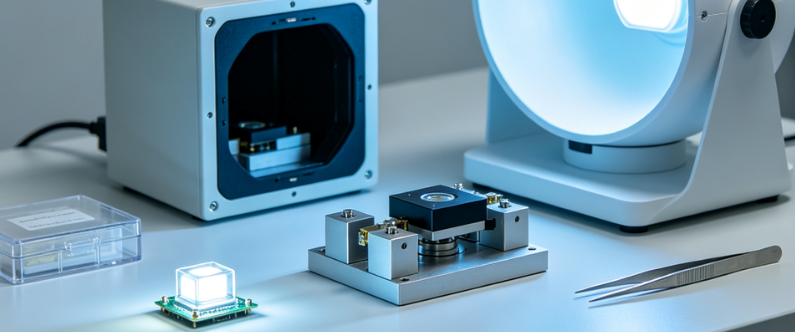
The most basic yet critical parameter is luminous efficacy (lm/W), which quantifies the visible light output per unit electrical power. Our primary measurement platform is a 1.5‑meter integrating sphere (Instrument Systems) coupled with a high‑resolution spectroradiometer (CAS 140D) and a calibrated power supply (Keithley 2657A). We perform absolute flux measurements in accordance with IES LM‑79‑22 and CIE S 025, with traceable calibration to NIST standards. The system simultaneously records total radiant flux (W), luminous flux (lm), spectral power distribution (SPD), and electrical parameters (forward voltage, current), allowing direct calculation of luminous efficacy. We also derive external quantum efficiency (EQE) by combining the radiant flux with the electrical power and the emission wavelength, and wall‑plug efficiency (WPE) as the ratio of optical power to electrical power. All measurements are performed at multiple current levels (from 1 mA to 5 A) and controlled junction temperatures (25 °C, 55 °C, 85 °C, and 105 °C) using a thermoelectric chuck with ±0.1 °C stability, enabling the extraction of temperature coefficients for efficiency (Δη/ΔT) – essential for system‑level thermal design.
For high‑power devices, we additionally measure efficiency droop – the decline in EQE with increasing current density – by comparing pulsed (0.1% duty cycle) and DC measurements at identical junction temperatures, thereby separating self‑heating from intrinsic droop mechanisms (Auger recombination, carrier leakage, or defect‑related saturation). Our analysis includes fitting the droop curve to the ABC model, providing quantitative values for the Auger coefficient (C) and the Shockley‑Read‑Hall (SRH) coefficient (A), which are invaluable for epitaxial optimization.
Internal Quantum Efficiency (IQE) and Light Extraction Efficiency (LEE) – Separating Loss Channels
Total efficiency is the product of IQE, LEE, and electrical injection efficiency. To diagnose the limiting factor, we offer temperature‑dependent photoluminescence (PL) and electroluminescence (EL) measurements to determine IQE. Our PL system uses a 266 nm or 325 nm laser, a cryostat (4 K to 300 K), and a high‑resolution spectrograph. By comparing the integrated PL intensity at 4 K (assuming near‑unity IQE) with that at 300 K, we calculate the room‑temperature IQE with an uncertainty of ±3%. For EL‑based IQE, we measure the emission power at low temperature and low current, then extrapolate to room temperature using the ABC model. The light extraction efficiency is then estimated by comparing the EQE (from electrical measurement) with the IQE (from optical measurement), providing a clear picture of whether losses arise from non‑radiative recombination (material quality) or photon trapping (chip design and packaging).
We also perform angle‑resolved EL using a goniometric stage to measure the far‑field radiation pattern, from which we calculate the extraction efficiency into a defined cone (e.g., ±30°) and the total hemispherical extraction. This information is critical for optimizing surface roughening, patterned sapphire substrates, and encapsulation lenses. For flip‑chip and vertical‑chip architectures, we provide spatially resolved EL mapping to identify current crowding or local non‑radiative regions that reduce overall efficiency.
Thermal Dependence and Junction Temperature Control – The Key to Accurate Efficiency Data
LED efficiency is strongly temperature‑dependent: increasing junction temperature reduces IQE due to enhanced non‑radiative recombination and increases wavelength shift. To obtain accurate efficiency data, we must control and measure junction temperature precisely. Our laboratory employs two independent methods: (i) the forward‑voltage temperature coefficient (K‑factor) method, calibrated from 20 °C to 120 °C using a temperature‑controlled oven, and (ii) transient thermal impedance spectroscopy (T3Ster) to determine the thermal resistance network (junction‑to‑case, case‑to‑ambient). During efficiency measurements, we use the K‑factor to monitor Tj in real time, ensuring that all data are reported at a defined junction temperature. We also measure the efficiency vs. temperature curve (from −40 °C to +150 °C) using a liquid‑nitrogen‑cooled or resistive‑heated stage, providing the temperature coefficient of efficiency (Δη/ΔT) with an accuracy of ±0.5% per 10 °C. This data is essential for predicting performance in real‑world luminaires where thermal management is imperfect.
Advanced Spectral and Color Maintenance Under Efficiency Testing
Efficiency is not the only parameter affected by current and temperature; the emission spectrum also shifts, impacting color point and color rendering. Our testing protocol includes simultaneous spectral monitoring during all efficiency measurements. We report peak wavelength, dominant wavelength, full width at half maximum (FWHM), color coordinates (CIE 1931 and 1976), correlated color temperature (CCT), and color rendering index (CRI) as a function of drive current and junction temperature. This allows clients to assess trade‑offs between efficiency and color quality – for example, whether increasing current for higher output compromises color stability. We also perform color maintenance testing during accelerated aging (e.g., 1,000 hours at 85 °C/85% RH) to ensure that efficiency gains are not offset by chromatic drift.
Reliability and Lifetime Impact on Efficiency – Lumen Maintenance and Degradation Kinetics
Initial efficiency is only part of the story; maintaining efficiency over time is equally critical. We perform LM‑80 compliant lumen maintenance testing at three junction temperatures (55 °C, 85 °C, 105 °C) for a minimum of 6,000 hours, with periodic measurement of luminous flux, electrical power, and spectral distribution. Using the TM‑21 extrapolation method, we project L70 and L50 lifetimes with 90% confidence intervals. For a deeper understanding of degradation mechanisms, we analyze the efficiency decay kinetics using both Arrhenius and Eyring models, extracting activation energies for different failure modes (e.g., contact degradation, defect generation, or phosphor degradation). This predictive capability enables clients to set realistic warranty periods and to optimize packaging for long‑term efficiency stability.
Our Distinctive Competencies – Precision, Depth, and Integration
Our LED luminous efficiency testing service is distinguished by several unique advantages. First, our integrating sphere and spectroradiometer are calibrated annually by NIST‑traceable standards, with a measurement uncertainty of less than 2% for luminous flux and 0.2 nm for wavelength – among the lowest in the industry. Second, we offer true junction temperature control during testing, not just ambient temperature, which is essential for accurate and comparable efficiency data. Third, our laboratory combines photometric, electrical, thermal, and optical techniques under one roof, enabling correlative analysis that reveals root causes of efficiency loss – whether from material defects, contact resistance, or thermal droop. Fourth, our scientific team includes PhD‑level device physicists who can interpret the ABC model parameters, droop behavior, and temperature coefficients in terms of epitaxial quality and chip design, offering actionable recommendations for improvement. Fifth, we provide custom testing protocols for emerging LED technologies such as micro‑LEDs, deep‑UV LEDs, and quantum‑dot LEDs, where standard measurement geometries require adaptation.
We are ISO/IEC 17025 accredited for luminous flux, color, and electrical measurements, and we participate in international round‑robins (e.g., NIST, PTB) to ensure global comparability. We offer rapid turnaround (3–5 business days for standard efficiency packages) and can accommodate single devices, arrays, or full luminaires. Our reports include comprehensive uncertainty budgets, graphical summaries (efficiency vs. current, efficiency vs. temperature, droop curves, and spectral maps), and expert commentary. We also provide post‑report consultation to help clients integrate the data into their development roadmaps.
Comprehensive Service Modules – Tailored to Your LED Application
We structure our testing into modular packages to meet diverse client needs:
Module 1 – Basic Luminous Efficacy and Power Efficiency: Luminous flux, radiant flux, forward voltage, and efficacy at 2–3 current levels and controlled Tj – ideal for datasheet verification and incoming inspection.
Module 2 – External Quantum Efficiency and Droop Analysis: EQE vs. current (DC and pulsed), droop curve fitting to ABC model, and Auger coefficient extraction – essential for epitaxial and chip design optimization.
Module 3 – Internal Quantum Efficiency (IQE) Determination: Temperature‑dependent PL and EL, IQE calculation, and LEE estimation – for separating material and extraction losses.
Module 4 – Thermal Dependence and Junction Temperature Characterization: K‑factor calibration, Tj measurement, efficiency vs. temperature (from −40 °C to +150 °C), and thermal resistance (RθJC, RθJA) – critical for luminaire thermal design.
Module 5 – Lumen Maintenance and Lifetime Prediction: LM‑80 aging at 3 temperatures, TM‑21 extrapolation, and degradation kinetics analysis – for warranty and reliability qualification.
Module 6 – Spectral and Color Maintenance Under Stress: EL spectra, CCT, CRI, and color coordinate monitoring during aging – for applications requiring color stability.
Module 7 – Comprehensive Efficiency Qualification Package: All modules combined into a single project, with integrated analysis, statistical summary, and a detailed interpretive report – suitable for product release, customer audits, or regulatory submissions.
We accept samples in various forms: bare die, packaged LEDs, chip‑on‑board (COB) modules, and finished luminaires. Minimum sample size is 3 units per test condition, though larger sample sizes are recommended for statistical confidence.
Data Integrity, Security, and Reporting
All measurements are performed under strictly controlled conditions (25.0 ± 0.5 °C ambient, unless otherwise specified), with fully traceable calibrations and standard operating procedures. Our Laboratory Information Management System (LIMS) records every step, including operator, timestamp, and environmental parameters, ensuring full auditability. We adhere to strict confidentiality protocols – all client data are encrypted and access‑controlled. Our reports include comprehensive tables, graphs, uncertainty statements, and an executive summary that translates technical findings into actionable insights. Raw data files are available upon request, and we offer a post‑delivery review meeting to discuss results and recommend next steps.
Client Engagement and Workflow
Our engagement begins with a complimentary consultation to understand your LED type, intended application, and specific efficiency concerns (e.g., droop, thermal quenching, or color shift). We then propose a tailored test plan with a fixed price and timeline. Upon sample receipt, we log and inspect the devices, then commence testing. Clients receive progressive updates through a secure portal, with preliminary data shared on request. The final report is delivered in PDF format, and we offer a follow‑up call to discuss the findings and their implications for your development or production.
Conclusion – Empowering Your LED Performance with Unmatched Efficiency Characterization
Luminous efficiency is the ultimate figure of merit for LED technology, and its accurate, reproducible measurement is essential for product development, quality assurance, and market success. Our comprehensive, ISO‑accredited testing service provides not only precise efficacy numbers but also deep insights into the physical mechanisms that govern efficiency – from Auger recombination to thermal droop, from light extraction to material quality. With our state‑of‑the‑art instrumentation, expert scientific team, and client‑centric approach, we empower LED manufacturers and integrators to optimize performance, reduce energy waste, and confidently meet the demands of an ever‑evolving lighting market.
We invite you to contact our LED efficiency testing specialists to discuss your specific needs. Let us partner with you to unlock the full luminous potential of your LED products – from the first prototype to high‑volume production. Your journey to superior LED efficiency begins with our rigorous, insightful, and actionable testing.