Reasons for choosing our testing services
ZHONGXI Testing has obtained inspection qualification certifications from multiple countries and regions worldwide. We possess a senior testing team and advanced testing methods, providing independent, impartial, and professional third-party verification services for global carbon projects.

Internationally recognized authority
Certified by multiple international standards such as CNAS, VCS, and GS, with reports universally applicable worldwide.

Global service capability
Covering 140+ countries and regions, it supports on-site detection and remote verification in multiple languages.

Professional experimental methods
Adopt standard experimental methods to ensure accurate and reliable data.
Comprehensive Rubber Tire Testing Services – Advanced Analytical Solutions for Performance, Safety, and Regulatory Compliance
Rubber tires are among the most safety‑critical components of any vehicle, directly influencing braking distance, fuel efficiency, ride comfort, and structural integrity under extreme loads. A tire’s performance is governed by a complex interplay of compound formulation, reinforcement architecture, curing kinetics, and manufacturing precision. Clients seeking rubber tire testing services typically aim to: (i) verify compliance with international standards such as ISO, ASTM, GB/T, ECE, DOT, and INMETRO, (ii) quantify physical and dynamic properties that determine rolling resistance, wet grip, and wear life, (iii) detect hidden defects in the carcass, belt, and bead areas that could lead to catastrophic failure, (iv) evaluate aging and weathering resistance for extended service life, and (v) generate certification data for homologation, customer audits, and product liability defense. Our laboratory offers a fully integrated, ISO/IEC 17025‑accredited rubber tire testing service that combines physical, mechanical, dynamic, chemical, durability, and non‑destructive testing with advanced instrumental analysis into a unified assessment platform. We do not merely report pass/fail results; we deliver a holistic tire performance fingerprint that correlates compound chemistry, structural design, and manufacturing parameters with real‑world behaviour, empowering our clients to accelerate development, reduce warranty claims, and achieve global market access with confidence.
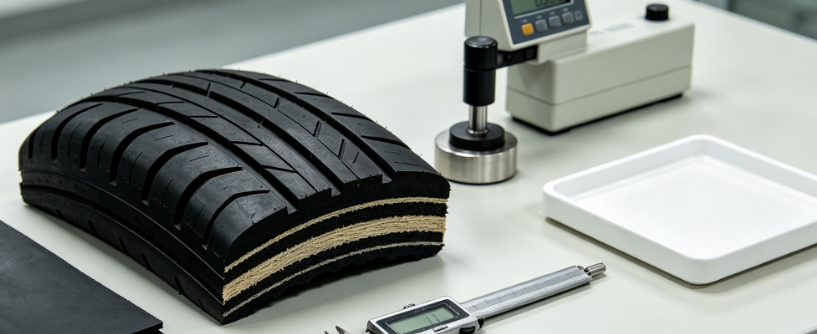
Why Professional Rubber Tire Testing Is Indispensable for Manufacturers, Importers, and Fleet Operators
Tire failures – such as tread separation, sidewall cracking, bead unseating, or excessive heat build‑up – can cause accidents, recalls, and severe reputational damage. Regulatory frameworks worldwide are also tightening: the U.S. DOT requires compliance with FMVSS 109, 119, 139; the EU mandates ECE R30, R54, R117, and the Tire Labelling Regulation (EU) 2020/740; and many countries enforce additional requirements for noise, wet grip, and rolling resistance. Our testing services provide the objective evidence needed to demonstrate conformity, support labelling claims, and win specification battles. We help clients navigate the complex landscape of standards, including ASTM D412, D624, D2240, D573, D1149, ISO 37, 188, 815, 4649, 4664, 2856, and GB/T 519, 528, 531, 1689, ensuring that every tire meets the requirements of its intended application.
Physical and Mechanical Property Testing – Fundamental Compound and Component Performance
The mechanical integrity of tire rubber and its reinforcing components determines load‑bearing capacity, fatigue resistance, and durability. Our laboratory performs a comprehensive suite of tests on cured rubber compounds, cords, and finished tires:
Tensile Properties: tensile strength, elongation at break, and modulus at 100%, 200%, and 300% elongation (ASTM D412, ISO 37) using dumbbell and ring specimens. We evaluate both original and aged samples to quantify degradation.
Tear Strength: Tear resistance (ASTM D624, ISO 34‑1) using trouser, angle, and crescent specimens, critical for resisting crack propagation in tread and sidewall.
Hardness: Shore A and IRHD hardness (ASTM D2240, ISO 48‑4) at multiple locations to assess cure uniformity and compound consistency.
compression set: Permanent deformation after prolonged compression (ASTM D395, ISO 815), indicating the rubber’s ability to recover from sustained loads.
Rebound resilience: Rebound percentage (ASTM D7121, ISO 4662) to correlate with heat build‑up and rolling resistance.
Adhesion and peel strength: Rubber‑to‑cord and rubber‑to‑rubber adhesion (ASTM D4393, ISO 36), essential for belt and carcass integrity.
Specific Gravity and Density: ASTM D297, ISO 2781 for compound formulation verification and weight control.
All tests are conducted under controlled temperature and humidity (23 ± 2 °C, 50 ± 5% RH) to ensure reproducibility, and results are reported with statistical confidence intervals.
Dynamic Mechanical Analysis and Viscoelastic Characterization – Predicting Rolling Resistance and Wet Grip
Dynamic properties govern a tire’s fuel efficiency, traction, and noise. We employ dynamic mechanical analysis (DMA) (ASTM D5992, ISO 4664) to measure storage modulus (E′), loss modulus (E″), and loss factor (tan δ) as a function of temperature (−60 °C to +120 °C), frequency (0.1 to 100 Hz), and strain amplitude. These data allow us to predict rolling resistance (low tan δ at 60–80 °C), wet grip (high tan δ at 0–20 °C), and snow traction (low E′ at low temperature). We also perform rubber process analyzer (RPA) tests (ASTM D6204, D6601) to characterize cure kinetics, filler dispersion, and dynamic properties under simulated processing conditions. For finished tires, we measure rolling resistance coefficient (RRC) using a laboratory drum tester (ISO 28580, SAE J2452) and wet grip index via instrumented trailer or indoor skid pad (ASTM E1337, ISO 23671). These tests provide the data required for EU tire labelling and other regulatory schemes.
Chemical Composition and Contaminant Analysis – Ensuring Formulation Integrity and Environmental Safety
The chemical composition of tire compounds affects performance, aging, and environmental impact. Our analytical suite includes:
Polymer Identification: Fourier‑transform infrared spectroscopy (FTIR) and pyrolysis GC‑MS to identify natural rubber, styrene‑butadiene rubber (SBR), polybutadiene (BR), and blends.
Carbon Black and Silica Content: Thermogravimetric Analysis (TGA) and solvent extraction (ASTM D297, ISO 1408) to quantify reinforcing fillers.
Crosslink Density: Swelling method (ASTM D6814) and nuclear magnetic resonance (NMR) crosslink density analysis to assess cure state and network uniformity.
Antidegradant and Oil Content: HPLC and GC‑MS to quantify antioxidants, antiozonants, and processing oils.
Heavy Metals and PAHs: ICP‑MS and GC‑MS (ISO 18287, ASTM D7439) to detect lead, cadmium, chromium, mercury, and polycyclic aromatic hydrocarbons (PAHs), which are restricted under REACH, CPSIA, and other regulations.
Volatile Organic Compounds (VOCs): Thermal desorption GC‑MS (ISO 16000‑6) to measure emissions for indoor air quality and cabin air quality compliance.
All chemical analyses are performed on state‑of‑the‑art instrumentation with full method validation and NIST‑traceable calibration.
Durability and Aging Testing – Simulating Years of Service in Weeks
Tires must withstand prolonged exposure to heat, oxygen, ozone, UV radiation, and dynamic fatigue. Our durability testing suite includes:
Heat Aging: ASTM D573 and ISO 188 at temperatures from 70 °C to 150 °C, measuring changes in tensile strength, elongation, and hardness.
Ozone Resistance: ASTM D1149 and ISO 1431‑1 under controlled ozone concentration (50–200 pphm) and strain, evaluating crack initiation and growth.
UV Weathering: QUV and xenon‑arc exposure (ASTM G154, G155) to assess surface degradation.
Fatigue Testing: De Mattia flex cracking (ASTM D430, ISO 132) and Ross flex (ASTM D1052) for crack propagation resistance.
Dynamic Drum Testing: High‑speed and endurance testing on a laboratory drum (ECE R30, FMVSS 139) to simulate real‑world loading, measuring temperature build‑up, tread wear, and structural integrity.
Thermal Cycling: Repeated exposure to −40 °C to +120 °C to evaluate thermal shock resistance and component adhesion.
These tests enable us to predict service life, identify weak points in design or compound, and support warranty decisions.
Non‑Destructive Inspection and Structural Integrity – Seeing Inside the Tire Without Cutting
Hidden defects in the carcass, belts, and bead area are a leading cause of tire failure. Our non‑destructive testing (NDT) capabilities include:
X‑ray Radiography: Digital X‑ray imaging (ASTM E94, ISO 5579) to detect belt misalignment, cord breakage, foreign objects, and voids in the tread and sidewall.
Shearography and Laser Interferometry: ASTM E2582 for detecting delaminations, separations, and voids in the tire structure under vacuum or thermal load.
Ultrasonic Testing: Phased array ultrasonic inspection (ASTM E2580) to measure thickness and detect internal discontinuities in the bead and belt areas.
Infrared Thermography: ASTM E1934 to identify hot spots during dynamic testing, indicating localized stress or separation.
CT Scanning: High‑resolution computed tomography for 3D visualization of internal structures, providing unmatched detail for failure analysis.
All NDT procedures are performed by certified inspectors (ASNT Level II/III) and are qualified per ISO 9712 and ASME Section V.
Uniformity, Balance, and High‑Speed Performance – Ensuring a Smooth and Safe Ride
Tire uniformity and balance are critical for vehicle handling, vibration, and safety. We perform:
Uniformity Testing: Radial and lateral force variation, conicity, and ply steer (ASTM F1806, ISO 13328) using a uniformity machine. These parameters affect steering pull, vibration, and tire wear.
Dynamic Balance: Static and dynamic balancing (ASTM F1805, ISO 21944) to measure imbalance and recommend correction weights.
High‑Speed Performance: Step‑speed and endurance tests (ECE R30, FMVSS 139) up to 300 km/h to evaluate centrifugal growth, tread stability, and structural integrity.
Run‑Flat and Bead Unseating: FMVSS 109 and ECE R30 tests to ensure safe performance under extreme conditions.
Noise Testing: ISO 10844 and ECE R117 for exterior pass‑by noise and interior cabin noise, essential for EU labelling and OEM specifications.
These tests provide the data required for vehicle manufacturers, regulatory bodies, and consumers.
Our Distinctive Competencies – Accreditation, Expertise, and Global Compliance
What sets our rubber tire testing service apart is the seamless integration of physical, dynamic, chemical, durability, and NDT testing within a single laboratory, enabling correlative interpretation that is impossible when samples are shipped between multiple vendors. Our team comprises PhD‑level polymer scientists, chemists, and engineers with extensive experience in tire technology, compound formulation, and failure analysis. We do not simply report numbers; we interpret them in terms of raw material quality, manufacturing parameters, and end‑use conditions – for example, distinguishing between rolling resistance loss due to filler dispersion versus cure state, or identifying the root cause of belt separation as an adhesion issue versus a fatigue mechanism.
Our laboratory is ISO/IEC 17025 accredited for a wide range of tire test methods, and we are recognized by major certification bodies (e.g., TÜV, DOT, ECE) as an approved testing partner. We maintain NIST‑traceable calibrations for all equipment and participate in international proficiency testing programs (e.g., ASTM, ISO, ETRTO) to ensure global comparability. We offer rapid turnaround – typically 5–10 business days for standard testing packages, with expedited options available – and we accept samples in various forms: raw rubber compounds, cord and belt materials, and finished tires (passenger, light truck, heavy duty, agricultural, and off‑the‑road). Our data analytics platform employs statistical process control and machine learning to identify trends and anomalies across batches, helping clients monitor supplier quality and optimize their own production.
We also provide custom test plans for novel tire technologies (e.g., airless, self‑sealing, run‑flat, electric vehicle‑specific) and for special environments (e.g., extreme cold, high temperature, high speed). Our consulting services include material selection, certification strategy, and failure analysis with root‑cause determination. We offer pre‑submission reviews of technical dossiers to ensure that all required data are complete and compliant with the target market regulations.
Comprehensive Service Modules – Tailored to Your Tire Type and Application
We organize our testing into modular packages to meet diverse client objectives:
Module 1 – Physical and Mechanical Properties: Tensile, tear, hardness, compression set, rebound, adhesion, and density – essential for compound and component quality control.
Module 2 – Dynamic Mechanical Analysis and Rolling Resistance: DMA, RPA, drum rolling resistance, and wet grip – for fuel efficiency and traction labelling.
Module 3 – Chemical and Environmental Compliance: Polymer ID, carbon black, crosslink density, heavy metals, PAHs, and VOC – for REACH, CPSIA, and OEM requirements.
Module 4 – Durability and Aging: Heat aging, ozone, UV, fatigue, and dynamic drum testing – for service life prediction and warranty support.
Module 5 – Non‑Destructive Inspection: X‑ray, shearography, ultrasonic, thermography, and CT – for defect detection and failure analysis.
Module 6 – Uniformity, Balance, and High‑Speed Performance: Uniformity, balance, high‑speed, run‑flat, and noise – for ride comfort, safety, and regulatory compliance.
Module 7 – Comprehensive Tire Qualification Package: All modules combined into a single project, with integrated analysis, statistical summary, and a detailed interpretive report – suitable for product launch, certification, or regulatory submission.
We also offer on‑site sampling and custom test design for unique tire constructions or applications.
Data Integrity, Security, and Reporting
All measurements are performed under strict SOPs, with fully traceable calibration records and environmental logging. Our Laboratory Information Management System (LIMS) records every operation, operator, and timestamp, ensuring full auditability. We use encrypted data transfer and role‑based access to protect client proprietary information. Our reports include comprehensive tables, graphs, uncertainty statements, and an executive summary that translates technical findings into actionable insights. Raw data files are available upon request. A post‑delivery review meeting is included to discuss results and recommend next steps.
Client Engagement and Workflow
Our engagement begins with a complimentary consultation to understand your tire type, intended application, target market, and specific concerns (e.g., rolling resistance, durability, or regulatory compliance). We then propose a tailored test plan with a fixed price and timeline. Upon sample receipt, we log and inspect the samples, then commence testing. Clients receive progressive updates through a secure portal, with preliminary data shared on request. The final report is delivered in PDF format, and we offer a follow‑up call to discuss the findings and their implications for your product development or certification.
Conclusion – Ensuring Tire Excellence from Compound to Finished Product
Rubber tires are complex, safety‑critical products that must perform reliably under extreme conditions. Our comprehensive, ISO‑accredited testing service provides exactly that – a one‑stop solution that combines physical, dynamic, chemical, durability, and NDT analyses into a unified, interpretable picture. With our advanced instrumentation, deep materials expertise, and global regulatory knowledge, we empower our clients to verify compliance, prevent costly failures, and confidently bring high‑performance tires to market. Whether you are developing a new compound, qualifying a new supplier, or investigating a field return, our service delivers the clarity and confidence you need to succeed.
We invite you to contact our rubber tire testing specialists to discuss your specific requirements. Let us partner with you to ensure that your tires meet the highest standards of quality, safety, and durability – from the factory to the road. Your journey to tire excellence begins with our rigorous, integrative, and actionable testing.