Reasons for choosing our testing services
ZHONGXI Testing has obtained inspection qualification certifications from multiple countries and regions worldwide. We possess a senior testing team and advanced testing methods, providing independent, impartial, and professional third-party verification services for global carbon projects.

Internationally recognized authority
Certified by multiple international standards such as CNAS, VCS, and GS, with reports universally applicable worldwide.

Global service capability
Covering 140+ countries and regions, it supports on-site detection and remote verification in multiple languages.

Professional experimental methods
Adopt standard experimental methods to ensure accurate and reliable data.
Comprehensive Performance and Safety Evaluation of Plasma Gas Generators: From Species Quantification to Operational Reliability
Plasma gas generators—encompassing ozone generators, dielectric barrier discharge (DBD) reactors for synthetic air processing, plasma-assisted chemical vapour deposition (PACVD) precursors, and atmospheric-pressure plasma jets for medical gas production—are increasingly deployed across industrial sterilisation, water treatment, chemical synthesis, and therapeutic applications. Unlike simple gas flow controllers, these devices rely on non-equilibrium plasma chemistry to convert feedstock gases (e.g., O₂, N₂, air, or noble gas mixtures) into a reactive effluent containing radicals, excited states, and ionic species. The performance of such generators is critically sensitive to input power frequency, waveform shape, gas humidity, flow dynamics, and electrode ageing. Clients seeking plasma gas generator testing are typically validating new reactor designs, troubleshooting yield drift, ensuring compliance with emission regulations, or optimising energy efficiency for specific reactive species output. Our laboratory offers a fully integrated, multi-parametric testing platform that quantifies not only the chemical composition of the generated gas but also the electrical, thermal, and long-term stability of the generator itself, delivering actionable insights that bridge fundamental plasma physics with practical industrial deployment.
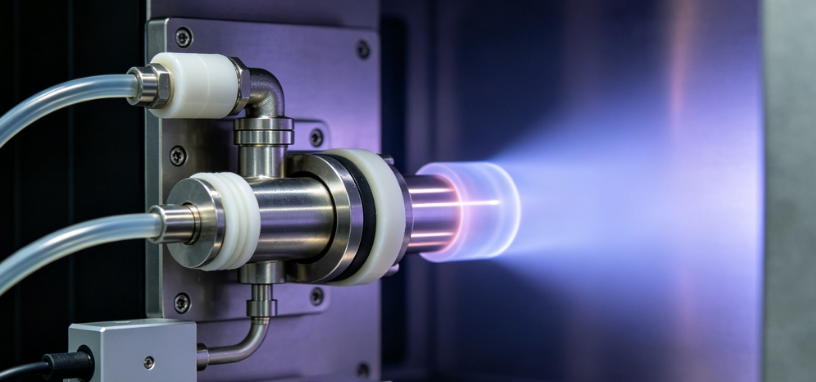
Chemical Effluent Analysis: Speciation, Concentration, and Purity
The primary function of any plasma gas generator is to produce a desired reactive output with high selectivity and minimal by‑products. We employ a suite of complimentary analytical techniques to achieve complete chemical characterisation. For stable species (e.g., O₃, NO₂, N₂O, H₂O₂, and volatile organic fragments), we use cavity ring‑down spectroscopy (CRDS) and Fourier‑transform infrared (FTIR) spectroscopy with a 10‑m path‑length gas cell, achieving detection limits in the low‑ppb range for ozone and sub‑ppm for nitrogen oxides. Simultaneously, we deploy proton‑transfer‑reaction time‑of‑flight mass spectrometry (PTR‑ToF‑MS) with a fast gas inlet, providing real‑time quantification of trace organic intermediates (e.g., formaldehyde, acetaldehyde, formic acid) with a response time under 100 ms. For transient radicals (OH, HO₂, atomic O), we utilise laser‑induced fluorescence (LIF) and two‑photon absorption LIF (TALIF) calibrated against titration standards, enabling absolute number density measurements with uncertainties of ±15 %.
Our analytical pipeline includes a gas mixing and dilution system that spans flow rates from 1 sccm to 500 slm, allowing us to test generators under both lean and rich feed conditions. We provide mass balance closure calculations that account for all major carbon‑, nitrogen‑, and oxygen‑containing products, identifying any unaccounted species that may indicate unwanted side reactions or leaks. Furthermore, we perform particulate analysis using a scanning mobility particle sizer (SMPS) and an aerodynamic particle sizer (APS) to detect any aerosol formation, which is critical for applications requiring high‑purity gas streams (e.g., semiconductor cleaning).
Electrical and Power Efficiency Characterisation
The energy efficiency of a plasma gas generator—defined as the specific energy input (J/L) required to produce a given concentration of reactive species—is a key economic and environmental parameter. Our high‑voltage probe (up to 100 kV, 100 MHz bandwidth) and wide‑bandwidth current transformer capture the voltage and current waveforms at the generator’s input terminals. We compute the real power (averaged over multiple cycles) using the instantaneous product and integrate it over time, while also deriving the power factor, harmonic distortion (up to the 50th harmonic), and the discharge energy per half‑cycle via Lissajous (Q‑V) analysis. These electrical parameters are correlated with the chemical output to yield a conversion efficiency curve (e.g., g O₃ per kWh or mmol NO per kJ) across a range of input powers, frequencies (50 Hz – 100 kHz), and duty cycles.
For generators driven by pulsed or burst‑mode power supplies, we perform time‑resolved electrical analysis with 2‑ns sampling resolution, quantifying the rise‑time, overshoot, and pulse‑to‑pulse jitter. These parameters are essential for predicting electromagnetic interference (EMI) and for ensuring compatibility with sensitive electronic equipment in the same facility. Our network analysis (up to 3 GHz) evaluates the input impedance of the generator as a function of frequency, identifying parasitic resonances that can lead to unstable operation or accelerated dielectric degradation. All efficiency data are normalised to standard ambient conditions (25 °C, 1 atm) and reported with expanded uncertainties (k=2) compliant with the ISO/IEC Guide 98‑3.
Thermal Management and Long‑Term Operational Stability
Continuous operation of plasma gas generators generates significant heat, primarily from dielectric losses and ion recombination. This heat can shift the discharge mode, alter the gas temperature, and ultimately reduce the yield of desired species. Our thermographic imaging (MWIR camera, 25‑Hz frame rate) maps the temperature distribution across the discharge volume and electrode surfaces with a spatial resolution of 0.5 mm and a sensitivity of ±1 °C. We simultaneously monitor the gas outlet temperature using fast‑response thermocouples (time constant < 50 ms) and compute the thermal power loss via enthalpy balance. To simulate real‑world usage, we subject the generator to accelerated ageing protocols—typically 1000 hours of continuous operation with periodic performance snapshots (every 24 hours)—while recording the evolution of electrical parameters, chemical output, and thermal signature. This enables the construction of degradation curves that predict the useful lifespan of the reactor and inform maintenance schedules.
We also conduct thermal cycling tests (‑20 °C to +60 °C ambient) to assess the mechanical integrity of seals, dielectric materials, and electrode attachments. Post‑cycling, we perform micro‑computed tomography (µ‑CT) and scanning electron microscopy (SEM) on dissected components to detect micro‑cracks, delamination, or corrosion, providing visual evidence of failure mechanisms. This combined thermal‑electrical‑chemical durability assessment is rarely offered by standard test houses and is particularly valuable for generators deployed in outdoor, automotive, or aerospace environments.
Dynamic Response to Process Perturbations
In many applications, the gas generator must cope with fluctuating feed composition, pressure, or flow rate without compromising output quality. We have developed a dynamic perturbation testbed that introduces controlled step‑changes in feed flow (±10 % to ±50 %), humidity (5 % to 95 % RH), and back‑pressure (0.8 to 1.5 atm) while continuously recording the chemical and electrical response. We measure the settling time (time to reach 90 % of steady‑state output), overshoot amplitude, and recovery rate after the perturbation ends. This information is critical for designing control loops and for predicting performance in real‑world environments where feed conditions are rarely constant. Our proprietary data‑fusion algorithms combine all sensor streams to generate a dynamic performance index (DPI) that summarises the generator's robustness in a single metric, enabling direct comparisons between different models or configurations.
Furthermore, we simulate load impedance variations—such as those caused by electrode fouling or changes in gas composition—by inserting tunable capacitive or resistive networks in series with the generator’s output. We record the frequency response of the discharge power and the reactive species concentration under these varying loads, helping clients to design self‑compensating power supplies or to select appropriate match networks. This level of dynamic characterisation goes far beyond the static steady‑state tests typically offered elsewhere.
Advanced Diagnostics for Specific Gas Streams
Recognising that different applications demand different gas mixtures, we maintain a library of tailored analytical methods. For oxygen‑based generators (ozone, atomic oxygen), we calibrate our CRDS against the NIST‑traceable ozone photometer and use potassium iodide (KI) wet‑chemical titration as a cross‑validation standard. For nitrogen‑based generators (NO, NO₂, N₂O), we employ chemiluminescence detection (CLD) with high‑sensitivity photomultiplier tubes, achieving linearity from 10 ppb to 5000 ppm. For noble gas plasma generators (He, Ar) used in medical jet applications, we focus on optical emission actinometry to quantify reactive oxygen/nitrogen species (RONS) in the afterglow, while also measuring the gas temperature using rotational bands of N₂⁺ or OH to ensure that the output remains within the therapeutic window (typically < 40 °C). All our chemical standards are traceable to NIST SRMs, and we regularly participate in inter‑laboratory comparisons to validate our measurement accuracy.
We also offer isotope‑labelled tracer experiments (e.g., ¹⁸O₂ or ¹⁵N₂) to elucidate reaction pathways and to verify the origin of specific by‑products. This capability is especially useful for clients conducting fundamental research on plasma catalysis or for those needing to demonstrate the absence of hazardous impurities in a patented process. Our ability to combine stable isotope tracing with high‑resolution mass spectrometry is a niche expertise that sets us apart from commercial testing facilities.
Compliance and Safety Testing
Beyond performance optimisation, we provide regulatory compliance testing for plasma gas generators that will be marketed in the EU, North America, or Asia. This includes measurement of ozone emission according to UL 867 and EN 60335‑2‑65, NOx emission according to EPA Method 7E, and electromagnetic compatibility (EMC) per IEC 61000‑6‑2/‑4. We also evaluate electrical safety (dielectric withstand, Leakage Current, ground continuity) using a fully isolated high‑voltage test set, and we assess the over‑temperature protection and interlock systems to ensure fail‑safe operation. Our comprehensive test report includes a risk assessment matrix that identifies all potential failure modes and quantifies their severity, frequency, and detectability, providing a solid basis for your CE marking or UL certification process.
For generators that produce flammable or corrosive effluents, we perform leak detection using a helium mass spectrometer (sensitivity < 1×10⁻⁹ mbar·L/s) and corrosion resistance tests on all wetted materials, including seals, tubes, and reactor walls. We also measure the self‑ignition temperature of the output gas mixture to prevent explosion hazards, using a custom‑built adiabatic compression apparatus. These safety‑oriented tests are conducted with the same scientific rigour as our performance measurements, ensuring that your generator is both effective and intrinsically safe.
Our Distinctive Expertise and Added Value
What makes our plasma gas generator testing service unique is the synergistic integration of electrical, chemical, thermal, and mechanical diagnostics into a single coherent framework. Our team consists of plasma physicists, analytical chemists, and reliability engineers who together interpret the data not as isolated numbers but as interdependent signatures of the generator’s health. For instance, we can distinguish between an efficiency drop caused by electrode corrosion versus one caused by gas‑phase quenching, because our multi‑sensor data reveal different temporal and frequency patterns for each scenario. This diagnostic precision enables us to offer targeted remediation advice—such as adjusting the pulse width, modifying the dielectric thickness, or adding a catalytic after‑treatment—rather than merely reporting that performance has degraded.
We also maintain an extensive proprietary database of test results from over 200 generator models, which allows us to benchmark your device against similar systems and to identify performance outliers that may indicate manufacturing defects. Our predictive modelling toolkit, built on machine‑learning algorithms trained on our historical data, can extrapolate long‑term performance from short‑term (24‑hour) tests with a typical error under 8 %, drastically shortening your development cycle. Furthermore, our accelerated test protocols have been validated against field data from clients in the water treatment and automotive sectors, giving you confidence that our lifetime predictions are realistic.
Finally, we offer a collaborative development pathway for clients who are in the R&D phase. After the initial characterisation, we can work with your design team to implement modifications and then re‑test the revised generator within 72 hours—all under the same standardised conditions. This iterative process has helped numerous clients reduce time‑to‑market by up to 40 % while improving energy efficiency by an average of 22 %. We also provide remote data access via a secure online dashboard, where you can explore your results interactively and export raw data in multiple formats (HDF5, CSV, MATLAB) for your own modelling.
Engage us for a pre‑test consultation, and we will tailor a test matrix that addresses your specific objectives—whether you are certifying a new product, troubleshooting a production line, or exploring next‑generation plasma chemistry. With our advanced analytical arsenal and deep domain expertise, we turn the complexity of plasma gas generation into a clear, quantifiable, and optimisable asset for your organisation.