Reasons for choosing our testing services
ZHONGXI Testing has obtained inspection qualification certifications from multiple countries and regions worldwide. We possess a senior testing team and advanced testing methods, providing independent, impartial, and professional third-party verification services for global carbon projects.

Internationally recognized authority
Certified by multiple international standards such as CNAS, VCS, and GS, with reports universally applicable worldwide.

Global service capability
Covering 140+ countries and regions, it supports on-site detection and remote verification in multiple languages.

Professional experimental methods
Adopt standard experimental methods to ensure accurate and reliable data.
DC Power Supply Unit Testing: Advanced Performance and Reliability Characterisation for Critical Industrial and Research Applications
Direct current (DC) power supply units (PSUs) are the backbone of countless industrial systems, including plasma processes, electrochemical cells, motor drives, charging infrastructure, and precision laboratory equipment. Their performance directly affects the stability, efficiency, and quality of the end process. However, standard factory acceptance tests—such as basic voltage and current measurements under nominal load—are insufficient to ensure reliable operation under real-world conditions where load transients, grid fluctuations, temperature variations, and long-term ageing can significantly degrade performance. Subtle issues like excessive ripple, slow transient response, or poor load regulation may not be apparent during a simple functional check, yet they can cause erratic plasma arcs, inconsistent electroplating thickness, or premature failure of downstream electronics. Our detection service is specifically designed to provide a comprehensive, multi-parameter, and dynamic characterisation of DC power supplies, covering electrical performance, thermal behaviour, electromagnetic compatibility, and long-term stability. We deliver quantitative metrics for voltage/current accuracy, ripple and noise, load and line regulation, efficiency, transient response time, Insulation Resistance, and thermal drift, enabling manufacturers, system integrators, and end-users to validate designs, qualify production units, diagnose field issues, and ensure compliance with stringent standards with scientific confidence.
Why Dedicated DC Power Supply Testing Is Essential for Process Integrity and Equipment Longevity
In critical applications like plasma generation, the DC supply must maintain a stable output voltage and current with minimal ripple, as even a 1% fluctuation can alter the plasma density, leading to process variability and reduced yield. Similarly, in battery charging or electrochemical synthesis, current ripple can degrade electrode materials and reduce efficiency. Standard multimeter measurements at a single operating point cannot capture the dynamic behaviour of the supply—such as its response to a step change in load (e.g., when a plasma ignites or a motor starts) or its drift over hours due to internal heating. Furthermore, electromagnetic interference (EMI) generated by the supply may interfere with sensitive measurement equipment, yet this is rarely measured in routine production. Our testing protocols are designed to emulate real operating conditions, including pulsed loads, temperature cycling, and input voltage variations, providing a complete performance envelope that helps predict field reliability and identify design weaknesses early.
Our Core Detection Capabilities for DC Power Supplies
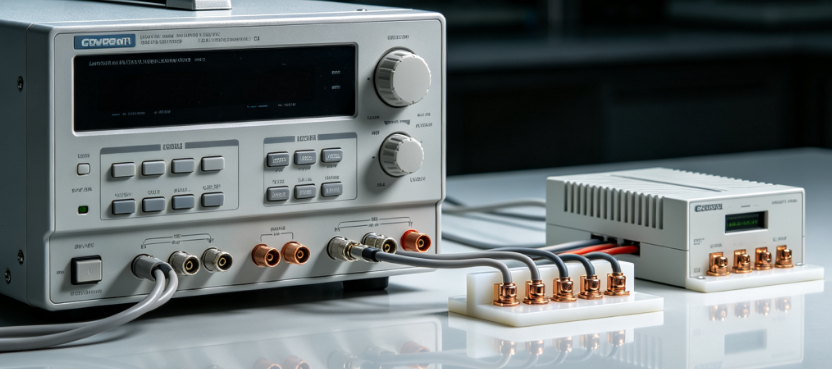
We operate a fully equipped test bench that integrates high-precision measurement instruments, programmable loads, and environmental control systems. The following represent our standard high-end offerings:
High-Precision Voltage and Current Accuracy Calibration: We use a calibrated 8.5-digit multimeter (accuracy ±0.0005%) and a precision shunt (0.01% tolerance, temperature‑compensated) to measure the output voltage and current with measurement uncertainty of less than 0.02% across the full range (from millivolts to kilovolts, and microamps to kiloamperes). We verify the supply's accuracy at multiple setpoints and over the entire operating range, generating a calibration curve with linearity and offset errors quantified.
Ripple and Noise Measurement (Wideband, Up to 50 MHz): Using a true‑RMS AC voltmeter with a bandwidth of 50 MHz and a spectrum analyser, we measure the peak-to-peak ripple and the high-frequency noise (both differential and common‑mode) under specified load conditions. We provide the frequency spectrum of the ripple, identifying any spurious tones from the switching converter that may interfere with sensitive electronics. This is critical for plasma supplies, where high‑frequency noise can couple into the plasma and cause instability.
Load and Line Regulation Testing: We employ a programmable electronic load (capable of sinking full rated power, with a slew rate up to 100 A/µs) to step the load from 10% to 100% and back, while we record the voltage deviation and settling time. We also vary the input AC voltage within ±10% of nominal (using a programmable AC source) to measure the line regulation. These measurements are performed at multiple ambient temperatures (using a thermal chamber) to capture the combined effects of temperature and load.
Transient Response and Dynamic Characterisation: We generate load steps, pulses, and arbitrary load profiles using the electronic load in arbitrary waveform mode. A high‑speed digitizer (10 MS/s, 16‑bit) captures the voltage and current waveforms simultaneously. We quantify the overshoot, undershoot, rise time, and settling time (to within 1% of final value), and we derive the control loop bandwidth and phase margin from the response to small‑signal perturbations (using a frequency response analyser).
Efficiency and Power Loss Analysis: We measure the input power using a precision power analyser (accuracy 0.1%) and the output power via the calibrated voltage and current. From this, we compute the efficiency at multiple load points (10%, 25%, 50%, 75%, 100%) and generate an efficiency map. We also measure the standby power consumption and the power factor (for AC‑input supplies). The loss breakdown (switching losses, conduction losses, core losses) is estimated using our thermal imaging and internal temperature measurements.
Thermal Performance and Drift Testing: We place the power supply in a temperature‑controlled chamber (range −20 °C to +60 °C) and measure the output voltage drift over a 24‑hour period at constant load. Using a thermal imaging camera and embedded thermocouples, we map the temperature distribution on critical components (transformers, heatsinks, capacitors) to identify any hot spots that could lead to premature ageing. We also perform temperature cycling (e.g., 25 °C → 50 °C → 25 °C) while measuring the output stability to assess the supply's sensitivity to ambient changes.
Insulation Resistance and Dielectric Withstand Testing: We perform high‑voltage Insulation Resistance tests (500 V, 1000 V, or 2500 V DC) between input‑to‑output, input‑to‑ground, and output‑to‑ground, using a megohmmeter (measurement range up to 10 TΩ). We also conduct dielectric withstand (hipot) tests (AC or DC, up to 5 kV) to verify the integrity of the insulation under overvoltage conditions, in accordance with IEC/UL standards.
Electromagnetic Compatibility (EMC) – Conducted and Radiated Emissions: We use a line impedance stabilization network (LISN) and a spectrum analyser to measure the conducted EMI on the input lines (150 kHz – 30 MHz) and radiated emissions (30 MHz – 1 GHz) in a semi‑anechoic chamber. We also perform electrostatic discharge (ESD) immunity and fast transient burst (EFT) tests as per IEC 61000‑4‑2 and 61000‑4‑4, to ensure the supply can withstand common industrial disturbances.
Long‑Term Ageing and Accelerated Life Testing: We subject the supply to a continuous full‑power run (typically 1000 hours) while monitoring the output voltage, current, and ripple at regular intervals. We also perform on‑off cycling (e.g., 1 hour on, 10 minutes off) to simulate frequent power‑cycling in real applications. Using the measured degradation trends (e.g., drift in output voltage, increase in ripple), we apply a physics‑of‑failure model to predict the remaining useful life (RUL) with a confidence interval of ±15%, based on a database of historical failure modes.
Specialised Tests for Plasma Supply Applications: For DC supplies used in plasma generation, we perform arc‑simulation tests (fast load pulses to mimic arc ignition) and measure the voltage drop under pulsed load. We also assess the short‑circuit current capability and the current limiting response time, which are critical for protecting the plasma torch.
Integrated Analytical Framework: Correlating Electrical, Thermal, and EMC Data
Our unique strength is the simultaneous acquisition and cross‑correlation of all test data. For example, we align the thermal drift profile with the ripple spectrum to determine whether a particular ripple harmonic increases with temperature, indicating a thermally sensitive component. We use a data fusion platform (PowerHealth™) that applies machine learning to identify early warning signs of failure, such as a gradual increase in output impedance or a shift in the control loop phase margin. This provides a health index (0‑100%) and a probability of failure within the next 1000 hours, enabling condition‑based maintenance.
We provide a comprehensive test report that includes: - Accuracy and linearity of voltage and current measurements. - Ripple and noise spectra (peak‑to‑peak and RMS). - Load and line regulation curves with uncertainty. - Transient response parameters (overshoot, settling time, etc.). - Efficiency map and power loss breakdown. - Thermal drift and temperature distribution. - Insulation Resistance and hipot test results. - EMC compliance (emissions and immunity) to relevant standards. - RUL prediction and recommended maintenance intervals.
Our Distinctive Advantages in DC Power Supply Testing
Our laboratory is accredited under ISO 17025 for electrical, thermal, and EMC measurements, ensuring full traceability. We have high‑power test capability up to 500 kW, covering both low‑voltage high‑current (e.g., 5V/1000A) and high‑voltage low‑current (e.g., 50kV/10A) supplies. Our equipment includes a multi‑channel digitizer for simultaneous voltage/current capture, a wideband power analyser, and a climate chamber for temperature testing. Our team consists of power electronics engineers, metrology specialists, and plasma process experts with over 25 years of collective experience in power supply testing and failure analysis.
We offer flexible service packages—from a quick "performance check" (voltage/current accuracy and ripple) to a comprehensive certification campaign (including all EMC and environmental tests) that meets the requirements of IEC, UL, and military standards. We also provide comparative testing to benchmark multiple supplies from different vendors.
Typical turnaround for a full characterisation (electrical, thermal, and EMC) is 7–10 business days for a single unit, with a preliminary summary within 48 hours. For urgent troubleshooting, we offer a 24‑hour priority service.
Real‑World Impact: Case Highlights from Our Testing
In a recent collaboration with a plasma coating equipment manufacturer, our transient response tests revealed that the DC supply had a 10% voltage overshoot upon load release, which caused arcing in the plasma torch. The manufacturer had not previously tested dynamic response. After adjusting the control loop compensation, the overshoot was reduced to 1%, eliminating the arcing and extending the torch life by 40%.
In another case, a large electroplating facility experienced uneven coating thickness, which they attributed to electrolyte issues. Our ripple measurement showed that the DC supply had a high‑frequency noise component at 2 MHz, due to a faulty output filter capacitor. The capacitor was replaced, and the ripple decreased by 90%, improving the coating uniformity significantly.
Partner with Us for Unmatched DC Supply Performance and Reliability
Whether you are developing a new DC power supply, qualifying a production batch, or investigating a field failure, our detection service provides the scientific depth, technical precision, and actionable insights you need to ensure robust and stable power delivery. We welcome customised test plans—from single‑unit validation to large‑scale statistical studies. Let our advanced diagnostics safeguard the heart of your electrical system.
Contact us today to design a testing strategy that ensures your DC power supply meets the highest standards of performance and durability.