Reasons for choosing our testing services
ZHONGXI Testing has obtained inspection qualification certifications from multiple countries and regions worldwide. We possess a senior testing team and advanced testing methods, providing independent, impartial, and professional third-party verification services for global carbon projects.

Internationally recognized authority
Certified by multiple international standards such as CNAS, VCS, and GS, with reports universally applicable worldwide.

Global service capability
Covering 140+ countries and regions, it supports on-site detection and remote verification in multiple languages.

Professional experimental methods
Adopt standard experimental methods to ensure accurate and reliable data.
knoop hardness Testing Services: Precision Micro‑Hardness Evaluation for Thin & Brittle Materials
As an independent third-party testing service provider, we offer specialised knoop hardness testing for materials where conventional hardness methods (Rockwell, Brinell, macro Vickers) are unsuitable – including thin coatings, brittle ceramics, glass, case‑hardened layers, electroplated and PVD/CVD coatings, semiconductors, small or delicate components, and microstructural phases. The knoop hardness test, developed by Frederick Knoop in 1939, is a micro‑indentation method that uses an elongated rhombic‑based diamond pyramid indenter. Unlike Vickers, which measures both diagonals of a square impression, Knoop measures only the long diagonal, and the indenter geometry produces a shallow impression – approximately half the depth of a Vickers indentation at the same load. This shallow penetration makes Knoop ideal for evaluating hardness gradients in thin sections without substrate interference. Our accredited laboratory follows international standards (ISO 4545, ASTM E384, GB/T 18449, JIS Z 2251) to deliver accurate, reproducible, and legally defensible knoop hardness data across the micro and low‑load ranges (1 gf to 2 kgf / 0.0098 N to 19.6 N). This article outlines our knoop hardness testing capabilities – including scope, key test items, parameter selection, test procedures, and standard methods – to help manufacturers, materials scientists, quality assurance teams, and research laboratories obtain reliable hardness characterisation for challenging materials.
1. What Is knoop hardness Testing?
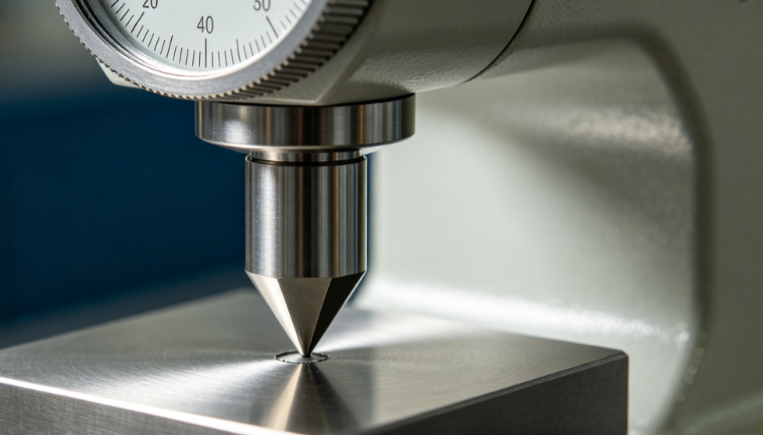
The knoop hardness test is a static micro‑indentation method that presses an elongated rhombic‑based diamond pyramid indenter into the test specimen under a precisely controlled test force. The indenter has a longitudinal edge angle of 172.5° and a transverse edge angle of 130°, producing a thin, elongated indentation with a characteristic long‑to‑short diagonal ratio of approximately 7:1[reference:0][reference:1]. After the test force is removed, only the long diagonal of the indentation is measured optically. The knoop hardness (HK) is calculated as the ratio of the test force to the projected area of the indentation using the formula:
HK = 14.229 × F / d² (with F in N, d in mm) or HK = 1.451 × F / d² (with F in kgf, d in mm), where d is the length of the long diagonal[reference:2][reference:3].
The resulting HK value is dimensionless but must be reported with the test force and dwell time. For example: 450 HK 0.5/20 means a knoop hardness of 450 measured with a test force of 0.5 kgf (500 gf) and a dwell time of 20 seconds.
2. How Knoop Differs from Vickers (Micro‑Hardness Comparison)
While both Knoop and Vickers are optical indentation methods for micro‑hardness testing, they differ fundamentally in indenter geometry, measurement approach, and optimal applications[reference:4]. The Vickers indenter is a square‑based diamond pyramid with a 136° angle between opposite faces, producing a symmetrical square indentation; both diagonals are measured, and the hardness value is calculated from the average diagonal length. The Knoop indenter is an elongated rhombic‑based pyramid with a 172.5° angle along the long axis, producing an asymmetrical, shallow indentation; only the long diagonal is measured. The Vickers indentation depth is approximately 1/7 of the diagonal length, while the Knoop indentation depth is approximately 1/30 of the long diagonal, making Knoop significantly shallower[reference:5][reference:6][reference:7]. For a given test force, the Knoop long diagonal is roughly 3.0 times longer than a Vickers diagonal, which enhances measurement resolution – a critical advantage when small indentations are produced (e.g., low loads, hard materials)[reference:8]. However, Knoop is more sensitive to surface preparation and operator skill because the shallow indentation requires a highly polished surface to obtain sharp, measurable corner boundaries. Vickers is better suited for small rounded areas and general micro‑hardness testing, while Knoop excels for thin coatings, brittle materials (where deeper Vickers indentation may cause cracking), and small elongated areas[reference:9]. Both methods can be performed on the same micro‑hardness testing machine by interchanging indenters.
3. Our Testing Scope for knoop hardness
We cover a specialised range of materials, products, and test configurations where micro‑indentation hardness is essential:
By material type / application: Thin coatings and surface layers – PVD and CVD coatings (TiN, TiAlN, CrN, DLC), electroplated coatings (nickel, chromium, gold, silver), thermal spray coatings, anodised aluminium oxide layers, conversion coatings, and automotive paint layers; Brittle materials – technical ceramics (alumina, zirconia, silicon carbide, silicon nitride, tungsten carbide‑cobalt cermets), glass (optical glass, float glass, glass ceramics), enamel and glazed surfaces; Case‑hardened components – carburised, carbonitrided, nitrided, induction‑hardened, and flame‑hardened surface layers where case depth is shallow (0.05‑0.3 mm); Semiconductor and electronic components – silicon wafers, GaAs, SiC substrates, solder bumps, microelectromechanical systems (MEMS), and wafer dicing evaluation; Small and delicate parts – watch gears, medical implants (dental crowns, hip joints), precision instrument components, miniature gears, bearings; Aerospace materials – quartz glass, ultra‑low expansion glass ceramics, and composite interface zones; Minerals and geological samples – including hard rock, ore sections, and single mineral grains; Powder metallurgy components; Welded zones – micro‑hardness mapping across weld metal and heat‑affected zones (HAZ); Research and development – phase‑specific hardness, anisotropic material evaluation, and failure analysis.
By test condition / environment: Laboratory micro‑hardness testing (precision Knoop testers with automated optical measurement, 1 gf to 1000 gf, up to 2 kgf by arrangement); Elevated or low temperature (‑50°C to +200°C for specific materials – by arrangement); Ambient temperature (23 ± 2°C standard with humidity control 45‑55% RH per ISO 4545).
By specimen configuration: Bulk samples (requires polishing to mirror finish); Thin sections and coated parts; Metallographic cross‑sections – mounted samples (25 mm or 30 mm diameter, with hardness traverse lines for case depth profiling); Small irregular samples – resin mounting recommended to facilitate alignment and indentation; Thin foils and strips down to 0.05 mm thickness (requires careful support to avoid deformation).
4. International Standards & Compliance
All knoop hardness tests are performed in strict accordance with the following international standards:
ASTM E384 (Standard test method for microindentation hardness of materials) – the primary US standard covering both Vickers (HV) and Knoop (HK) micro‑hardness testing with test loads from 1 gf to 1000 gf (0.0098 N to 9.807 N). It defines test procedures, verification of testing machines (direct and indirect methods), calibration of reference hardness blocks, specimen preparation, measurement requirements (diagonal length ≥ 20 μm), indentation spacing (≥ 2.5× diagonal length from edge; ≥ 3× between adjacent indentations), and reporting rules[reference:10][reference:11]. It is designed to evaluate small volumes, thin sections, coatings, and microstructural phases where conventional hardness testing is unsuitable[reference:12].
ISO 4545‑1 (Metallic materials – knoop hardness test – Part 1: Test method) – the international equivalent of ASTM E384 for Knoop testing, covering test force range 0.09807 N to 19.614 N (1 gf to 2 kgf). It specifies test force application, dwell time, indentation measurement criteria (long diagonal only), and result expression (HK)[reference:13][reference:14].
GB/T 18449.1 (Metallic materials – knoop hardness test – Part 1: Test method) – Chinese national standard, aligned with ISO 4545, covering test principle, equipment, procedure, and reporting.
JIS Z 2251 (knoop hardness test – Test method) – Japanese industrial standard for knoop hardness testing.
ASTM E92 (Standard test methods for Vickers and knoop hardness of metallic materials) – supplementary standard covering macro‑load ranges and providing guidance on instrument verification[reference:15].
ISO 4545‑2 (Verification and calibration of testing machines).
ISO 4545‑3 (Calibration of reference blocks).
GB/T 9790 (Metallic and other inorganic coatings – Vickers and Knoop microhardness tests).
5. Key Test Items & Measurement Parameters
Our knoop hardness testing services focus on precise micro‑indentation measurement and hardness characterisation at the micro‑scale.
knoop hardness value (HK) – computed from the measured long diagonal length of the indentation and the applied test force. The formula used per ISO 4545 and ASTM E384 is: HK = 14.229 × F / d² (F in Newtons, d in mm) or HK = 1.451 × F / d² (F in kgf, d in mm). The indentation must be free from cracks, asymmetrical shapes, or surface defects; otherwise, the measurement is invalidated[reference:16][reference:17].
Indentation long diagonal measurement – the long diagonal of the Knoop indentation is measured using an optical microscope with calibrated reticle or automated image analysis system. The measurement resolution must be ≤ 0.5 μm, with a minimum measurable diagonal length of 20 μm (per ASTM E384). Shorter diagonals produce unacceptable measurement uncertainty[reference:18][reference:19]. The measurement accuracy is enhanced because the Knoop long diagonal is approximately 3 times longer than a Vickers diagonal for the same load, improving the signal‑to‑noise ratio for small indentations[reference:20].
Test force (load) selection – the Knoop test force range is 1 gf to 2000 gf (0.0098 N to 19.6 N) per ISO 4545 and ASTM E384, with typical micro‑hardness forces of 10 gf, 25 gf, 50 gf, 100 gf, 200 gf, 300 gf, 500 gf, 1000 gf, and optionally 2000 gf[reference:21]. For ultra‑thin coatings (< 10 μm), loads of 1‑50 gf are used to ensure indentation depth does not exceed 10% of coating thickness. For brittle ceramics, loads of 100‑500 gf are typical to prevent cracking at indentation corners. For semiconductors and glass, 10‑200 gf is common. The test force tolerance is ±1.0% for loads ≥ 100 gf and ±1.5% for loads below 100 gf, per ISO 4545‑2.
Dwell time (loading duration) – The test force is maintained for a specified hold period. For metallic materials and coatings, standard dwell time is 10‑15 seconds. For polymers, ceramics, and glass, longer dwell times of 30‑60 seconds are used to allow full plastic deformation and creep stabilisation. Dwell time tolerance is ±0.5 seconds[reference:22].
Indentation spacing – To avoid edge effects and work‑hardening interference, proper spacing is critical per ISO 4545 and ASTM E384: distance between indentation centre and specimen edge ≥ 2.5 × long diagonal length; distance between adjacent indentation centres ≥ 3 × long diagonal length for parallel (side‑by‑side) indentations; for head‑to‑head indentations (aligned along the long axis), minimum spacing ≥ 1 × long diagonal length of the larger indentation[reference:23].
Specimen thickness requirement – To ensure that the substrate does not influence the hardness measurement, the specimen thickness must be ≥ 10 times the indentation depth (per ASTM E384). The Knoop indentation depth is only about 1/30 of the long diagonal length – significantly shallower than Vickers (1/7 of diagonal). Consequently, Knoop can test much thinner specimens than Vickers at the same load. For a typical 100 gf load, the Knoop indentation depth is approximately 1‑3 μm, allowing testing of coatings and surface layers down to 10‑20 μm thickness[reference:24][reference:25].
Hardness gradient / case depth profiling – for carburised, nitrided, or induction‑hardened components, we perform a series of Knoop indentations at progressively increasing distances from the surface (e.g., at intervals of 0.025 mm, 0.05 mm, or 0.10 mm) using an automated XY motorised stage. The hardness profile (HK vs. distance from surface) is plotted, and the effective case depth is defined as the distance from the surface where the hardness falls to a specified value (e.g., 550 HK for carburised steel per ISO 2639).
Coating‑only hardness (substrate‑free evaluation) – by selecting an appropriately low test force such that the indentation depth does not exceed 1/10 of the coating thickness, we can measure the true hardness of the coating material without substrate interference. For a 2 μm TiN coating, a 10 gf test force will produce an indentation depth of approximately 0.15 μm, fully within the coating layer[reference:26].
Anisotropy assessment – for anisotropic materials (single crystals, oriented polymers, certain metals), knoop hardness is measured along different crystallographic orientations (e.g., <100> vs. <110> on silicon wafers) to quantify directional hardness variations. The specimen is rotated under the indenter, and hardness is measured at fixed angular increments.
6. Test Procedure & Specifications
Our laboratory strictly follows the procedural requirements of ISO 4545‑1 and ASTM E384. The key steps and specifications are summarised below:
Specimen preparation – The test surface must be highly polished to a mirror finish (Ra ≤ 0.1 μm) to ensure that the indentation edges are clearly visible and measurable. For micro‑hardness testing, any surface scratches, oxide scale, or contamination will distort the indentation shape and produce erroneous results. Metallographic preparation typically involves sequential grinding (600, 800, 1200 grit), polishing with 3‑1 μm diamond paste, and final polishing with 0.05 μm colloidal silica. For cross‑sectional hardness traverses, the specimen is mounted in epoxy or acrylic resin, polished, and then etched (if required to reveal microstructural features). Small or irregular samples are resin‑mounted to provide a flat, stable surface for testing[reference:27][reference:28].
Indentation procedure – The specimen is placed on a rigid anvil and levelled. The test force is applied smoothly, without impact or vibration. The force is increased at a rate not exceeding 0.1‑1.0 N/s until the full test force is reached. The full force is maintained for the specified dwell time (typically 10‑15 seconds for metals, 30‑60 seconds for ceramics and polymers). After dwell, the force is removed, and the indentation is measured.
Indentation measurement – The long diagonal length (d) of the Knoop indentation is measured using an optical microscope with calibrated reticle or an automated image analysis system. The magnification must be sufficient to resolve the indentation corners clearly – typically 400× to 1000×. The long diagonal is measured from the centre of one rounded end to the centre of the opposite rounded end. The measurement resolution must be ≤ 0.5 μm. For each valid indentation, the HK value is calculated using the standard formula. If the two long‑diagonal ends appear asymmetric or the indentation shows cracking at the corners, the indentation is rejected and the test is repeated. A minimum of 3 to 5 valid indentations are performed for routine quality control; 5 or more are recommended for acceptance testing.
Verification & calibration – The knoop hardness tester is verified daily (or before each test series) using certified reference hardness blocks calibrated to ISO 4545‑3. At least 5 indentations are made on a block with hardness in the expected range; the average HK must be within the certified tolerance (±5% for micro‑hardness ranges). The measuring system (microscope reticle) is checked using a stage micrometer. Annual direct verification by an accredited calibration laboratory verifies test force accuracy (±1.0% for loads ≥ 100 gf), indenter geometry (pyramid angles, tip radius), dwell timer (±0.5 s), and measurement system accuracy.
7. Typical Applications & Suitable Materials
knoop hardness testing is uniquely suited for the following applications where Vickers or macro‑hardness methods are inadequate:
Thin coatings and surface layers – PVD coatings (TiN, TiAlN, CrN, DLC) applied to cutting tools, decorative coatings, and wear‑resistant layers; electroplated coatings (nickel, chromium, gold, silver) on electronic connectors, jewellery, and automotive trim; anodised aluminium oxide layers (e.g., Al₂O₃ on aircraft components); thermal spray coatings (e.g., WC‑Co, Cr₂C₃‑NiCr); conversion coatings (phosphate, chromate). For each application, load is selected so that indentation depth ≤ 1/10 of coating thickness to avoid substrate influence. For a 3 μm TiN coating, a 25 gf load is typical, producing an HK of approximately 2000‑2400[reference:29].
Brittle ceramic materials – advanced ceramics such as alumina (Al₂O₃), zirconia (ZrO₂ – partially stabilised, yttria‑stabilised), silicon carbide (SiC), silicon nitride (Si₃N₄), tungsten carbide‑cobalt cermets (WC‑Co), and beryllium oxide (BeO). The shallow Knoop indentation reduces the risk of crack initiation compared to Vickers[reference:30]. Loads of 100‑500 gf are typical, producing HK values ranging from 600 for low‑density alumina to 2000‑2800 for SiC and WC‑Co.
Glass and optical materials – float glass, borosilicate glass (BK7), quartz glass, soda‑lime glass, optical glass, glass ceramics (e.g., Zerodur), and enamel coatings. The shallow penetration prevents excessive surface damage and crack propagation. knoop hardness provides a direct measure of scratch resistance and brittleness. For glass, loads of 100‑300 gf are common, with HK ranging from 400‑650[reference:31].
Semiconductor wafers – silicon (monocrystalline and polycrystalline), GaAs, SiC, and sapphire substrates for microelectronics, MEMS, and LED manufacturing. Knoop testing evaluates wafer surface integrity after polishing, detects subsurface damage (SSD), and assesses mechanical stability. For silicon wafers, loads of 10‑100 gf are typical, with HK of approximately 1000‑1200 for <100> orientation and 1100‑1300 for <111> orientation. Anisotropy measurements on single‑crystal silicon can detect hardness variations of 10‑15% between crystallographic directions[reference:32].
Case‑hardened layers – shallow carburised layers (effective depth 0.1‑0.8 mm), nitrided layers (0.05‑0.6 mm), induction‑hardened zones, and flame‑hardened surfaces. Hardness traverse profiling from the surface inward determines the effective case depth (defined as depth where HK drops to a specified value, e.g., 550 HK per ISO 2639).
Small or delicate parts – watch gears, orthodontic wires, dental crowns, miniature bearings, surgical tools, and micro‑injection‑moulded components. The small indentation (long diagonal typically 30‑100 μm) is virtually non‑destructive and does not compromise the function of the part.
Aerospace components – quartz glass (SiO₂) windows for space applications, ultra‑low expansion glass ceramics for mirror substrates, and ceramic matrix composites (CMC) for high‑temperature turbine components.
Research & failure analysis – micro‑hardness of individual phases in metallic alloys (martensite, bainite, ferrite, pearlite), residual stress assessment (via hardness gradients), and micro‑indentation of failed components to identify localised softening or hardening.
8. Advantages & Limitations of knoop hardness Testing
Understanding the strengths and limitations of the Knoop method ensures proper selection and interpretation for your specific materials and applications.
Advantages: Extremely shallow indentation (depth ≈ 1/30 of long diagonal) – up to 4 times shallower than Vickers at the same test force[reference:33]. This makes Knoop uniquely suited for testing thin coatings (< 20 μm), surface layers, and brittle materials without risk of substrate influence or crack initiation[reference:34]. The long diagonal is approximately 3 times longer than a Vickers diagonal for the same load, providing higher measurement resolution and minimising reading errors when working with small indentations[reference:35]. The small indentation size is virtually non‑destructive, making Knoop ideal for finished components where cosmetic or functional surface integrity must be preserved. The single‑diagonal measurement (long diagonal only) is simpler and faster than Vickers (which measures two diagonals). Excellent for anisotropic materials – allows hardness measurement along specific crystallographic orientations (rotatable stage).
Limitations: Requires a highly polished mirror finish (Ra ≤ 0.1 μm) for accurate measurement – more stringent than Vickers (Ra ≤ 0.4 μm acceptable)[reference:36]. The test is sensitive to surface preparation quality; any remaining scratches, residual stress, or contamination will distort the indentation shape and produce erroneous results. The measurement process is slower than Rockwell (typically 30‑60 seconds per indentation, including positioning, loading, measurement, and analysis). High‑quality optics and a skilled operator are required to consistently resolve the indentation corners. For very soft materials (plastics, soft non‑ferrous metals), the indentation may not retain a sharp shape, making measurement difficult. Knoop is not recommended for test forces producing a long diagonal less than 20 μm (due to measurement uncertainty)[reference:37]. The method is less common than Vickers; fewer laboratories offer Knoop testing, and reference hardness block selection is more limited. Not suitable for very hard materials above 3000 HK (indenter tip damage risk).
9. Reporting & Result Presentation
Our test reports are detailed, transparent, and compliant with ISO/IEC 17025 and ASTM E384/ISO 4545 requirements. Each report includes:
Specimen identification – material grade, coating specification (if applicable), component description, sampling location, orientation (for anisotropic materials), and any special preparation (mounting, polishing, etching).
Test conditions – standard referenced (ASTM E384, ISO 4545, GB/T 18449, JIS Z 2251), test force (e.g., 100 gf, 0.5 kgf), dwell time (seconds), indenter type (Knoop diamond, serial number), temperature (23 ± 2°C), humidity (45‑55% RH), and equipment model.
Individual indentation data – for each indentation: long diagonal length (μm), calculated HK value, and any remarks (crack presence, asymmetry, rejection). For case depth profiling: a table of HK vs. distance from the surface (mm).
Statistical summary – mean HK, standard deviation (SD), coefficient of variation (CV), range, and minimum/maximum values. For acceptance testing, the number of indentations and the measurement uncertainty (per ASTM E384) are reported.
Metallographic images – high‑resolution optical microscope images of each indentation, showing the long diagonal measurement lines. For automated systems, the indentation detection and measurement overlay is included.
Equipment calibration status – model and serial number of knoop hardness tester, date of last calibration, reference block identification (e.g., HK 640 block) and certified value, verification results (average measured HK vs. block certified value, repeatability %).
Compliance statement – pass/fail determination against specification limits, customer purchase order, or material standard (e.g., “The measured average hardness of 1920 HK 0.1 meets the requirement of 1850‑2000 HK 0.1 for this TiN coating”). For case depth profiling, the effective case depth (mm) at the specified hardness threshold (e.g., 550 HK) is clearly stated.
10. Why Choose Our Third‑Party knoop hardness Testing Services?
As an independent laboratory with specialised expertise in micro‑indentation hardness testing, we provide unbiased, accurate, and legally defensible data. Our strengths include:
ISO/IEC 17025 accreditation – Our knoop hardness testing is CNAS (China National Accreditation Service) and CMA (China Metrology Accreditation) certified, with regular participation in inter‑laboratory proficiency testing (e.g., ISO 4545 round robins)[reference:38].
Specialised micro‑hardness testers – We operate fully automated Knoop/Vickers micro‑hardness testers (Wilson Tukon 2500, Mitutoyo HM-220, Shimadzu HMV-G21, Buehler Micromet 5106) with test force resolution down to 0.01 gf, maximum magnification 1000×, and motorised XY stages for automated traverse lines (case depth profiling). Our instruments feature closed‑loop load cell technology for precise force control (±0.5% accuracy) and automated image analysis with AI‑assisted indentation edge detection[reference:39].
Comprehensive test force range – We perform Knoop testing from 1 gf (0.0098 N) up to 2000 gf (19.6 N), covering ultra‑thin coatings (1‑10 gf), standard coatings (10‑200 gf), ceramics and glass (100‑500 gf), and bulk material evaluations (500‑2000 gf).
Thin coating expertise – For coating‑only hardness measurements (PVD, CVD, electroplated, anodised, thermal spray), we select test forces such that indentation depth ≤ 10% of coating thickness, ensuring a substrate‑free reading. We also perform gradient Knoop testing across coating cross‑sections to map hardness from surface to substrate[reference:40].
Case depth profiling – Our automated motorised stages can perform up to 50‑100 indentations along a programmed traverse line, with spacing as fine as 0.025 mm. Hardness depth profiles are generated with statistical analysis and effective case depth calculation per ISO 2639, GB/T 9450, or QC/T 262.
Fast turnaround – Routine knoop hardness testing (batch of 5 specimens, 5 indentations each) typically completed within 2‑3 business days. Automated case depth profiling (50 indentations) in 3‑5 business days. Full type testing (multiple loads, anisotropy) in 1‑2 weeks.
Detailed reporting – Includes indentation images with measurement overlays, hardness tables, statistical summaries, hardness‑depth graphs (for case profiling), equipment calibration certificates, and clear pass/fail conclusions against customer or specification limits.
Confidentiality – Full protection of your material composition, coating recipe, component geometry, and test objectives.
Consultative support – Our metallurgists and materials scientists assist with load selection (ensuring indentation depth ≤ 10% of coating thickness), interpretation of anisotropic hardness results, diagnosis of cracking or asymmetrical indentations, and optimisation of sample preparation (polishing, mounting, etching).
Whether you need to certify a PVD coating on a cutting tool, measure case depth of a nitrided gear, evaluate the hardness of a brittle ceramic, assess the surface integrity of a silicon wafer, or perform anisotropic hardness mapping on a single crystal component, our knoop hardness testing experts are ready to deliver reliable, actionable results.
Get Started with Your knoop hardness Testing Project
Contact our team with your material type (coating, ceramic, glass, semiconductor, case‑hardened layer, etc.), expected hardness range (HK), required test force or coating thickness (for load selection), applicable standard (ASTM E384, ISO 4545, GB/T 18449, JIS Z 2251, or custom), and any special requirements (case depth profiling, anisotropy mapping, elevated/low temperature testing). We will provide a detailed quotation, sample submission guidelines (including surface preparation recommendations, recommended minimum thickness, and mounting requirements for small/irregular specimens), and a testing schedule. Let us help you obtain precise, accurate knoop hardness data for your most challenging thin, brittle, or delicate materials.
This article provides an overview of our knoop hardness testing capabilities. For specific test methods, sample quantity, and pricing, please request a tailored service proposal.