Reasons for choosing our testing services
ZHONGXI Testing has obtained inspection qualification certifications from multiple countries and regions worldwide. We possess a senior testing team and advanced testing methods, providing independent, impartial, and professional third-party verification services for global carbon projects.

Internationally recognized authority
Certified by multiple international standards such as CNAS, VCS, and GS, with reports universally applicable worldwide.

Global service capability
Covering 140+ countries and regions, it supports on-site detection and remote verification in multiple languages.

Professional experimental methods
Adopt standard experimental methods to ensure accurate and reliable data.
High-Voltage Discharge Electrode Testing: Advanced Diagnostics for Corona, Spark, and Plasma Systems
High-voltage discharge electrodes are fundamental components in a vast array of industrial, scientific, and medical systems, including electrostatic precipitators, spark igniters, ozone generators, high-voltage switches, pulsed power systems, and plasma reactors. Their performance hinges critically on the geometry of the active surface, the integrity of insulation, the resistance to electrical erosion, and the stability of the discharge onset voltage. However, the extreme electric fields (often exceeding 10⁶ V/m) and repeated high-energy pulses impose severe stresses that lead to micro-cracking, surface roughening, metal sputtering, dielectric degradation, and eventual failure. Routine visual inspection and simple resistance checks are entirely inadequate to detect these incipient changes or to predict the statistical variability of breakdown events. Our detection service is specifically designed to provide a comprehensive, multi-parametric, and statistically rigorous characterisation of high-voltage discharge electrodes, covering geometric precision, surface condition, electrical withstand capability, partial discharge activity, and long-term reliability. We deploy state-of-the-art high-voltage test systems, partial discharge analysers, and advanced microscopy to deliver quantitative metrics for Breakdown Voltage, hold-off time, field enhancement factor, surface charge decay, erosion rate, and partial discharge inception voltage (PDIV), enabling manufacturers, utility engineers, and research laboratories to validate designs, qualify production batches, diagnose service failures, and optimise electrode materials with scientific confidence.
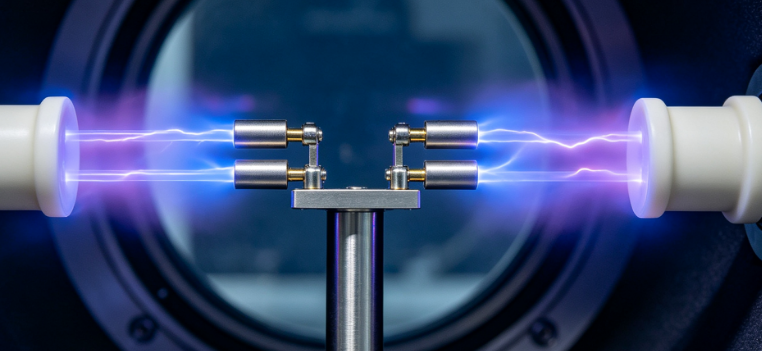
Why Dedicated High-Voltage Electrode Testing Is Critical for System Safety and Lifetime
In high-voltage applications, the electrode is often the weakest link in the chain. A reduction in Breakdown Voltage of only 5% can lead to premature flashover, causing system downtime and potential damage to associated electronics. Surface contaminants, even at the molecular level, can alter the field emission characteristics and initiate corona discharge at voltages well below the design value. Moreover, the statistical nature of gas breakdown—governed by the Townsend and streamer mechanisms—means that a single electrode may pass a factory test yet fail unpredictably in the field under slightly different environmental conditions (humidity, pressure, temperature). Standard factory tests, often based on a single shot at a fixed voltage, do not provide the Weibull distribution of Breakdown Voltages or the time-dependent degradation caused by repeated pulses. Our testing protocols are designed to emulate the actual operational stress, including voltage ramps, repetitive pulses, and environmental variations, providing a complete statistical picture that enables condition-based maintenance and design optimisation.
Our Core Detection Capabilities for High-Voltage Discharge Electrodes
We operate a fully shielded high-voltage test laboratory equipped with precision measuring instruments, environmental control, and non-destructive inspection tools. The following represent our standard high-end offerings:
High-Voltage Withstand and Breakdown Voltage Testing: Using a programmable high-voltage source (AC, DC, and impulse up to 300 kV) and a high-precision voltage divider (accuracy ±0.1%), we perform ramp tests (voltage increase at controlled rates), step-stress tests, and impulse tests (1.2/50 µs and 10/700 µs waveforms). We record the Breakdown Voltage and the time to breakdown, and we apply Weibull statistics to determine the characteristic Breakdown Voltage (V63.2) and the shape parameter (β), which indicates the uniformity of the electrode's performance. We also measure the hold-off voltage for prolonged stress (up to 1000 hours) to assess long-term stability.
Partial Discharge (PD) Measurement and Localisation: We use a wideband PD detector (frequency range 100 kHz – 50 MHz, sensitivity 1 pC) in accordance with IEC 60270. We measure the partial discharge inception voltage (PDIV), the extinction voltage (PDEV), and the apparent charge magnitude (pC) as a function of applied voltage. Our multi-channel PD mapping system, using multiple high-frequency current transformers (HFCT), allows us to locate the source of PD activity within the electrode assembly—whether it is on the tip, along the shank, or at a connection point. This is critical for identifying weak points in the insulation or at the metal-dielectric interface.
Surface Roughness and Topography Analysis (Pre- and Post-Stress): Using a white-light interferometer (vertical resolution 0.1 nm) and a scanning electron microscope (SEM), we quantify the surface roughness (Sa, Sq, Sz) and the micro-crack density on the electrode surface. We perform this analysis on virgin electrodes and again after accelerated ageing to quantify the erosion rate (µm per kilo-pulse) and the change in effective field enhancement factor. We also use atomic force microscopy (AFM) to map the surface potential and work function distribution at the nanoscale.
Field Enhancement Factor (β) Determination via Fowler–Nordheim Analysis: In a vacuum chamber (10⁻⁶ Pa) with a planar counter-electrode, we measure the field emission current as a function of applied voltage (I–V curve). From the slope of the Fowler–Nordheim plot, we extract the geometric field enhancement factor (β), which is directly related to the tip sharpness and surface roughness. We also measure the emission site density using a phosphor screen, providing a visual map of emission hotspots.
Dielectric Strength and Leakage Current Monitoring: For electrodes with insulating parts (ceramic sleeves, epoxy coatings), we perform AC and DC dielectric tests (up to 100 kV) while monitoring the Leakage Current with a resolution of 0.1 µA. We detect any Leakage Current drifts that may indicate surface contamination or moisture absorption. We also perform Insulation Resistance tests (500 V – 5000 V Megger) and capacitance and tan δ measurements (at power frequency and up to 1 MHz) to assess the state of the dielectric material.
Thermal Imaging and Hot-Spot Detection under High Voltage: Using a high-speed infrared camera (3–5 µm, 0.02 °C sensitivity), we capture the temperature distribution on the electrode and surrounding components during high-voltage application. We identify any localised heating caused by Leakage Currents, dielectric losses, or micro-discharges, which are precursors to catastrophic failure.
Accelerated Ageing and Life Testing under Combined Stresses: We subject electrodes to repetitive high-voltage pulses (e.g., 10⁵ pulses at 80% of the measured Breakdown Voltage) while simultaneously varying the ambient temperature and humidity in a controlled chamber. At intervals, we repeat the Breakdown Voltage, PD, and surface roughness measurements to construct a degradation curve. We fit the data to a power-law or exponential model to predict the remaining useful life (RUL) with a confidence interval of ±15%, and we provide a recommended replacement interval based on the desired risk level.
Environmental and Gas-Specific Breakdown Tests: We can perform all of the above tests in various gases (air, N₂, SF₆, CO₂, Ar, or custom mixtures) at pressures ranging from vacuum (10⁻⁶ Pa) to 10 bar. This is crucial for electrodes used in gas-insulated switchgear (GIS), particle accelerators, or space applications. We provide the Breakdown Voltage vs. pressure curves (Paschen curves) for each gas, enabling the client to select the optimal operating pressure.
Integrated Analytical Framework: Correlating Electrical, Physical, and Chemical Degradation
Our unique strength is the synchronised correlation of partial discharge activity, surface chemical changes (from XPS/AES), and geometric erosion (from profilometry). Using our proprietary platform (HVHealth™), we build a multi-dimensional degradation model that predicts the remaining life based on the measured evolution of PDIV, β, and surface roughness. For example, a 10% drop in PDIV coupled with a 5% increase in surface roughness and the appearance of specific XPS peaks (indicating oxidation) may trigger a “recommended replacement” alert. This model is continuously updated with data from each test, improving its predictive accuracy over time.
We provide a comprehensive test report that includes: - Breakdown Voltage statistics (Weibull parameters, mean, standard deviation). - Partial discharge characteristics (PDIV, PDEV, charge magnitude, location maps). - Field enhancement factor (β) from emission analysis. - Surface roughness parameters and erosion rates. - Dielectric properties (Insulation Resistance, tan δ). - Thermal maps and hot-spot identification. - RUL prediction with confidence intervals. - Comparisons with prior batches or competitor designs.
Our Distinctive Advantages in High-Voltage Electrode Testing
Our laboratory is equipped with high-voltage sources up to 300 kV (DC, AC, and impulse), ultra-low-noise PD detectors, UHV chambers for field emission, and a full suite of surface analytical tools (SEM, AFM, XPS). We are accredited under ISO 17025 for high-voltage testing, partial discharge, and dimensional metrology. Our team includes high-voltage engineers, materials scientists, and statisticians with over 25 years of cumulative experience in electrode characterisation for power transmission, pulsed power, and aerospace applications.
We offer flexible service packages—from a single-point “quick check” (Breakdown Voltage and PDIV) to a full qualification campaign (including ageing, environmental, and emission tests). We also provide comparative benchmarking of different electrode materials, coatings, or manufacturing routes. Our reports are clear, actionable, and include raw data, processed results, and uncertainty analyses.
Typical turnaround for a standard characterisation (breakdown, PD, and roughness) is 5–7 business days for a set of 5 electrodes, with a preliminary summary within 24 hours. For urgent failure analysis, we offer a same-day priority service.
Real-World Impact: Case Highlights from Our Testing
In a recent collaboration with a manufacturer of electrostatic precipitators, our partial discharge mapping detected a localised PD source at the junction between the electrode and its ceramic support, which was not visible in conventional PD measurements. The problem was traced to a sub-millimetre void in the potting compound. The manufacturer improved the potting process, and the field failure rate dropped by 60%.
In another project with a pulsed power laboratory, our Weibull analysis of Breakdown Voltages for a batch of spark gap electrodes revealed two distinct sub-populations: one with a higher Breakdown Voltage and one with lower, indicating a manufacturing inconsistency. The laboratory was able to identify the root cause (variation in electrode polishing) and to screen out the lower-performing units, improving the overall reliability of the pulse generator.
Partner with Us for Unmatched High-Voltage Electrode Assurance
Whether you are developing a new electrode for a high-voltage switchgear, qualifying a batch for a medical defibrillator, or investigating a failure in a particle accelerator, our detection service delivers the scientific depth, technical precision, and actionable insights you need to ensure safety, reliability, and long service life. We welcome customised test plans—from single-sample verification to large-scale statistical studies. Let our advanced diagnostics protect your high-voltage systems from unexpected failure.
Contact us today to design a testing strategy that ensures your high-voltage discharge electrodes perform flawlessly under the most demanding conditions.