Reasons for choosing our testing services
ZHONGXI Testing has obtained inspection qualification certifications from multiple countries and regions worldwide. We possess a senior testing team and advanced testing methods, providing independent, impartial, and professional third-party verification services for global carbon projects.

Internationally recognized authority
Certified by multiple international standards such as CNAS, VCS, and GS, with reports universally applicable worldwide.

Global service capability
Covering 140+ countries and regions, it supports on-site detection and remote verification in multiple languages.

Professional experimental methods
Adopt standard experimental methods to ensure accurate and reliable data.
DC Withstand Voltage Testing: Comprehensive High-Voltage Diagnostic Solutions for Insulation Integrity and Safety Assurance
DC Withstand Voltage testing—commonly referred to as DC hipot testing—is a fundamental, non‑destructive diagnostic technique used to validate the electrical insulation integrity of cables, transformers, switchgear, motors, and electronic assemblies. Unlike AC tests, DC testing imposes a steady‑state stress that is less capacitive‑current‑dependent and provides a more direct measure of Leakage Current, Insulation Resistance, and the onset of partial discharge, making it particularly suitable for long cables and high‑capacitance equipment. However, a simple “pass/fail” voltage application is insufficient to characterise the insulation’s true condition. Subtle defects such as moisture ingress, carbonised tracks, conductive contaminants, and mechanical degradation often manifest as non‑linear current‑voltage behaviour or time‑dependent leakage, which are missed by a quick test. Our detection service is specifically designed to deliver a comprehensive, multi‑phase DC withstand test that goes beyond a single voltage application. We perform step‑up and ramp‑type voltage profiles, measure Leakage Current at each step, record time‑dependent absorption and leakage components, and apply post‑test Polarisation Index and dielectric absorption ratio calculations. Our test systems cover DC voltages up to 400 kV and currents from nanoamperes to milliamperes, with a measurement accuracy of ±1% for voltage and ±0.5% for current. We apply advanced interpretation techniques—including current‑voltage characteristic analysis, time‑resolved current decomposition, and comparison with historical baseline data—to differentiate between benign surface leakage, capacitive charging, and dangerous bulk conduction. This enables cable manufacturers, utility companies, and plant engineers to detect incipient failures, verify repairs, and ensure safe commissioning with a confidence level that far exceeds a simple go/no‑go test.
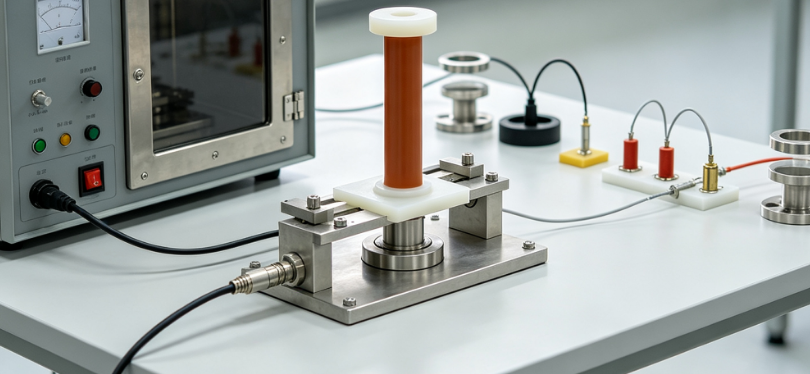
Why Advanced DC Withstand Testing Is Essential for Insulation Quality Assurance and Risk Management
DC withstand testing applies a voltage that is typically 1.5 to 2 times the system’s nominal operating voltage, but the stress is applied with controlled ramp rates and durations. This allows observation of the insulation’s dielectric absorption and polarisation processes, which provide valuable insight into the insulation’s moisture content and cleanliness. A steady Leakage Current that increases with voltage—rather than remaining constant—indicates a voltage‑dependent defect such as partial discharge or tracking. Conversely, a high initial current that decays slowly suggests a dry, clean insulation with good dielectric properties. Conventional tests that simply apply the voltage for 60 seconds and check for a sudden current rise provide none of this diagnostic information. Our protocols are designed to capture the full current waveform during the ramp and the hold period, extracting the Leakage Current at multiple voltage levels and calculating the Insulation Resistance at each step. We also perform a post‑test Polarisation Index (PI) based on the current decay curve, providing an additional layer of condition assessment. This comprehensive approach allows early detection of degradation that would otherwise go unnoticed until a catastrophic failure occurs.
Our Core Detection Capabilities for DC Withstand Voltage Testing
We operate a fully equipped high‑voltage laboratory and also provide on‑site testing with mobile DC hipot units. The following represent our standard high‑end offerings:
Programmable Step‑Up and Ramp‑Type Voltage Profiles: Our DC test systems are capable of generating linearly ramped or stepped voltage profiles with precise control over the ramp rate (e.g., 0.5–5 kV/s), the hold time at each step, and the total test duration. This flexibility allows us to tailor the test to the specific insulation type and to comply with standards such as IEEE 400, IEC 60840, and IEC 60270. We apply voltages up to 400 kV DC for cable testing and up to 100 kV for rotating machines and switchgear. During the ramp, we continuously record the Leakage Current with a resolution of 1 nA, enabling us to detect the voltage threshold where non‑linear current begins—a strong indicator of partial discharge or micro‑cracking.
High‑Precision Leakage Current Measurement and Time‑Domain Recording: Our measurement system uses a shunt‑based current sensing with a wide dynamic range (1 nA–100 mA) and a sampling rate of 1 MHz. This allows us to capture transient currents during voltage application and to distinguish between the capacitive charging current (which decays quickly), the absorption current (polarisation processes), and the steady‑state Leakage Current (bulk conduction). We provide a time‑resolved Leakage Current curve for the entire test duration, which is invaluable for diagnosing the type of insulation degradation—for instance, a long‑lasting absorption current indicates dry, clean insulation, while a rapid decay to a high residual current suggests contamination.
Voltage‑Withstand and Leakage‑Current‑Based Pass/Fail Criteria: Our test protocols go beyond a simple “hold voltage for 60 seconds.” We define a maximum permissible Leakage Current at each voltage step, and we also define a maximum allowable rate of change of current (dI/dt) during the hold period. An increasing current during the hold phase indicates progressive conduction, which is a serious warning. We apply statistical criteria (e.g., failure if the current exceeds 3 standard deviations of the baseline) to ensure that the test is both sensitive and robust against noise.
Dielectric Absorption Ratio (DAR) and Polarisation Index (PI) Post‑Test: Immediately after the hold phase, we discharge the test object and monitor the recovery voltage (if applicable) or we use the decay of the current after voltage removal to calculate the dielectric absorption ratio (DAR = I30s / I60s) and the Polarisation Index (PI = I1min / I10min) from the Leakage Current at the beginning of the test. These values are compared with typical ranges for the type of insulation, and they are used to assess the presence of moisture or conductive by‑products.
Non‑Linear Current‑Voltage Characteristic (I‑V) Analysis: By collecting Leakage Current at multiple voltage levels (e.g., 0.2 Un, 0.5 Un, 0.8 Un, 1.0 Un, and 1.2 Un), we construct an I‑V curve. A linear I‑V relationship indicates pure ohmic leakage, while a quadratic or exponential relationship indicates space‑charge‑limited current or defect‑related non‑linear conduction. We quantify the non‑linearity index (γ) and provide a comparison with a baseline curve from the same asset or from a reference database. This is a powerful tool for early detection of ageing.
Partial Discharge (PD) Detection During DC Withstand: DC withstand tests are often combined with partial discharge measurement using a high‑frequency current transformer (HFCT) and a wideband PD detector. We perform DC‑PD testing to detect and localise PD activity that occurs during the voltage application. This is particularly important for cables and GIS, where PD is a precursor to breakdown. Our DC‑PD system has a sensitivity of 1 pC and can distinguish between internal voids, surface tracking, and corona.
Temperature and Humidity Compensation: Leakage Current is strongly influenced by temperature and humidity. We record the ambient conditions and apply correction factors (based on ASTM D4496 and IEEE 43) to normalise the measured current to a standard reference temperature (e.g., 20 °C). For critical assets, we perform tests at two different temperatures to determine the actual activation energy and to improve the accuracy of the correction.
Post‑Test Diagnostic Summary and Expert Interpretation: Our final report does not simply state “passed” or “failed.” We provide a detailed diagnostic narrative that describes the observed Leakage Current behaviour, its interpretation (e.g., “dry insulation with low moisture content,” “indication of surface contamination,” “possible internal void”), and a risk assessment (low/medium/high) for future operation. We also provide recommendations for corrective actions, such as cleaning, drying, or applying a protective coating.
Integrated Analytical Framework: Beyond Raw Data to Actionable Decisions
Our unique strength lies in the correlation of multiple diagnostic parameters—Leakage Current at test voltage, I‑V non‑linearity, DAR/PI, and PD activity—to form a holistic insulation health index. We use a proprietary scoring algorithm that weights each parameter based on its statistical relevance for the specific insulation type. The health index is then mapped to a probability of failure within the next 5 years, based on our extensive database of field failures. This enables clients to prioritise maintenance investments and to justify capital replacement with solid evidence.
Our test report includes: - Applied voltage profile (ramp and hold phases) with exact timings. - Leakage Current vs. time curve (full recording). - Leakage Current at each voltage step and the calculated Insulation Resistance. - I‑V characteristic plot and non‑linearity index. - DAR and PI values (if extracted from the current decay). - PD detection results (if PD measurement was included). - Temperature‑corrected values and correction method. - Health index and risk assessment. - Interpretation and recommendations.
Our Distinctive Advantages in DC Withstand Testing
Our laboratory is accredited under ISO 17025 for high‑voltage testing, and we are NIST‑traceable for both voltage and current measurements. We have a wide range of DC test sets—from 5 kV/10 mA for electronic assemblies to 400 kV/50 mA for long‑distance power cables. Our field teams are equipped with mobile DC hipot units that are lightweight, battery‑operated, and capable of remote control, ensuring safe testing in any environment.
We offer flexible service options: routine production testing (with high throughput), site‑acceptance testing for new installations, and periodic maintenance testing for ageing assets. Our engineers have extensive experience with various insulation systems—paper/oil, XLPE, epoxy, silicone rubber, and glass—and can adapt the test procedures to the specific requirements of each. We also provide training and consulting to help clients establish their own in‑house DC testing programmes.
Turnaround time: For laboratory tests, a complete DC withstand test with full analysis and report is completed within 2 business days. For on‑site testing, we provide verbal results immediately, with a formal report delivered within 24 hours. For emergency testing (e.g., after a fault), we offer a 6‑hour priority dispatch.
Real‑World Impact: Case Highlights from Our Testing
In a recent project with an offshore wind farm, our DC withstand test on 33 kV submarine cables revealed a non‑linear I‑V characteristic with a sudden current increase above 1.4 U0. The current was 60% higher than predicted by the linear extrapolation, and we detected partial discharge activity at that voltage. The client decided to replace the cable section before commissioning, avoiding a potential outage during operation. The failure analysis later confirmed the presence of a small manufacturing defect in the insulation.
For a large industrial plant, our routine DC withstand testing on a 6.6 kV motor detected a steady increase in Leakage Current over three consecutive tests, while the PI remained stable. The I‑V curve showed a progressively more pronounced non‑linearity, indicating accumulating moisture and contaminants. The motor was scheduled for a comprehensive insulation drying and cleaning, which restored the Leakage Current to its original low value and extended the motor’s service life by over five years.
Partner with Us for Unmatched DC Withstand Diagnostic Insight
Whether you are commissioning new equipment, verifying repairs, or performing routine maintenance, our DC withstand testing service provides the accuracy, depth, and expert interpretation you need to ensure the safety and reliability of your electrical insulation. We welcome customised test plans—from simple 60‑second qualification to extended step‑up profiling with PD detection. Let our advanced diagnostics help you prevent failures and maximise asset uptime.
Contact us today to schedule your DC withstand test and gain a comprehensive understanding of your insulation condition.