Reasons for choosing our testing services
ZHONGXI Testing has obtained inspection qualification certifications from multiple countries and regions worldwide. We possess a senior testing team and advanced testing methods, providing independent, impartial, and professional third-party verification services for global carbon projects.

Internationally recognized authority
Certified by multiple international standards such as CNAS, VCS, and GS, with reports universally applicable worldwide.

Global service capability
Covering 140+ countries and regions, it supports on-site detection and remote verification in multiple languages.

Professional experimental methods
Adopt standard experimental methods to ensure accurate and reliable data.
Breakdown Voltage Testing: Precision High-Voltage Characterisation for Insulation Strength and Dielectric Reliability
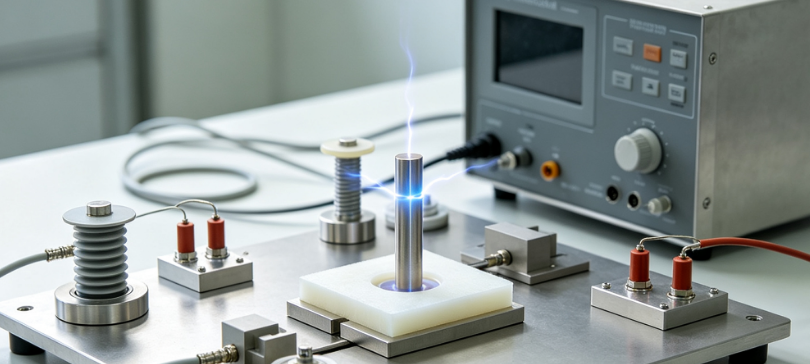
Breakdown Voltage testing—whether performed as a withstand test, a step‑stress test, or a ramp‑to‑breakdown test—is the definitive method for determining the dielectric strength of insulating materials, components, and electrical assemblies. The Breakdown Voltage is a critical parameter that defines the maximum electric field a material can sustain before catastrophic conduction occurs, and it is influenced by a multitude of factors: material purity, thickness, temperature, humidity, electrode geometry, and the rate of voltage application. A simple “go/no‑go” withstand test provides only a minimum performance indicator, but it does not reveal the voltage margin, the statistical distribution of breakdown strength, or the effects of ageing and environmental stress. Our detection service is specifically designed to deliver a comprehensive, statistically robust, and application‑relevant Breakdown Voltage characterisation that goes far beyond a single-point measurement. We offer AC, DC, and impulse breakdown testing over a wide range of voltages (up to 600 kV AC, 800 kV DC, and 1.5 MV impulse), with precise control of ramp rates, hold times, and environmental conditions. We employ advanced breakdown detection systems that capture the voltage and current waveforms at the instant of breakdown, allowing us to distinguish between true dielectric breakdown, surface flashover, and partial discharge‑induced failure. Our analysis includes Weibull statistical evaluation to determine the characteristic Breakdown Voltage (V63.2%) and the shape parameter (β), providing a measure of the material’s consistency. We also perform temperature‑dependent and time‑dependent breakdown tests to assess the long‑term reliability under actual service conditions. This enables material suppliers, equipment manufacturers, and quality assurance teams to validate design margins, qualify new materials, predict field life, and ensure compliance with international standards (IEC 60243, ASTM D149, UL 746A) with scientific confidence.
Why Professional Breakdown Voltage Testing Is Indispensable for Material Qualification and Safety
The Breakdown Voltage is not a fixed material constant; it varies with the test method, electrode configuration, and environmental factors. For instance, a material that passes a 60‑second withstand test at a given voltage may still fail under a longer‑duration stress due to space‑charge accumulation, or it may show a significantly lower Breakdown Voltage when tested at elevated temperatures. Conventional factory tests often use a simple “voltage‑withstand” at a predetermined level, but they do not provide the complete breakdown strength distribution needed for reliability calculations. In applications such as power transformers, high‑voltage cables, capacitors, and printed circuit boards, the design must account for the statistical variation of breakdown strength. Our testing protocols are designed to provide this essential data by conducting multiple breakdown measurements on representative samples and applying Weibull statistics. We also measure the time‑to‑breakdown under constant voltage (i.e., lifetime tests) to characterise the dielectric’s endurance. This enables engineers to set appropriate safety margins, to qualify alternative materials, and to predict the end‑of‑life of insulation systems with a known confidence level.
Our Core Detection Capabilities for Breakdown Voltage Testing
We operate a state‑of‑the‑art high‑voltage laboratory equipped with AC, DC, and impulse generators, as well as precision measurement and control systems. The following represent our standard high‑end offerings:
AC Breakdown Testing (50/60 Hz and up to 600 kV): We use a series‑resonant AC test system with a high‑voltage transformer and a variable inductor to achieve a pure sinusoidal waveform with a distortion of less than 1%. The system is capable of delivering voltages up to 600 kV and currents up to 1 A. We perform ramp‑to‑breakdown tests (with controlled ramp rates from 0.5 to 5 kV/s) and step‑stress tests (with incremental voltage steps of 2% of the expected Breakdown Voltage). We record the Breakdown Voltage and the breakdown time, and we capture the voltage and current waveforms using a high‑speed digitizer (100 MS/s) to detect the exact instant of breakdown and to distinguish between a pure dielectric breakdown and a surface discharge. The test cell is equipped with electrodes conforming to ASTM D149 or IEC 60243, including flat, spherical, and needle‑plate configurations.
DC Breakdown Testing (Up to 800 kV, with Ramp and Step Profiles): Our DC test system uses a Greinacher cascade circuit with a ripple factor < 0.5%, providing a highly stable DC voltage. We can perform linear ramp tests (0.5–5 kV/s), step‑stress tests with user‑defined hold times, and constant‑voltage endurance tests (to measure time‑to‑breakdown). We measure the Leakage Current during the ramp (with a resolution of 1 nA) to detect pre‑breakdown conduction phenomena. For materials that exhibit a significant voltage‑dependent breakdown, we also perform polarity reversal tests and voltage‑cycling tests to simulate realistic stress conditions.
Impulse Breakdown Testing (1.2/50 µs and 10/700 µs, Up to 1.5 MV): We have a multi‑stage impulse generator capable of delivering lightning impulse (1.2/50 µs) and switching impulse (10/700 µs) waveforms with a peak voltage up to 1.5 MV. We measure the Breakdown Voltage by multiple‑level testing (up and down method) to determine the 50% impulse Breakdown Voltage (V50%). The impulse voltage divider has a response time of < 10 ns, ensuring an accurate measurement of the peak voltage. We also provide the voltage‑time (V‑t) characteristic for the material, which is essential for coordination of insulation in power systems.
Temperature‑Controlled and Environmental Chambers for Breakdown Testing: To evaluate the effect of temperature and humidity, we perform breakdown tests in a temperature‑controlled oven (up to 300 °C) and a humidity chamber (10–90% RH). We also have a cold chamber for testing at sub‑zero temperatures (down to −60 °C). This allows us to generate a Breakdown Voltage vs. temperature curve and to determine the temperature coefficient of dielectric strength—critical for applications in extreme environments.
Statistical Weibull Analysis and Breakdown Probability Prediction: We perform tests on a minimum of 10 samples (or as many as required for a statistically significant estimate) and apply Weibull distribution fitting to the measured Breakdown Voltages. We report the characteristic Breakdown Voltage (V63.2%), the shape parameter (β) (which indicates the dispersion of results), and the Breakdown Voltage at specified probability levels (e.g., 1% and 10% failure probability). This analysis is essential for design verification and quality control, as it provides a realistic estimate of the minimum Breakdown Voltage that can be expected under mass production.
Time‑to‑Breakdown (Endurance) Testing Under Constant Voltage: For applications where long‑term ageing is a concern, we perform constant‑voltage tests (also called life tests) at a fraction of the measured Breakdown Voltage (e.g., 50%, 60%, 70%). We record the time to failure for multiple samples and apply the inverse‑power law (IPL) or exponential model to predict the lifetime at the operating voltage. This data is used to estimate the service life of the insulation under real stress levels.
Diagnostic Analysis of Breakdown Sites and Failure Modes: After breakdown, we examine the failure site using optical microscopy, SEM, and EDX to identify the failure mechanism—whether it is thermal breakdown, electrical breakdown (intrinsic), or treeing. This information is crucial for improving material formulation or design.
Comprehensive Documentation and Compliance Reports: We provide a detailed test report that includes the test method, experimental setup, raw data, Weibull plots, Breakdown Voltage statistics, and an interpretation of the results in the context of the relevant standard (IEC, ASTM, UL, or customer‑specified). We also provide a certificate of compliance if the tested sample meets the specified Breakdown Voltage requirement.
Integrated Analytical Framework: From Breakdown Voltage to Material Reliability
Our integrated approach combines the measured Breakdown Voltage with the Weibull shape parameter, the temperature dependence, and the time‑to‑breakdown data to construct a complete reliability profile of the insulating material. We use this profile to estimate the maximum safe operating voltage that ensures a specified failure rate (e.g., 0.01% over 10 years) under the intended service conditions. This information is invaluable for designers who need to balance performance and safety.
Our final report includes: - Breakdown Voltage data (individual values, mean, median, standard deviation). - Weibull distribution parameters (V63.2%, β, and confidence intervals). - Breakdown probability at specific voltages (e.g., at 1% and 10% failure probability). - Temperature‑dependence curves (if performed). - Time‑to‑breakdown (life) data and predicted lifetime at operating voltage. - Failure mode analysis (if breakdown sites are examined). - Comparison with relevant standards and a pass/fail statement.
Our Distinctive Advantages in Breakdown Voltage Testing
Our laboratory is one of the few facilities that offers combined AC, DC, and impulse breakdown testing under one roof, covering a voltage range from 1 kV up to 1.5 MV. We are accredited under ISO 17025 for high‑voltage testing and are fully traceable to national standards. Our equipment is regularly calibrated using internationally recognised reference dividers and voltage probes. Our team consists of high‑voltage engineers and material scientists with over 25 years of experience in dielectric testing, and we have tested thousands of materials—from polymers and ceramics to composite insulation systems.
We offer flexible service options: rapid screening tests (with 5 samples) for preliminary qualification, comprehensive qualification tests (with 20+ samples for Weibull analysis), and custom research‑oriented tests involving multiple temperatures and environmental conditions. We also provide field testing services for in‑situ breakdown measurements on large equipment such as transformers and cables.
Turnaround time: for a standard set of 10 samples, we provide the complete report within 3 business days. For urgent requests, we offer a 24‑hour rapid service for up to 5 samples.
Real‑World Impact: Case Highlights from Our Testing
In a recent project, a manufacturer of high‑voltage connectors was experiencing field failures due to flashover at the rated voltage. Our Breakdown Voltage tests at multiple temperatures revealed that the breakdown strength decreased by 30% when the temperature exceeded 100 °C, whereas the manufacturer had only tested at room temperature. We provided the V‑t characteristic and recommended a change in the insulating material to a higher‑glass‑transition polymer. The new material passed all tests, and the field failure rate dropped to zero.
In another case, a power cable manufacturer needed to qualify a new XLPE insulation for a 220 kV cable system. Our DC step‑stress tests and Weibull analysis showed that the new material had a characteristic Breakdown Voltage 12% higher than the incumbent material, with a similar shape parameter, indicating a robust improvement. The manufacturer was able to certify the new material for production and reduce the insulation thickness, resulting in a significant cost saving.
Partner with Us for Unmatched Breakdown Voltage Characterisation
Whether you are developing a new insulating material, qualifying a component, or investigating a failure, our Breakdown Voltage testing service provides the precision, statistical depth, and expert interpretation you need to ensure electrical safety and reliability. We welcome customised test plans that cover a variety of voltage shapes, environmental conditions, and sample geometries. Let our advanced diagnostics help you quantify the dielectric strength of your materials and components with confidence.
Contact us today to schedule your Breakdown Voltage testing and gain a thorough understanding of your insulation’s strength and reliability.