Reasons for choosing our testing services
ZHONGXI Testing has obtained inspection qualification certifications from multiple countries and regions worldwide. We possess a senior testing team and advanced testing methods, providing independent, impartial, and professional third-party verification services for global carbon projects.

Internationally recognized authority
Certified by multiple international standards such as CNAS, VCS, and GS, with reports universally applicable worldwide.

Global service capability
Covering 140+ countries and regions, it supports on-site detection and remote verification in multiple languages.

Professional experimental methods
Adopt standard experimental methods to ensure accurate and reliable data.
Leakage Current Testing: A Comprehensive Technical Guide for Compliance and Safety Verification
Leakage Current testing represents a critical diagnostic procedure in electrical safety engineering, serving as the primary means to quantify unintended current flow through insulation systems, protective barriers, and patient-connected circuits. For manufacturers, healthcare institutions, and regulatory bodies, the decision to commission Leakage Current measurements typically arises from mandatory compliance requirements, pre-market certification processes, or post-installation safety audits. This article provides a rigorous examination of Leakage Current testing methodologies, international standards frameworks, and the advanced technical capabilities that distinguish high-precision testing services from routine electrical inspections.
Understanding Leakage Current: Physical Principles and Hazard Mechanisms
Leakage Current is fundamentally defined as the vector sum of currents flowing through insulation materials, parasitic capacitances, and unintended conductive paths under normal operating conditions. The physical origins of Leakage Current encompass capacitive coupling between live conductors and grounded metal enclosures, surface conduction across contaminated insulation, and dielectric absorption phenomena in polymeric materials. Clinically significant Leakage Currents exceeding 100 μA in medical electrical equipment can produce ventricular fibrillation in patients with direct cardiac access, while industrial equipment with Leakage Currents above 3.5 mA poses fire and shock hazards under single-fault conditions. The rigorous characterization of these current components demands measurement systems capable of resolving submicroampere variations while maintaining frequency response from DC to 1 MHz, a technical threshold that standard multimeters cannot satisfy.
International Regulatory Frameworks Governing Leakage Current Limits
The global regulatory landscape for Leakage Current testing is defined by harmonized standards that prescribe both measurement methodologies and maximum permissible values. IEC 60601-1 establishes the foundational requirements for medical electrical equipment, classifying Leakage Currents into earth leakage, enclosure leakage, patient leakage, and patient auxiliary currents, each with distinct limits depending on equipment type (Type B, BF, or CF) and patient contact duration. For general industrial equipment, IEC 60990 specifies measurement network characteristics—including the frequency-weighting network (Figure 4) that simulates human body impedance—while UL 60950-1 and IEC 62368-1 address information technology and audio/video equipment with touch current limits of 0.5 mA for sinusoidal AC and 0.7 mA for DC components. Automotive applications invoke ISO 6469-3 for electric vehicle high-voltage systems, imposing Leakage Current thresholds below 1 mA under worst-case humidity and temperature conditions. Our testing laboratory maintains active accreditation to all cited standards, ensuring that measurements are defensible during regulatory audits and product liability proceedings.
Advanced Measurement Methodologies: Beyond Simple Amperometry
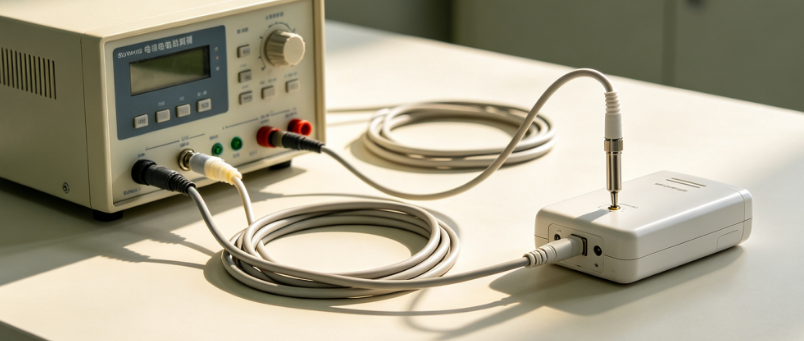
Contemporary Leakage Current testing has evolved from rudimentary series-ammeter measurements to sophisticated multi-parameter analyses that account for supply voltage variations, frequency distortions, and transient phenomena. The core technique involves connecting the device under test (DUT) to a reference ground plane through a calibrated measurement network (MD) whose impedance characteristics mimic the human body or fault current paths. Our implementation employs dual-channel simultaneous sampling at 1 MS/s with 24-bit resolution, enabling the separation of resistive and capacitive leakage components through phase-sensitive detection. This capability is particularly critical for switch-mode power supplies, where high-frequency common-mode currents (50 kHz to 1 MHz) can constitute over 80% of total leakage but are often suppressed by standard passive networks. We further augment conventional measurements with Fourier-domain decomposition, allowing us to identify harmonic contributions that violate insulation coordination requirements even when total RMS values remain within limits.
Test Configurations and Fault Condition Simulations
Comprehensive Leakage Current testing must encompass not only normal operating conditions but also single-fault scenarios that reflect realistic failure modes. Our test protocols systematically evaluate leakage under the following configurations: normal polarity and reversed polarity of supply mains, interruption of protective earth conductor, neutral conductor open-circuit conditions, and application of 110% rated voltage to stress insulation margins. For medical devices, we execute additional fault simulations including patient lead isolation failure and simultaneous application of multiple fault conditions, as required by IEC 60601-1 Clause 8.7. Each measurement is repeated across the DUT's rated temperature range (-10°C to +40°C) and relative humidity (10% to 93% RH) using our environmental conditioning chamber integrated with the test station, ensuring that Leakage Current data reflect worst-case field conditions rather than laboratory-ideal scenarios.
Our Technical Capabilities: Precision, Range, and Diagnostic Depth
We operate a dedicated Leakage Current test facility featuring six independently isolated measurement channels with synchronizable sampling clocks, enabling simultaneous characterization of multiple leakage paths in complex systems such as surgical robots or MRI-compatible patient monitors. Our primary measurement instrument—a custom-calibrated electrometer-grade transimpedance amplifier—achieves a noise floor of 0.1 μA RMS (10 Hz–100 kHz bandwidth) and a dynamic range spanning from 1 μA to 20 A, accommodating both implantable stimulators and industrial motor drives within the same test setup. For high-voltage applications (up to 6 kV DC or 4 kV AC), we employ optically isolated probes with galvanic separation exceeding 20 kV, ensuring operator safety while preserving measurement integrity. Our data acquisition system performs real-time statistical analysis over 10,000 consecutive power cycles, generating probability density functions for Leakage Current distributions that reveal intermittent discharge events invisible to snapshot measurements. This level of diagnostic granularity allows us to differentiate between predictable leakage due to design parameters and anomalous leakage indicative of manufacturing defects or impending insulation failure.
Distinguishing Advantages of Our Leakage Current Testing Services
Our laboratory differentiates itself through three core competencies that address the most demanding requirements of modern electrical safety engineering. First, we maintain traceable calibration to national metrology institutes (NIST and PTB) with uncertainties of ±0.5% for current magnitude and ±0.2° for phase angle, significantly exceeding the ±5% tolerance permitted by regulatory standards. This metrological rigor ensures that clients receive not only pass/fail determinations but also actionable margin data—quantifying the safety factor between measured leakage and applicable limits—which facilitates informed design iterations and risk management documentation. Second, our proprietary post-processing algorithm performs automatic cross-correlation between leakage waveforms and supply voltage harmonics, identifying whether elevated leakage stems from external grid distortion (correctable by filtering) or internal insulation degradation (requiring hardware redesign). This diagnostic intelligence transforms compliance testing from a gatekeeping hurdle into a design optimization tool, reducing time-to-market for clients who engage us during early development phases.
Third, our team comprises senior electrical engineers with cumulative experience exceeding 120 person-years in safety-critical industries including aerospace, implantable medical devices, and traction systems. We provide customized test plans that address unique aspects of each product—such as non-sinusoidal drive waveforms in variable-frequency drives or high-creepage clearances in PCB layouts—rather than applying generic test templates. Our reporting deliverables include fully annotated measurement setups with photographic documentation, uncertainty budgets compliant with ISO/IEC 17025, and concrete remediation recommendations when leakage values approach or exceed thresholds. Furthermore, we offer expedited turnaround for emergency certifications (24- to 48-hour service) and global market access support, interpreting results across the divergence between IEC, UL, and JIS standards to eliminate redundant testing for multinational product launches.
Typical Applications and Industry-Specific Considerations
Leakage Current testing finds application across an expanding array of industries, each presenting unique technical challenges that our methodology addresses. In medical device manufacturing, we routinely test patient monitors, infusion pumps, electrosurgical units, and diagnostic imaging systems, paying particular attention to CF-type applied parts where Leakage Currents must remain below 10 μA even under single-fault conditions—a requirement that necessitates specialized low-capacitance isolation transformers and guarded measurement techniques. In the electric vehicle sector, our services cover on-board chargers, battery management systems, and DC/DC converters, where we evaluate leakage under variable DC link voltages (up to 800 V) and high-frequency PWM ripple (2–10 kHz) that conventional test houses cannot accurately measure due to bandwidth limitations. For industrial automation, we assess servo drives, programmable logic controllers, and robotic manipulators, focusing on common-mode leakage through shielded cables and the cumulative effect of multiple drives sharing a common DC bus—a phenomenon that produces non-linear superposition effects we model using advanced network analysis.
Case Example: Identifying Hidden Leakage Paths in Multilayer PCBs
A recent engagement illustrates the diagnostic value of our advanced approach. A client manufacturing high-density medical telemetry modules had passed standard Leakage Current testing at their in-house facility but experienced intermittent field failures correlated with high-humidity environments. Our investigation employed time-domain reflectometry combined with Leakage Current mapping, revealing that parasitic coupling between adjacent internal PCB layers (0.8 mm separation) produced a Leakage Current of 12 μA at 95% RH—within the 100 μA general limit but exceeding the 10 μA limit for CF-type patient connections due to the device's intended use in operating theaters. By performing frequency-dependent leakage profiling, we identified that the leakage was predominantly capacitive and centered at the switching frequency of the device's internal DC-DC converter (150 kHz). Our recommendation to modify the converter's phase-shift modulation reduced the 150 kHz component by 18 dB, bringing the worst-case leakage to 6 μA and enabling the client to achieve regulatory clearance without board redesign. This case demonstrates that comprehensive Leakage Current testing, when executed with appropriate technical depth, yields engineering insights that transcend simple compliance verification.
Engagement Process and Technical Consultation
Our engagement begins with a pre-test technical review in which our engineers analyze the DUT's schematics, intended application, and applicable standards to define a tailored test matrix. We then provide clients with detailed test fixture requirements, ensuring that power supplies, load simulators, and connection interfaces are prepared correctly before shipment to our facility. During the test phase, we maintain real-time communication via secure data portals, allowing clients to observe measurement progress and preliminary results remotely. The final report, typically delivered within five business days for standard projects, includes comprehensive data tables, waveform captures, spectral plots, and a comparative analysis against the relevant standards table with explicit pass/fail annotations. For clients requiring ongoing compliance support, we offer annual retainer agreements that include priority scheduling, discounted re-test rates, and quarterly regulatory update bulletins to preemptively address standards revisions.
To initiate a Leakage Current testing project or to discuss specific technical requirements not covered in this overview, we invite you to contact our engineering consultation team. We provide free preliminary feasibility assessments for complex or non-standard products, ensuring that your testing strategy aligns with both regulatory expectations and your product development timeline. Our commitment to technical excellence, traceable accuracy, and actionable reporting positions us as a strategic partner in electrical safety assurance rather than a mere testing vendor—a distinction that delivers measurable value across the entire product lifecycle, from prototype validation to post-market surveillance.