Reasons for choosing our testing services
ZHONGXI Testing has obtained inspection qualification certifications from multiple countries and regions worldwide. We possess a senior testing team and advanced testing methods, providing independent, impartial, and professional third-party verification services for global carbon projects.

Internationally recognized authority
Certified by multiple international standards such as CNAS, VCS, and GS, with reports universally applicable worldwide.

Global service capability
Covering 140+ countries and regions, it supports on-site detection and remote verification in multiple languages.

Professional experimental methods
Adopt standard experimental methods to ensure accurate and reliable data.
Equipotential Bonding Resistance Testing: Principles, Standards, and Advanced Measurement Capabilities
Equipotential Bonding Resistance testing is a fundamental diagnostic procedure in electrical safety engineering, designed to verify the integrity of conductive connections that equalize potential differences between exposed metal parts, grounding systems, and protective conductors. Clients seeking this test are typically engaged in the installation, commissioning, or periodic verification of electrical systems in critical environments such as hospitals, data centers, industrial plants, and hazardous areas. The primary objective is to ensure that under fault conditions, no dangerous touch voltages develop across accessible conductive surfaces, thereby protecting personnel and sensitive equipment from electric shock and electromagnetic interference. This article provides a rigorous technical exposition of Equipotential Bonding Resistance measurement methodologies, applicable international standards, and the advanced service capabilities that distinguish high-level testing from routine continuity checks.
Physical Basis and Engineering Significance of Bonding Resistance
The concept of equipotential bonding arises from the fundamental requirement that all simultaneously accessible conductive parts must be maintained at substantially the same potential during both normal operation and fault conditions. The resistance of the bonding conductor—including its terminations and connections—directly influences the magnitude of touch voltage under fault current flow. According to Ohm's law, a bonding resistance of 0.1 Ω carrying a fault current of 100 A develops a potential difference of 10 V, which, while below the 50 V AC touch voltage limit in most standards, may still present hazards in wet or medical environments. More critically, the impedance character of bonding paths at higher frequencies (50 Hz to several kHz) determines their effectiveness in diverting transient overvoltages and electromagnetic noise. Our testing protocols therefore extend beyond simple DC resistance measurements to include AC impedance analysis at relevant frequencies, capturing the inductive and skin-effect contributions that dominate under surge conditions. This comprehensive approach ensures that bonding systems perform reliably not only under steady-state power frequencies but also during lightning strikes and switching transients.
Regulatory Framework and Threshold Criteria
International standards provide explicit requirements for bonding resistance values, though the specific limits vary by application. IEC 60364-4-41 mandates that the resistance of the main equipotential bonding conductor to the earth termination point shall not exceed 0.2 Ω when measured with a test current of at least 10 A. For medical locations, IEC 60364-7-710 imposes a stricter limit of 0.1 Ω for supplementary bonding conductors in patient environments, given the heightened risk of ventricular fibrillation. In the telecommunications and data center sectors, ANSI/TIA-607-C recommends a maximum bonding resistance of 0.1 Ω between the building grounding electrode system and equipment racks, with additional requirements for high-frequency performance. Our laboratory is fully accredited to perform tests in accordance with IEC 61557-4, which specifies the measurement equipment, test current characteristics, and uncertainty requirements for bonding resistance testers. We maintain a comprehensive library of standard-specific limit tables, enabling us to provide clear pass/fail judgments tailored to the client's operational jurisdiction and application domain.
Advanced Measurement Methodologies: Beyond Simple Ohmmeters
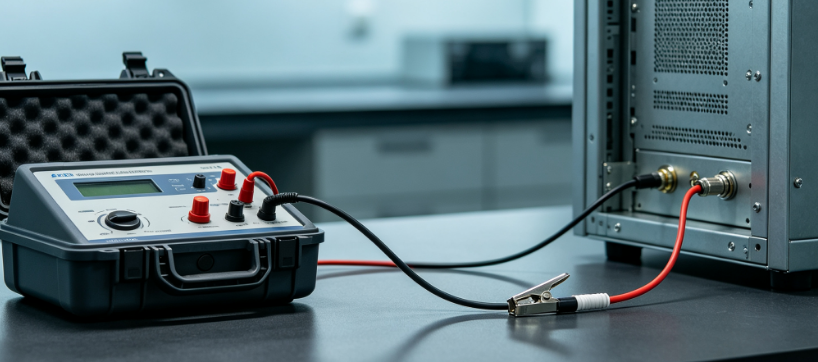
Routine continuity checkers using low test currents (1 mA to 200 mA) are inadequate for verifying bonding integrity, as they cannot overcome contact oxidation or detect high-resistance terminations that manifest only under fault-level currents. Our measurement approach employs true four-terminal Kelvin configuration to eliminate lead and contact resistances, ensuring that the measured value reflects only the bonding path itself. For each test point, we apply a DC test current of 25 A to 100 A (selectable based on the anticipated fault current rating), with a minimum current of 10 A as required by most standards, and we measure the voltage drop using a separate sense pair. This high-current injection method effectively burns through surface oxide films and compresses mechanical junctions, revealing the true steady-state resistance that would govern fault current distribution. Furthermore, we perform ramped current testing from 1 A to 100 A, capturing the resistance variation as a function of current—a diagnostic feature that identifies loose connections that exhibit increasing resistance with thermal rise due to joule heating. Our data acquisition system records the thermal voltage coefficient of each bonding joint, providing early warning of incipient failure mechanisms that standard pass/fail tests would overlook.
Comprehensive Test Configurations for Complex Installations
Modern facilities incorporate extensive bonding networks that interconnect structural steel, metallic plumbing, cable trays, equipment frames, and dedicated grounding buses. Testing such networks requires a systematic strategy that balances coverage with efficiency. Our service deploys distributed measurement nodes using wireless synchronization, allowing simultaneous resistance readings across multiple bonding points without the need for long test leads that introduce significant series resistance. For large-scale installations such as hospitals or semiconductor fabrication plants, we execute a matrix-based test plan that measures resistance between every accessible conductive part and the main grounding terminal, as well as cross‑bonds between subsidiary busbars. We then compute the transfer resistance between any two points in the network, identifying weak paths that might compromise the overall equipotentiality. In addition, we conduct dynamic impedance measurements under simulated fault conditions using a controllable pulse generator, verifying that bonding conductors can carry the prospective fault current without excessive temperature rise or mechanical dislodgement.
Our Technical Capabilities: Precision, Range, and Diagnostic Depth
Our testing facility is equipped with a custom-designed bonding resistance test platform that integrates a high-stability DC current source (0–120 A, 0.01% accuracy), a nanovoltmeter with 10 nV resolution, and a synchronized temperature logger to correct for ambient variations. The system achieves a measurement uncertainty of ±0.5% of reading + 1 µΩ, surpassing the typical ±5% requirement of most field testers. For applications demanding extreme precision—such as in aerospace bonding verification or metrology-grade grounding systems—we offer traceable calibration to SI units through reference resistors maintained in a temperature-controlled oil bath, with recalibration intervals of 90 days. Our instrument's frequency response extends from DC to 10 kHz, enabling us to characterize the inductive component of bonding paths, which is particularly critical for lightning protection systems where the surge current front contains significant high-frequency energy. We also provide on-site testing services using portable versions of the same high-current instrumentation, ensuring that large or immovable equipment can be assessed without disconnection.
Distinguishing Advantages of Our Equipotential Bonding Testing Service
Our laboratory differentiates itself through three principal advantages that address the most demanding requirements of modern electrical safety assurance. First, we maintain metrological traceability to national standards (NIST and PTB) with documented uncertainty budgets compliant with ISO/IEC 17025, ensuring that every resistance value reported is defensible in regulatory audits and legal proceedings. Second, our advanced data analytics suite automatically compares measured values against historical data from previous tests—whether performed by us or by the client—to detect trending degradation that might indicate corrosion, mechanical fatigue, or thermal cycling damage. This condition-based monitoring approach transforms periodic compliance testing into a predictive maintenance tool, allowing clients to schedule corrective actions before faults occur. Third, our engineering team possesses deep expertise in complex bonding configurations, including intrinsically safe systems in explosive atmospheres, marine vessels, and high-voltage substations. We provide customized test report formats that include annotated schematics, photographic evidence of each test point, and prioritized recommendations for remediation when resistances exceed thresholds. Our reports also incorporate risk-based analysis, quantifying the potential touch voltage under worst-case fault scenarios to aid in safety margin assessment.
Industry-Specific Applications and Critical Considerations
Equipotential bonding testing is essential across a broad spectrum of industries, each with unique technical challenges that our methodology addresses. In healthcare facilities, we rigorously test patient-accessible metallic surfaces (bed frames, IV poles, medical gas outlets) to ensure that bonding resistance remains below 0.1 Ω, as specified by the national electric code for critical care areas. Our testing includes simultaneous measurement of multiple bonding points to verify that no stray potentials exist between adjacent equipment, which could produce microshock hazards during invasive procedures. In data centers and telecommunication hubs, we focus on bonding between racks, grounding busbars, and raised floor grids, with additional scrutiny on the high-frequency impedance to ensure effective dissipation of stray currents from switching power supplies and high-speed digital signals. For oil and gas installations, we evaluate bonding of all metallic structures in classified areas, applying test currents certified as non-incendive and using intrinsically safe adapters to prevent ignition risks. In transportation systems—including railways and electric vehicle charging stations—we assess the bonding of traction return circuits and protective earthing, often requiring measurements at elevated DC currents (up to 200 A) to reflect real operational conditions.
Case Example: Uncovering Hidden Bonding Deficiencies in a Hospital Operating Theatre
A recent project exemplifies the diagnostic value of our comprehensive approach. A major hospital engaged us to verify the equipotential bonding in a newly constructed operating suite, after a routine audit indicated intermittent alarm trips on the insulation monitoring device. Our initial resistance measurements using low-current continuity testers showed all bonding connections below 0.1 Ω. However, our high-current stepped testing revealed that one critical bonding conductor—connecting the anaesthetic machine to the room grounding point—exhibited a resistance increase from 0.05 Ω at 1 A to 0.35 Ω at 50 A, with a pronounced thermal coefficient. Thermal imaging identified a poorly crimped lug that had high contact resistance, causing localized heating under fault-level currents. After our recommended re-termination, the resistance stabilized at 0.04 Ω across the entire current range, and the alarm issue resolved. The client received a detailed report with current-dependent resistance curves and thermographic images, enabling them to implement stringent quality checks for future cable terminations. This case underscores that true bonding integrity cannot be assured by low-current measurements alone—a principle that underpins our entire service philosophy.
Our Engagement Process and Technical Support
We initiate every project with a preliminary site survey or documentation review, where we identify all bonding points, conductor sizes, and relevant standards. Based on this, we design a tailored test matrix that optimizes measurement efficiency while ensuring complete network coverage. Our field engineers arrive with fully calibrated portable test sets, capable of delivering test currents up to 100 A with built-in data logging and wireless communication to a central base station. For each test point, we record ambient temperature, relative humidity, and conductor temperature, applying correction factors to reference measurements to 20°C, as required by IEC 61557-4. We provide clients with interim progress reports during large-scale projects, allowing early identification of critical issues that demand immediate rectification. Upon completion, the final deliverable is a comprehensive digital report containing summarized results, detailed tables per test location, graphical trends (if historical data exist), and clear certification of conformity for each applicable standard. We also offer post-test consultation to interpret findings and assist in developing corrective action plans, including specification of appropriate conductor gauges, termination torque values, and anti-corrosion treatments.
For clients with recurring testing obligations—such as annual hospital inspections or five-year industrial recertifications—we offer maintenance contracts that include priority scheduling, discounted rates, and proactive notification of changes to relevant standards. Our expertise in both fixed-laboratory and on-site testing ensures that we can accommodate projects of any scale, from single equipment cabinets to entire industrial complexes. To discuss your specific equipotential bonding testing needs or to schedule a technical consultation, we invite you to contact our engineering team. We provide complimentary preliminary assessments for complex or non-standard bonding configurations, ensuring that your safety verification strategy is both rigorous and cost-effective. Our commitment to technical excellence, traceable accuracy, and actionable insights establishes us as a trusted partner in electrical safety assurance, delivering value beyond mere compliance.