Reasons for choosing our testing services
ZHONGXI Testing has obtained inspection qualification certifications from multiple countries and regions worldwide. We possess a senior testing team and advanced testing methods, providing independent, impartial, and professional third-party verification services for global carbon projects.

Internationally recognized authority
Certified by multiple international standards such as CNAS, VCS, and GS, with reports universally applicable worldwide.

Global service capability
Covering 140+ countries and regions, it supports on-site detection and remote verification in multiple languages.

Professional experimental methods
Adopt standard experimental methods to ensure accurate and reliable data.
Comprehensive Performance Testing of Magnesium Carbonate Pyrolysis Reactors: Advanced Analytical and Diagnostic Solutions
Magnesium carbonate pyrolysis reactors are critical units in the production of high‑purity magnesia (MgO), refractories, and magnesium‑based chemicals through the thermal decomposition of magnesite or precipitated magnesium carbonate. The efficiency, product quality, and energy consumption of these reactors depend on a complex interplay of heat transfer, gas‑solid reaction kinetics, solid‑state diffusion, and product layer formation. Even minor deviations in temperature profiles, residence time, or feedstock characteristics can lead to incomplete calcination, excessive sintering of MgO, or high energy penalties, significantly affecting process economics and downstream performance. Our laboratory offers a fully integrated, multi‑scale testing platform specifically designed for the rigorous characterisation and optimisation of magnesium carbonate pyrolysis reactors, combining thermal analysis, gas evolution kinetics, solid‑product characterisation, and reactor modelling. We deliver quantitative, diagnostic, and predictive data that supports process optimisation, quality assurance, troubleshooting, and scale‑up for the mining, refractory, and chemical industries.
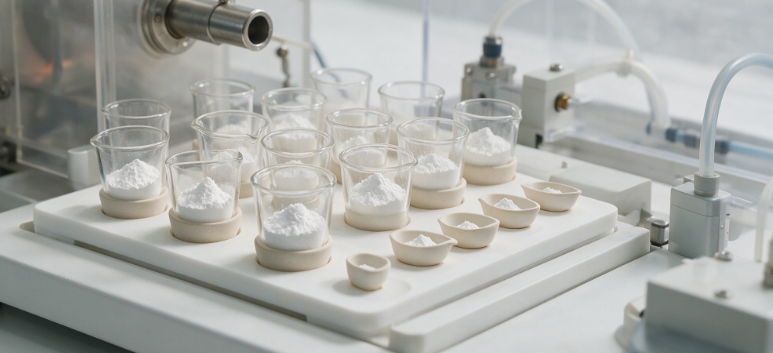
Why Dedicated Testing of Magnesium Carbonate Pyrolysis Reactors Is Essential for Process Efficiency and Product Quality
Plant operators, process engineers, and equipment manufacturers seeking pyrolysis reactor testing often encounter challenges such as unexpectedly high residual carbonate in the final MgO, poor reactivity of the calcined product, or increased specific energy consumption. These issues frequently stem from non‑optimal temperature gradients, insufficient residence time, excessive gas bypassing, or variations in feed particle size and composition. Moreover, the presence of impurities (Ca, Fe, Al, Si) can alter the decomposition pathway and sintering behaviour, affecting product quality. Our service provides a systematic characterisation that quantifies decomposition kinetics (activation energy, reaction order), gas evolution profiles (CO₂ release), product phase composition (XRD), MgO crystallite size, specific surface area (BET), and purity. By identifying the root causes of sub‑standard reactor performance—such as heat transfer limitations, dead zones, or channeling—we enable clients to optimise temperature profiles, adjust feed preparation, and implement effective control strategies for consistent, high‑quality MgO production with reduced energy consumption.
Our Analytical Capabilities: From Thermal Kinetics to Reactor Modelling and Product Quality
Our testing framework is structured into five interconnected modules, each addressing a critical dimension of pyrolysis reactor performance and product quality:
Thermal decomposition and kinetic analysis—We perform Thermogravimetric Analysis (TGA) and differential scanning calorimetry (DSC) under controlled atmospheres (air, N₂, CO₂) and heating rates (0.1‑50 °C/min) to determine the decomposition temperature, reaction kinetics (apparent activation energy and pre‑exponential factor), and the effect of heating rate on decomposition profiles. Using model‑fitting (Coats‑Redfern, Friedman) and model‑free (Kissinger‑Akahira‑Sunose, Flynn‑Wall‑Ozawa) methods, we provide reliable kinetic parameters that can be used for reactor design and scale‑up. High‑temperature TGA coupled with mass spectrometry (TGA‑MS) enables real‑time analysis of evolved gases, detecting trace impurities (e.g., SO₂, NOₓ) that may affect reactor corrosion or product purity.
Solid‑product characterisation—We characterise the calcined product (MgO) using X‑ray diffraction (XRD) with Rietveld refinement to quantify MgO crystallinity, crystallite size, and secondary phases (e.g., CaO, CaCO₃, silicates). Specific surface area (BET) and pore size distribution (DFT/BJH) are measured by N₂ physisorption at 77 K to assess the surface reactivity of the MgO product, which is crucial for refractories and chemical applications. Scanning electron microscopy (SEM) with EDS visualises particle morphology and elemental distribution, identifying any compositional inhomogeneities or impurity segregation.
Reactor modelling and heat transfer analysis—We integrate TGA‑derived kinetic data with computational fluid dynamics (CFD) and multiphysics models to simulate the coupled heat and mass transfer within the reactor. We assess temperature profiles, gas flow patterns, and solid conversion as functions of reactor design (e.g., rotary kiln, fluidised bed, multiple‑hearth furnace) and operating conditions. This enables us to predict the optimal temperature setpoints, bed depth, and residence time for maximum conversion and product quality, and to identify potential hot spots, cold zones, or gas channeling.
Impurity and trace element analysis—We quantify major and trace elements (Ca, Fe, Al, Si, Mn, Pb, etc.) in both feed and product using inductively coupled plasma optical emission spectrometry (ICP‑OES) and X‑ray fluorescence (XRF). Loss on ignition (LOI) at 1000 °C provides a quick measure of carbonate content. For environmental compliance, we also measure sulphur and chlorine by combustion‑ion chromatography (CIC).
Pilot‑scale and industrial reactor diagnostics—For in‑service reactors, we perform on‑site temperature profiling using thermocouple arrays, gas composition analysis (CO₂, O₂, CO) at various points along the reactor, and pressure drop measurements to assess gas distribution. We also collect solid samples at different axial positions to quantify conversion profiles and identify operational inhomogeneities. These data are correlated with our laboratory‑scale results to provide a complete diagnosis of reactor performance and to guide targeted interventions.
High‑Level Diagnostic and Predictive Modelling
We combine experimental kinetics, solid characterisation, and reactor modelling to build a predictive digital twin of the pyrolysis process. Using multivariate statistical analysis (PCA, PLS), we correlate feedstock properties (particle size, impurity levels) with product quality (MgO reactivity, crystallite size) and energy consumption, enabling quality‑by‑design (QbD) for feed preparation and reactor control. Our diagnostic approach pinpoints the rate‑limiting step—whether it be heat transfer, mass transfer, or chemical kinetics—and recommends specific modifications to reactor design or operation.
Regulatory Compliance and Quality Assurance
All test methods are aligned with ASTM, ISO, and DIN standards for thermal analysis, refractory materials, and chemical analysis. Our laboratory is ISO/IEC 17025:2017 accredited for a broad scope of physicochemical and thermal testing. We issue certified test reports with full measurement uncertainty, traceability to NIST/CRM reference materials, and quality control data (reference materials, blanks, duplicate runs). For process scale‑up and technology licensing, we provide comprehensive data packages with detailed protocols and raw data archives.
Our Distinctive Advantages in Magnesium Carbonate Pyrolysis Reactor Testing
Integrated multi‑scale approach: We bridge laboratory TGA‑MS, pilot‑scale reactors, and full‑scale plant diagnostics, providing a seamless pathway from fundamental kinetics to commercial optimisation. This enables our clients to make confident decisions based on validated scale‑up procedures.
Advanced in‑situ and ex‑situ product characterisation: We correlate real‑time gas evolution (TGA‑MS) with product phase development (XRD) and surface properties (BET) on the same sample set, providing a holistic understanding of the decomposition‑sintering interplay that determines final MgO quality.
Customised reactor modelling and simulation: Our CFD and kinetic modelling services are tailored to your specific reactor geometry and operating conditions, delivering actionable insights on optimal temperature profiles, feed rate, and potential process bottlenecks—a capability rarely offered by general‑purpose testing labs.
Expert guidance for process improvement: Our team includes pyro‑processing engineers and thermal analysts with decades of experience in the magnesia industry. We provide specific, actionable recommendations—for example, suggesting a pre‑calcination step to reduce energy consumption, adjusting particle size to enhance reaction uniformity, or modifying burner design to improve heat distribution.
Fast turnaround and flexible sample formats: Our standard characterisation and kinetic package is delivered within 7‑10 working days, with expedited 48‑hour screening for key parameters (LOI, decomposition temperature, and product reactivity). We handle bulk materials, drill cores, and off‑gases from operating reactors, as well as custom‑prepared feed stocks.
End‑to‑End Service Workflow
We initiate each project with a complimentary technical consultation to define your reactor type, operational challenges, and performance targets. We design a tailored test plan, including sampling and shipping guidelines. Upon sample receipt, we perform receipt inspection and preparation. All tests are executed with strict QA/QC—reference materials, blanks, and duplicates. Data are integrated and reviewed by our lead pyro‑processing specialist, then compiled into a comprehensive report containing kinetic parameters, solid product characterisation, modelling results, and a clear executive summary with optimisation recommendations. A post‑report meeting is offered to discuss findings and plan further actions or scale‑up.
Partner with Us for Reliable, High‑Performance Magnesium Carbonate Pyrolysis Solutions
Efficient pyrolysis of magnesium carbonate is essential for producing high‑quality MgO with competitive energy costs. Our testing service provides the scientific depth, practical realism, and regulatory support necessary to optimise your reactor performance, improve product consistency, and reduce energy consumption. We have supported mining companies, refractory manufacturers, and engineering firms in achieving reliable and cost‑effective pyro‑processing operations.
We invite you to contact our technical experts to discuss your specific testing needs—whether for new reactor design, process troubleshooting, or product quality improvement. With our advanced analytical capabilities, accredited protocols, and deep domain expertise, we provide the clarity and confidence you need to excel in magnesium carbonate pyro‑processing. Request a detailed proposal or schedule a technical consultation today and take the next step towards superior, data‑driven reactor optimisation.